Skip to content
FCFirst ClassCHAUFFEURS

SVAirports and terminals

Private aviation transfers, timed from the tail number

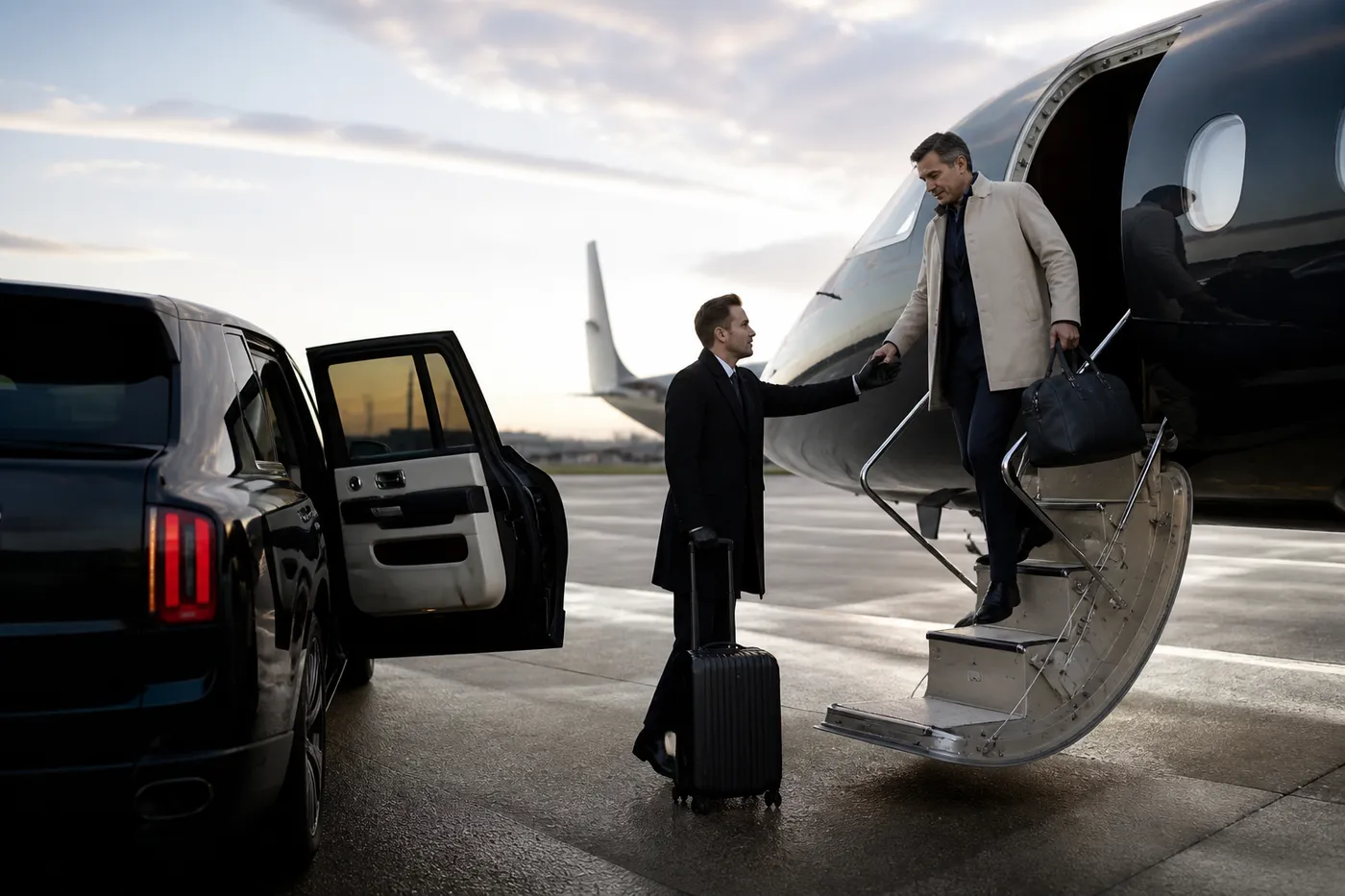
Bookings run on the tail number and the handler’s estimate, not on a published timetable. The car is at the jet centre before the aircraft is on the ground.

  • Timed from the tail number
  • Handler estimates confirmed
  • Airside where the airport permits
  • UK-wide coverage
Private aviation transfer

Written quotation, usually within the hour

Private jet and FBO chauffeur: summary

First Class Chauffeurs provides ground transport for private aviation at business airports and FBOs across the United Kingdom, including Farnborough, Biggin Hill, RAF Northolt, Luton, Stansted, London City and the general aviation terminals at the larger regional airports. Bookings are worked from the aircraft registration and the handler’s estimate rather than a scheduled time, which is what allows a car to move with a slot that has shifted. Where the airport and the handler permit it, the vehicle meets the aircraft on the ramp; where they do not, it waits at the terminal door. Crew transfers, second cars for larger parties and onward drives to addresses with no nearby airport are all quoted in writing before the day.

Worked from

Tail number and handler estimate

Airports

Farnborough, Biggin Hill, Northolt, Luton

Ramp access

Where the airport permits it

Vehicles

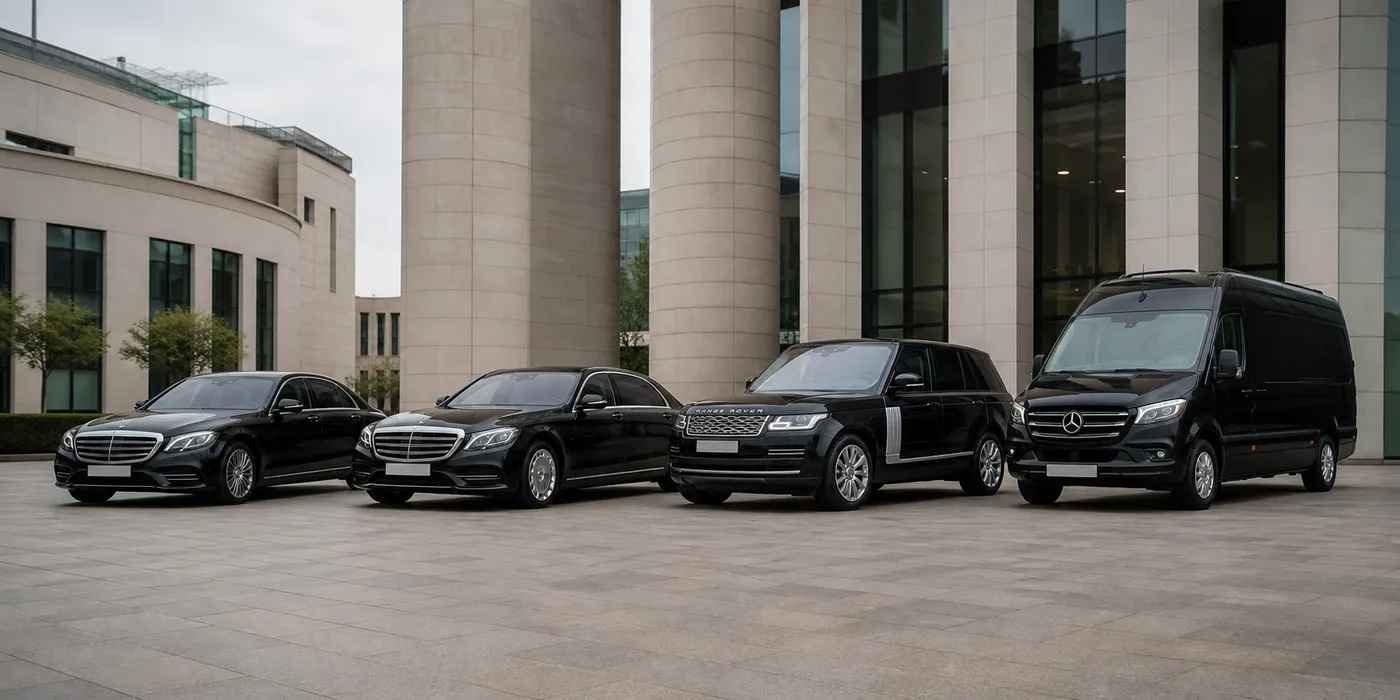
S-Class, Range Rover, Maybach, V-Class

01Overview

What this covers

Private flights do not keep timetables, they keep slots, and slots move. A departure booked for 14:00 can become 13:20 because the crew got an earlier release, or 15:40 because a passenger is still in a meeting. Ground transport that works from a scheduled time is useless here. We work from the aircraft registration and from whatever the handler last told us, and we re-time the car as the day changes.

That means talking to people rather than screens. Handlers at Farnborough, Luton, Biggin Hill, Northolt and Stansted will confirm a landing estimate and a stand, and they will say when a car can come through the gate. Passengers usually notice only the result: the doors open, the steps come down, and the car is where the aircraft stopped or a short walk from it.

02At a glance

The detail in brief

What a reservations clerk would tell you in the first thirty seconds of the call.
Worked from
Tail number and handler estimate
Airports
Farnborough, Biggin Hill, Northolt, Luton
Ramp access
Where the airport permits it
Vehicles
S-Class, Range Rover, Maybach, V-Class

03Included as standard

What private aviation includes

  • 01

    Handler liaison

    We speak to the FBO rather than guessing. The landing estimate, the stand and the gate procedure all come from them, on the day.

  • 02

    Registration on the job

    The aircraft registration goes on the worksheet so the movement can be followed even when the schedule changes twice in an afternoon.

  • 03

    Ramp-side collection

    At airports that allow it and with the handler’s escort, the car meets the steps. Where access is refused, the car is at the terminal door instead.

  • 04

    Slot changes absorbed

    A departure that moves forward by forty minutes moves the collection with it, by phone, without renegotiating the booking.

  • 05

    Crew as well as passengers

    Flight crew to a hotel and back is booked on the same reservation, often in a separate vehicle timed to the aircraft rather than to the passengers.

  • 06

    Onward drives from small fields

    Business airports rarely sit next to the destination. The drive that follows, whether twenty minutes or three hours, is quoted as part of the same job.

04Who books it

Who asks for this

Four kinds of enquiry arrive for this work, and each wants something slightly different from it.
  • 01

    Charter brokers and operators

    One call arranges the ground segment at both ends of a leg, with the times keyed to the tail number the broker is already quoting.

  • 02

    Aircraft owners and their offices

    Regular movements from the same field, with the same standing arrangements and the same chauffeurs, so nothing has to be explained twice.

  • 03

    Companies flying a group in

    Eight passengers off one aircraft rarely go to one address. Cars are sequenced at the ramp so nobody waits in a jet centre lobby.

  • 04

    Flight departments and crew

    Positioning crews to hotels, and back at report time, on a schedule that runs to the aircraft rather than to the passengers.

05How it works

From the first message to the last mile

The same sequence every time, so nobody is left guessing what happens next.
  1. Step 01

    Send the registration and the field

    The tail number, the airport, the handler if you know it, and where the passengers are going. Times can stay approximate at this stage.

  2. Step 02

    We confirm with the handler

    Landing estimate, stand, and what the airport allows in terms of vehicle access. Some fields grant ramp access readily; others never do.

  3. Step 03

    A written quotation follows

    Vehicles, chauffeur arrival times and the total. If two cars are needed for the party and the bags, that is set out rather than assumed.

  4. Step 04

    The day is worked live

    The handler’s updates reach the chauffeur directly. A slot that moves changes the car’s timing, not your plans.

  5. Step 05

    Aircraft to address, in one movement

    Steps or terminal door, then the drive, with the onward leg already priced. Nothing is handed to a third party in the middle.

06Detail

In detail

Tail numbers, handlers and who tells us when you land

LF-01Tail numbers, handlers and who tells us when you land

Tail numbers, handlers and who tells us when you land

A private flight has no departure board, so the information comes from a handler. The FBO knows the estimate, the stand and roughly how long customs will take, and they will tell a chauffeur company that rings them properly and gives them a tail number rather than a passenger name. That single phone call replaces the guesswork that makes so many jet-centre pick-ups go wrong.

The aircraft registration is what ties it all together. Given a tail number, a movement can be followed across a day of legs, so a car sent to Farnborough for a 16:00 arrival is not still sitting there at 17:15 wondering what has happened. It also means we can tell a client’s office where the aircraft actually is, which is very often the question behind the question they rang to ask.

None of that is exotic. It is simply the difference between a booking made against a time somebody typed in three weeks ago and a booking made against an aircraft that is presently in the air, descending, with an estimate that updates every few minutes. The first arrangement fails quietly and often. The second one is why nobody standing in an FBO lobby has to wonder where their car is.

07Detail

Working the ground segment

Airside, and when a car is allowed on it

LF-02Airside, and when a car is allowed on it

Airside, and when a car is allowed on it

Driving to the aircraft steps looks routine in photographs and is anything but. Every ramp is a controlled area with its own rules on speed, routing and who may drive on it. Access needs the airport’s permission, usually an escort from the handler, and at some fields it is simply not granted to visiting vehicles at all, however confidently the booking was sold to the passenger.

We arrange it where it is possible and we say so plainly where it is not. Farnborough and the dedicated business fields are generally the most workable, because the terminal and the apron are a few metres apart in the first place. At a large commercial airport with a general aviation terminal, the answer is usually that the car waits at the door, which costs a passenger about ninety seconds of walking and nothing else.

RAF Northolt sits in its own category. It is a military station that accepts civil business movements, so entry runs through a guardroom, and the vehicle and driver details have to be with the handler in advance rather than offered at the barrier. Bookings there are made earlier for that reason, and a car cannot simply be swapped on the morning because the first one has a flat battery.

08Detail

What to expect

The business airports around London, and how they differ

LF-03The business airports around London, and how they differ

The business airports around London, and how they differ

Farnborough is the purpose-built one, with a single business terminal and a road layout designed for exactly this traffic. Biggin Hill sits on the Kent side and keeps limited operating hours, which shapes late arrivals more than anything else about the field. Northolt is the west London option with controlled access, and Luton and Stansted both run substantial business aviation alongside their scheduled operations from separate terminals.

Geography decides more than reputation. Farnborough to Mayfair is a straightforward run down the M3 outside the peaks and a long one inside them. Biggin Hill is quick into south and east London and slow across to Heathrow. Northolt is close to the A40 and can put a passenger in the West End very quickly at the right hour, which is a large part of why it is used the way it is.

London City deserves a mention here too, because its private jet centre operates alongside the scheduled terminal and the drive-in is short. For a passenger flying privately into a meeting in the City or Canary Wharf, it is frequently the quickest ground segment available anywhere in the country, and the difference against Luton on a weekday afternoon can be the better part of an hour.

09Vehicles

The cars usually sent for this

Seats and cases for each car, taken from the vehicle itself. Nothing below is a class average.

First Saloon

Mercedes-Benz S-Class

3 passengers, 3 large cases

Passengers
Up to 3
Large cases
3, plus cabin bags
Cabin class
First Saloon

First Saloon

BMW i7

3 passengers, 3 large cases

Passengers
Up to 3
Large cases
3, plus cabin bags
Cabin class
First Saloon

First SUV

Range Rover Autobiography

4 passengers, 4 large cases

Passengers
Up to 4
Large cases
4, plus cabin bags
Cabin class
First SUV

Suite

Mercedes-Benz Jet Class

4 passengers, 5 large cases

Passengers
Up to 4
Large cases
5, plus cabin bags
Cabin class
Suite

Suite

Mercedes-Maybach S-Class

3 passengers, 3 large cases

Passengers
Up to 3
Large cases
3, plus cabin bags
Cabin class
Suite

No standing price list. Send the journey on WhatsApp and the written quotation confirms the price, what it includes and any applicable tax. Compare every vehicle if none of these is quite right.

10Detail

Behind the booking

LF-04A departure that moves by an hour

A departure that moves by an hour

Slots move. A crew gets an earlier release, weather closes in over the destination, or a principal finishes a meeting late and the aircraft waits on the ground for them. Any of those can shift a departure by an hour in either direction, sometimes with twenty minutes of notice, and the ground arrangements either follow it or become the reason the aircraft is still sitting there.

The booking is built to absorb it. Because the collection is timed to the aircraft rather than to a clock, a call from the handler or from the office moves the chauffeur and nothing else has to be renegotiated. On departures we would rather have the car at the address early and holding than have it arriving at the gate as the crew calls for passengers who are not yet in the building.

It works in the other direction as well. If an aircraft is going to sit for two hours before it can go, we do not leave a chauffeur idling on a stand for the sake of appearances. The car steps away, stays close, and comes back on a phone call, which is a more honest use of everybody’s time and considerably better for the chauffeur who has been on duty since four in the morning.

11Detail

On the day

Crew, cabin bags and the second car

LF-05Crew, cabin bags and the second car

Crew, cabin bags and the second car

Crew movements run to their own clock. Pilots report well before passengers arrive and finish long after the aircraft is buttoned up, so putting them in the same car as the passengers rarely works for either party. A separate vehicle, usually smaller, timed to report and to release rather than to the passenger movement, is the arrangement that actually holds up over a week of flying.

Luggage is the other thing that gets under-counted on private flights. A light jet has a modest hold, but the six people getting out of it still have coats, cases, sample boxes and a set of clubs between them. If the party and the bags will not sit comfortably in one car, a second one is quoted rather than squeezed in, and the two are sequenced so nobody is left standing on a ramp.

Where a group splits on landing, cars are staged in order of departure from the field. The first away is the one with the tightest onward appointment, even where that passenger was the last down the steps, which sounds obvious and takes about five minutes of planning the day before to get right. Doing it in the moment, on a windy apron, with everybody talking at once, does not work.

12Coverage

Where we drive

London based, driving the whole of the United Kingdom. Pick a region for the towns inside it, or a terminal to see where the chauffeur stands.

13Detail

Practical notes

Regional fields and the drive that follows

LF-06Regional fields and the drive that follows

Regional fields and the drive that follows

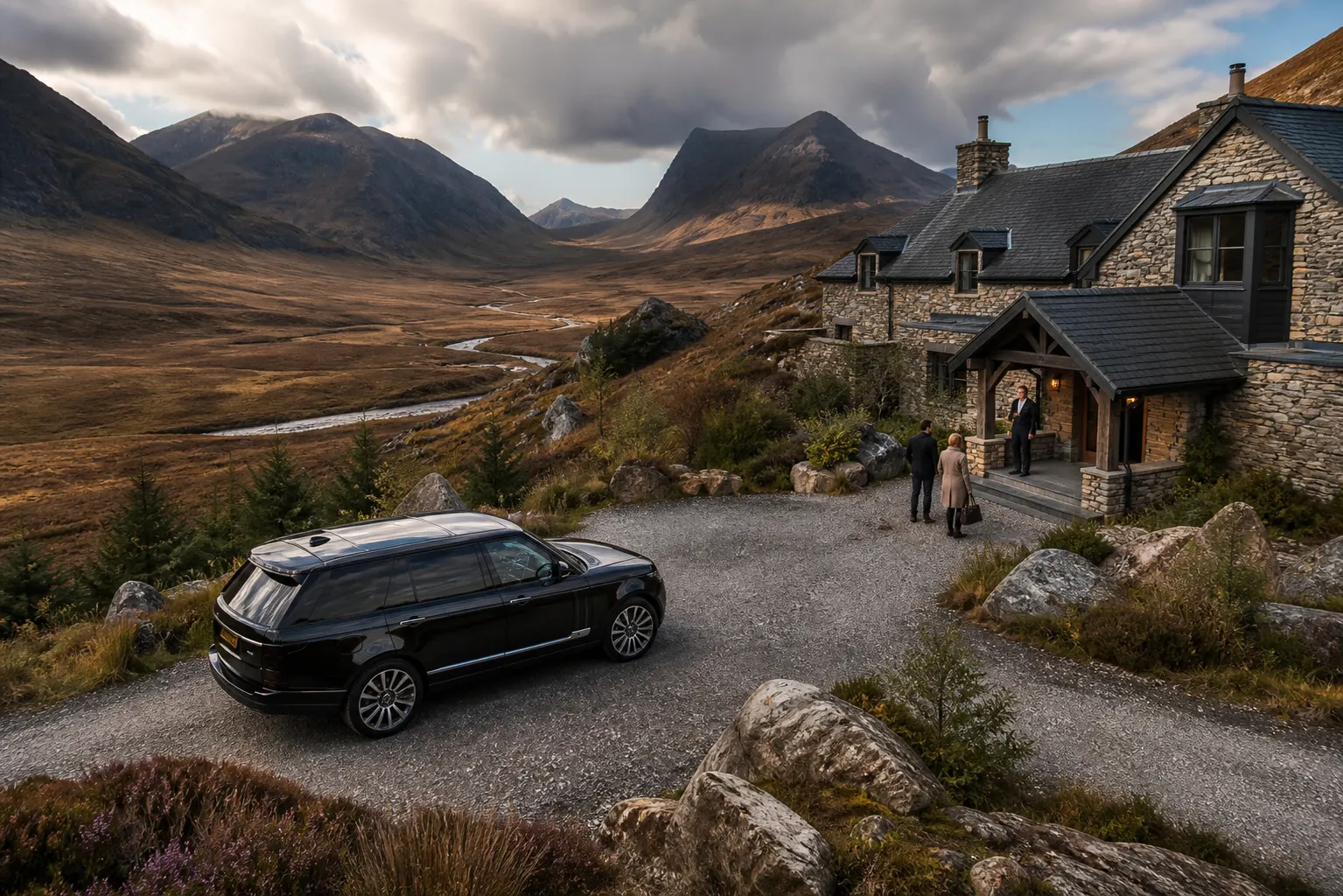
Private aviation exists partly to reach places the scheduled network ignores, which means the ground segment afterwards is often long. An aircraft into Inverness with a drive on to a lodge, into Exeter with an hour into Cornwall, or into Leeds Bradford with a run across the Dales, is an entirely normal shape of job for us and is quoted as a single journey.

Those drives use one chauffeur throughout. Handing a passenger to a local firm halfway is where standards slip, and on a two-hour run through the dark on unlit single-track roads it is exactly the wrong moment for a change of car and a driver who has not been briefed. The person who met the aircraft is the person who opens the door at the other end.

Smaller fields also have thinner facilities than people expect. Some close their terminal outside published hours, some have no fuel available after a certain time, and a few have gates that are locked with nobody in attendance once the last movement has gone. We check the specifics for the field rather than assuming that what worked at Farnborough will work at a grass strip in Norfolk on a Sunday evening.

14Detail

Before you confirm

LF-07Joining a private leg to a scheduled one

Joining a private leg to a scheduled one

Mixed itineraries are common and they are where the ground half earns its keep. A private flight into Luton followed by a scheduled long-haul out of Heathrow is a cross-London drive with an immovable check-in cut-off at the end of it, and the inbound aircraft has usually already changed its arrival time twice by the time the car sets off.

Timing that properly means holding a margin nobody enjoys paying for and then using it. We quote the drive for the traffic that will be there, add the terminal transit for the departing airport, and tell you the latest workable landing time rather than pretending the connection is comfortable when it plainly is not. That number is more useful than reassurance.

When it does not work, saying so early is more valuable than optimism. A connection with forty minutes of slack across the M25 in the evening peak is not a connection at all, and a client is better served by moving the private leg forward by an hour than by discovering the problem somewhere around Junction 15 with a suitcase and a boarding pass.

15What it costs

How this is quoted

One message with the shape of the job, and a fixed figure in writing before you commit to anything.
Smallest cabin
Mercedes-Benz S-Class
Seats
Up to 3
Large cases
3
Quoted
In writing, before you travel

No standing price list. Send the journey on WhatsApp and the written quotation confirms the price, what it includes and any applicable tax. The pricing page sets out what moves a figure, and a message on WhatsApp fixes the figure for your date, your pick-up and your car.

Notice, slots and the shape of a quotation

LF-08Notice, slots and the shape of a quotation

Notice, slots and the shape of a quotation

Private aviation books late by nature, and we work to that. Reservations are answered around the clock, and a movement arranged the same afternoon is ordinary rather than exceptional, subject only to a car and a chauffeur being free. What cannot be compressed is site access at fields like Northolt, where the paperwork takes the time it takes regardless of how urgent the flight is.

Quotations are written per movement, with the vehicle named, the chauffeur’s arrival time stated and the onward drive priced, so a two-leg day reads as two lines rather than one lump. The cabin is the largest single lever on the figure, and the step from the S-Class through the Range Rover to the Maybach is a real one in both directions. Your written quotation confirms the final price, what it includes and any applicable tax.

Where a day involves several legs, we would rather quote the day than assemble it from fragments. A car held at a field between two flights is cheaper as a booked block than as three separate transfers, and the arithmetic is a great deal easier to check when it is written down in one place. Clients who fly regularly tend to move to that arrangement within a month or two.

18Answers

Questions about private aviation

Six answers that come up on almost every enquiry of this kind.

Can the car come out to the aircraft?

At the fields that permit it, with the handler arranging the escort, yes. Farnborough and the dedicated business airports are usually workable. At larger commercial airports the answer is more often that the car waits at the jet centre door, which is a walk of a few metres. We confirm which applies before the day rather than trying it on at the gate.

How do you know when we have actually landed?

From the handler and from the aircraft registration on the booking. The FBO gives us the estimate and updates it, and the tail number lets us follow the movement independently. Between the two, the chauffeur is on site before the aircraft is on stand rather than working from a time somebody wrote down last week.

Our departure slot has moved forward. Is that a problem?

No. Collections are timed to the aircraft, so a call from your office or the handler moves the chauffeur and the rest of the booking stands. On departures we prefer the car to be at the address early and waiting, because the cost of that is nothing and the cost of the reverse is a crew calling for passengers who are not there.

Do you handle crew transfers as well?

Regularly, and usually in a separate vehicle. Crew report before passengers arrive and are released long after the aircraft is closed up, so a shared car satisfies nobody. Hotel runs at both ends can be added to the same reservation and timed to report rather than to the passenger movement.

What happens at RAF Northolt specifically?

Access runs through the guardroom, so the vehicle registration and the chauffeur’s details have to be passed to your handler in advance. That makes late substitutions difficult and is the one place where we ask for notice rather than shrugging. Once cleared, the movement runs like any other business aviation job.

Can you cover both ends of a UK domestic private flight?

Yes, and it is usually the tidier way to do it. One reservation covers the car at the departure field and the car at the arrival field, both timed off the same registration, with one office to ring if the slot changes. That removes the handover that causes most of the trouble on split bookings.

FCReservations

Ready to book private aviation?

Send the date, the pick-up and where you are going. A fixed written quotation comes back with the car, the chauffeur's arrival time and what the figure covers.

Hours
Reservations answered around the clock, every day of the year.
CallGet a quote