Skip to content
FCFirst ClassCHAUFFEURS

SVOccasions

Wedding chauffeur hire

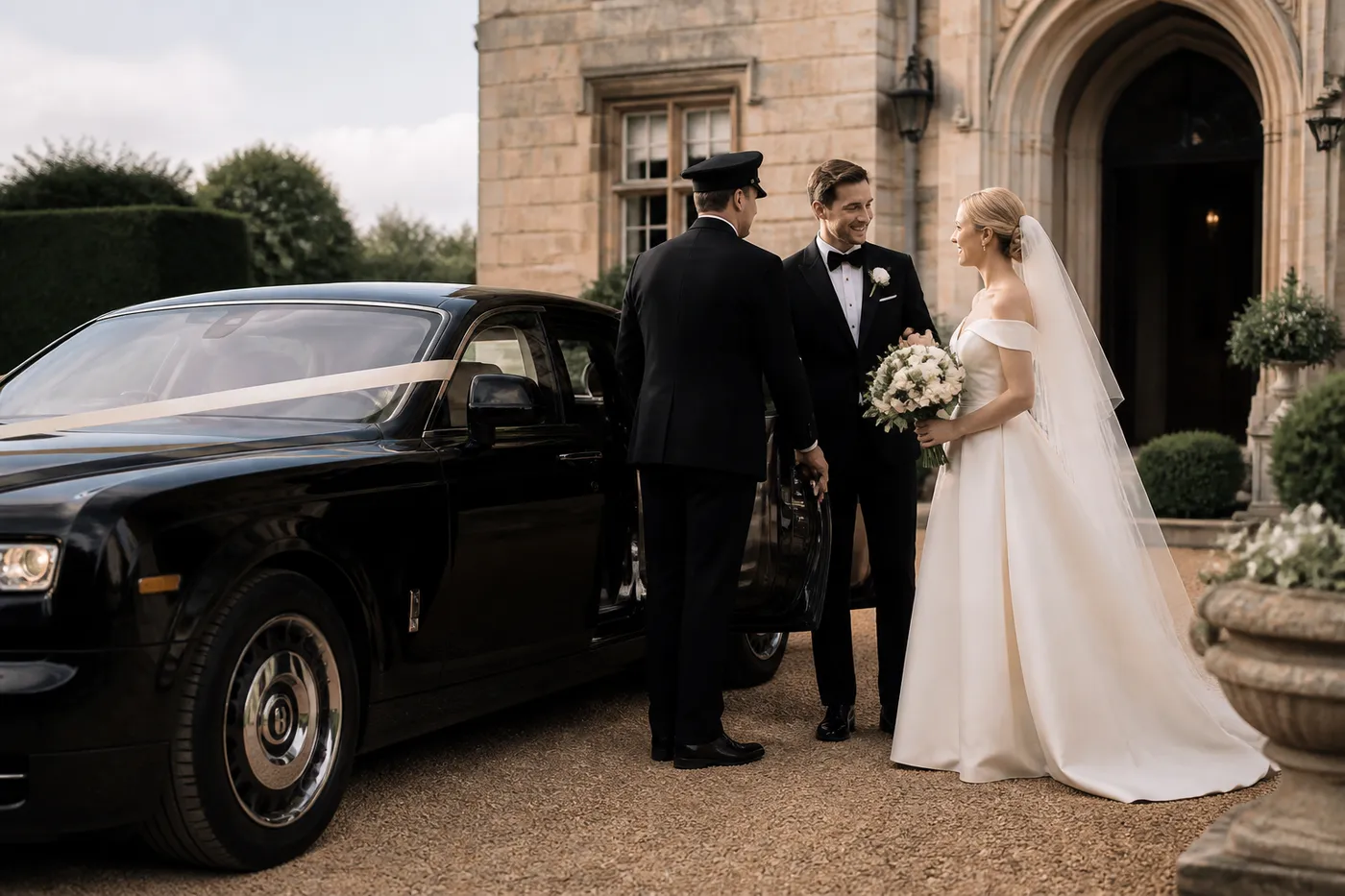
Wedding cars are a timing problem before they are anything else. Ours are booked by the hour, briefed from a running order, and driven by someone who has waited outside a lot of churches.

  • Booked by the hour, not by the journey
  • Route checked before the day
  • Ribbons fitted on the morning
  • Fixed written quotation
Wedding chauffeur ribbons

Written quotation, usually within the hour

Wedding chauffeur hire: summary

Wedding chauffeur hire from First Class Chauffeurs is booked as a block of hours rather than as a set of separate journeys, because the timings on a wedding running order rarely survive contact with the day. One chauffeur and one car are held from the first collection through to release, with the route driven and checked before the wedding so that lane widths, gravel drives and gate access are known rather than assumed. Ribbons are fitted on the morning in a chosen colour. Second and third cars are quoted for parents, bridesmaids and guests, and larger vehicles cover the gap between a ceremony and a reception at a different address. Vehicles run from a Mercedes V-Class at the affordable end to a Rolls-Royce Phantom at the top, which carries a longer minimum block, and every booking is quoted and confirmed in writing.

Booked as

Hourly blocks, from the first collection to release

Booked as

A block of hours, not separate journeys

Signature cars

Rolls-Royce Phantom, longer minimum block

Route check

Driven in advance where the venues are new to us

Additional cars

Quoted for parents, party and guest shuttles

Coverage

London, the home counties and the rest of the UK

01Overview

What this covers

A wedding car has one job on the day: everyone arrives where they are meant to be, in the order the day was built around, without anybody standing in a car park in heels. That is a scheduling exercise. It depends on knowing how long the drive really takes at eleven on a Saturday, how long the photographer will keep the couple outside, and what the church does with its gate when the previous service overruns.

We quote weddings as blocks of hours rather than as journeys, because a wedding day never runs to the times written on the running order. The car is yours from the first collection to the release, whether that is four hours or twelve. A V-Class carrying a wedding party sits at the affordable end; a Phantom sits at the top of the fleet and carries a longer minimum block.

02At a glance

The detail in brief

What a reservations clerk would tell you in the first thirty seconds of the call.
Booked as
Hourly blocks, from the first collection to release
Booked as
A block of hours, not separate journeys
Signature cars
Rolls-Royce Phantom, longer minimum block
Route check
Driven in advance where the venues are new to us
Additional cars
Quoted for parents, party and guest shuttles
Coverage
London, the home counties and the rest of the UK

03Included as standard

What weddings includes

  • 01

    One car, one chauffeur, the whole block

    The person who collects the first passenger at ten is the person still there at four. No shift handover in the middle of the day.

  • 02

    Ribbons in your colour

    Fitted on the morning of the wedding rather than the night before, because ribbons do not survive a motorway.

  • 03

    A route driven in advance

    Where a venue is new to us, the approach is driven before the day so the gravel, the gate width and the turning circle are known facts.

  • 04

    The running order on the job sheet

    Ceremony time, photographer, speeches, the moment the couple leave. Written down so nobody is relaying it through a bridesmaid.

  • 05

    Waiting built into the block

    The forty minutes outside the church while photographs happen are hours you have already paid for, not a supplement.

  • 06

    An umbrella and a clean rear seat

    Two large umbrellas in the boot, and the back of the car checked between every leg so a dress does not pick up the last passenger's day.

04Who books it

Who asks for this

Four kinds of enquiry arrive for this work, and each wants something slightly different from it.
  • 01

    Couples with two venues

    A ceremony in one place and a reception somewhere else, with a gap in the middle that has to be filled properly.

  • 02

    Wedding planners

    Professionals running a timeline who need a transport supplier that reports back rather than one that improvises.

  • 03

    Families arriving from abroad

    Relatives landing at Heathrow on the Thursday who need collecting, then moving again on the Saturday morning.

  • 04

    Guests staying off site

    Parties split across three hotels who need shuttling to a rural venue with no taxis and no phone signal.

05How it works

From the first message to the last mile

The same sequence every time, so nobody is left guessing what happens next.
  1. Step 01

    Send the running order

    Even a draft one. Ceremony time, addresses, photographer's name and the point at which the couple expect to leave.

  2. Step 02

    We work backwards from the ceremony

    Every collection time on the day is calculated back from the moment the bride has to be at the door, with slack built into the last leg rather than the first.

  3. Step 03

    The route is checked

    Unfamiliar venues get driven in advance. Narrow lanes, weight limits and gravel that swallows a low car are found now rather than on the day.

  4. Step 04

    A call the week before

    Times move in the final fortnight. We confirm the final version rather than driving to the one sent in March.

  5. Step 05

    The day runs on the block

    The car stays with the wedding for the hours booked, absorbing the overrun that almost always happens somewhere.

06Detail

In detail

Where the car waits, and for how long

LF-01Where the car waits, and for how long

Where the car waits, and for how long

Between the arrival at the church and the departure for the reception, a wedding car spends most of its day stationary. Where it stands matters more than people expect. A car parked at the lychgate looks right in photographs and blocks the only vehicle access for the next hour, which is a problem the moment a florist arrives or an elderly guest needs dropping at the door.

Our chauffeurs park where they can be reached in under two minutes and where nothing else is trapped behind them. At a village church that is usually the far end of the lane with the nose pointing out. At a hotel it is the service side rather than the front steps, unless the hotel has said otherwise.

The other half of that answer is time. Between ceremony and reception, cars typically wait between forty minutes and an hour and a half, and it is the photographs that decide it. Because the car is booked by the hour, none of that waiting produces a new conversation about money.

07Detail

Working the ground segment

What a photographer actually needs from the car

LF-02What a photographer actually needs from the car

What a photographer actually needs from the car

Wedding photographers want three things from a car, and none of them is the car. They want it clean on the side the light is coming from, they want the door opened slowly enough to shoot twice, and they want the chauffeur out of frame without having to ask.

The arrival shot takes longer than anyone allows for. A photographer will often want the car to pull up, stop, and then reverse twenty yards and do it again. Our chauffeurs expect that and will ask the photographer at the start of the day rather than being surprised by it at the church gate.

Confetti is the practical footnote. It gets everywhere, it stains a wet paint finish and it will still be in the door seals a fortnight later, so the car is positioned away from the confetti line and brought forward afterwards.

08Detail

What to expect

LF-03When the ceremony overruns

When the ceremony overruns

Ceremonies run late roughly as often as they run to time, and the reasons are predictable: a previous service at the same church, a registrar arriving behind schedule, a hymn nobody remembered was in there. Twenty minutes is normal. An hour happens.

What a good transport plan does is absorb that rather than transmit it. If the ceremony finishes half an hour late, the pressure lands on the gap before the reception, and the chauffeur will already have worked out whether the drive can be shortened, whether the guests can be moved first, and who needs telling. What does not happen is a car leaving on its original time with half a wedding still inside a church.

Because the booking is a block of hours rather than a set of departures, a late ceremony changes the shape of the day and not the price of it. If the whole day slides past the reserved block, the extra hours are added at the same rate afterwards.

09Vehicles

The cars usually sent for this

Seats and cases for each car, taken from the vehicle itself. Nothing below is a class average.

Cabin MPV

Mercedes-Benz V-Class

7 passengers, 5 large cases

Passengers
Up to 7
Large cases
5, plus cabin bags
Cabin class
Cabin MPV

First Saloon

Mercedes-Benz S-Class

3 passengers, 3 large cases

Passengers
Up to 3
Large cases
3, plus cabin bags
Cabin class
First Saloon

First SUV

Range Rover Autobiography

4 passengers, 4 large cases

Passengers
Up to 4
Large cases
4, plus cabin bags
Cabin class
First SUV

Suite

Rolls-Royce Ghost

3 passengers, 3 large cases

Passengers
Up to 3
Large cases
3, plus cabin bags
Cabin class
Suite

Signature

Rolls-Royce Phantom

3 passengers, 3 large cases

Passengers
Up to 3
Large cases
3, plus cabin bags
Cabin class
Signature

No standing price list. Send the journey on WhatsApp and the written quotation confirms the price, what it includes and any applicable tax. Compare every vehicle if none of these is quite right.

10Detail

Behind the booking

Why the second car matters more than the first

LF-04Why the second car matters more than the first

Why the second car matters more than the first

Most couples book one beautiful car and then discover the actual problem two weeks out: the bridesmaids, the mother of the bride, the grandparents who cannot walk from the village car park, and the two guests whose taxi never arrived. The first car handles a moment. The second car handles the day.

A second vehicle usually does three or four jobs before the ceremony has even started. It brings the bridal party to the church, goes back for the parents, collects the two people whose lift fell through, then repositions to the reception with the dresses and the bags. None of that is glamorous and all of it is why the ceremony starts on time.

On a rural wedding the case is stronger still. A venue thirty minutes from the nearest town with no local taxis means any transport failure is an hour to fix, and a second car already on site is the only realistic contingency.

11Detail

On the day

Ribbons, and the ten minutes they take

LF-05Ribbons, and the ten minutes they take

Ribbons, and the ten minutes they take

Ribbons go on in the morning, at the first collection address, and take about ten minutes to fit properly. They are not put on the night before, because a ribbon driven at seventy miles an hour for an hour arrives looking like something that has been driven at seventy miles an hour for an hour.

Colour is yours to choose and worth choosing deliberately. Ivory and white photograph well against a dark car and disappear against a silver one. Anything narrower than about 50mm reads as a thin line in a wide shot and is generally a waste of the effort.

What we will not do is anything adhesive on the paint, or a decoration attached to the boot lid that has to be removed before the car can be opened. Flowers on a bonnet are fine if they are supplied and stood on a proper base; a florist arriving with a staple gun is not.

12Coverage

Where we drive

London based, driving the whole of the United Kingdom. Pick a region for the towns inside it, or a terminal to see where the chauffeur stands.

13Detail

Practical notes

Church gravel, narrow lanes and the recce

LF-06Church gravel, narrow lanes and the recce

Church gravel, narrow lanes and the recce

A great many wedding venues were built long before anything with a 3.5 metre wheelbase existed. Deep gravel, a cattle grid, a five-tonne weight limit on the only bridge, a gateway a Phantom clears by four inches: all of these are common and none of them appear on a map.

Where a venue is new to us the approach gets driven in advance, usually on a weekday morning. The chauffeur looks for the turning circle at the door, the width at the gate, the surface between the two, and where a large car can turn round without a fourteen-point manoeuvre in front of a hundred guests.

Occasionally the recce produces bad news, and it is better heard in April than in August. If a long-wheelbase car genuinely cannot reach the church door, we will say so and propose the car that can rather than promising something that ends with a bride walking the last forty yards.

14Detail

Before you confirm

Guests, shuttles and the gap after the ceremony

LF-07Guests, shuttles and the gap after the ceremony

Guests, shuttles and the gap after the ceremony

The hour after a ceremony is where wedding transport is won or lost. A hundred and twenty guests need to travel between two addresses, half of them have been drinking, none of them are in a hurry, and the reception cannot start until the last one arrives.

Shuttles work when they run in a loop with a stated first and last departure, and when somebody at each end knows what that loop is. A luxury Sprinter moving sixteen at a time will clear a hundred guests in four runs if the venues are ten minutes apart, which is a very different plan from ordering four taxis and hoping.

Evening guests and early leavers need their own thought. A shuttle that stops at nine is no use to the couple with a babysitter, and one that runs until midnight is wasted if the last train from the nearest station goes at eleven.

15What it costs

How this is quoted

One message with the shape of the job, and a fixed figure in writing before you commit to anything.
Smallest cabin
Mercedes-Benz S-Class
Seats
Up to 3
Large cases
3
Quoted
In writing, before you travel

No standing price list. Send the journey on WhatsApp and the written quotation confirms the price, what it includes and any applicable tax. The pricing page sets out what moves a figure, and a message on WhatsApp fixes the figure for your date, your pick-up and your car.

The end of the night, and who is still waiting

LF-08The end of the night, and who is still waiting

The end of the night, and who is still waiting

Departure times at the end of a wedding are the least accurate numbers on any running order. A couple leaving at eleven leave at half past midnight, and the car booked to eleven has usually gone. We would rather hold the later hour and release it than send a chauffeur home at the moment they are needed.

Where the couple are going on somewhere, the practical details are small and they matter: which case goes in which car, who has the room key, whether the hotel front desk is staffed at one in the morning. Those get written down in advance because nobody is in a state to work them out at the time.

The last thing a chauffeur does is a sweep of the car. Phones, one shoe, a bouquet, a speech in a jacket pocket: all of it turns up, all of it gets logged, and all of it is returned rather than left in a boot until somebody rings.

18Answers

Questions about weddings

Six answers that come up on almost every enquiry of this kind.

How long does the car stay after the ceremony?

As long as the block you booked. Cars usually wait between forty minutes and an hour and a half between the ceremony and the reception, almost all of which is photographs, and none of that waiting is charged separately.

Do you decorate the car with ribbons?

Yes, fitted on the morning at the first collection address in a colour you choose. They go on then rather than the night before, because ribbons driven at motorway speed arrive looking tired. Nothing adhesive is put on the paintwork.

What happens if the ceremony overruns?

The car stays. Because a wedding is booked as a block of hours rather than as a list of departures, a late finish reshapes the day rather than repricing it. If the whole day runs past the reserved block, the extra hours are added afterwards at the same rate.

Can one car do both the arrival and the departure?

It can, and it often does. The limit is what happens in between: if the same car is also needed to move parents or bridesmaids, a single vehicle turns the middle of the day into a relay. That is where a second car usually earns its keep.

Will the chauffeur do a route check before the day?

Where a venue is unfamiliar to us, yes, driven in advance on a quiet weekday. Gravel depth, gate widths, weight limits and the turning circle at the door are things we would rather know in April than discover in front of your guests.

Can you move guests between the church and the reception?

Yes. Guest shuttles run as a loop with a stated first and last departure, usually in a luxury Sprinter carrying sixteen at a time. Give us the guest numbers and the distance and we will tell you how many runs it takes.

FCReservations

Ready to book weddings?

Send the date, the pick-up and where you are going. A fixed written quotation comes back with the car, the chauffeur's arrival time and what the figure covers.

Hours
Reservations answered around the clock, every day of the year.
CallGet a quote