
Skip to content
FCFirst ClassCHAUFFEURS

SVBusiness travel

Executive travel, timed to the door rather than the diary

A car that is already outside when you come down, and a chauffeur who knows where to wait for the ninety minutes you are upstairs.

  • Chauffeur arrives ahead of time
  • Hourly and half-day hire
  • Waiting time included as quoted
  • Driven anywhere in the UK
Corporate city chauffeur

Written quotation, usually within the hour

Executive chauffeur service: summary

Executive travel from First Class Chauffeurs covers the ground segment of a working day: collections from home or hotel, movements between appointments, airport and station legs, and the return at the end of the evening. Bookings are taken by the hour, as half days from a minimum block on most vehicles, or as fixed transfers, and the written quotation states which basis applies and what the figure includes. Chauffeurs arrive ahead of the stated time and hold in a legal waiting position nearby rather than on a restricted kerb, so a meeting that overruns changes nothing. The company is based in London and drives the whole of the United Kingdom, with the same arrangements in Aberdeen or Exeter as in Mayfair.

Booking basis

Hourly, half day or fixed transfer

As directed

From four hours on most vehicles

Booked as

By the hour, half day or transfer

Coverage

London based, driving the whole UK

01Overview

What this covers

Most of an executive day is spent not in the car. The value sits in the four or five moments when you step out of a building and the vehicle is there, and in the fact that nobody had to ring anybody to make that happen. We build the day around those moments: the chauffeur arrives before the appointment ends, holds somewhere legal and close, and is at the door as you reach it.

Bookings run by the hour, by the half day or as single transfers, whichever fits the shape of what you are doing. A morning of three meetings across a city is an hourly job. A run to an airport and a return three days later is two transfers. The written quotation says which, what it covers and what the figure is, before anybody sets off.

02At a glance

The detail in brief

What a reservations clerk would tell you in the first thirty seconds of the call.
Booking basis
Hourly, half day or fixed transfer
As directed
From four hours on most vehicles
Booked as
By the hour, half day or transfer
Coverage
London based, driving the whole UK

03Included as standard

What executive travel includes

  • 01

    Early arrival as standard

    The chauffeur is at the address before the booked time and stays out of the way until you appear. Nobody is ever the reason you are late.

  • 02

    A legal waiting position

    City kerbs outside offices are red route or loading only. The car holds in a nearby side street or car park and returns in a couple of minutes.

  • 03

    A day that can change

    Meetings overrun and get cancelled. On an hourly booking the schedule is yours to move, by a message to the chauffeur.

  • 04

    The same chauffeur where possible

    Repeat bookings go to the person who already knows the buildings, the gate codes and where your office loading bay actually is.

  • 05

    Airport and station legs joined on

    A day that starts at Heathrow and ends at Euston is one booking rather than three, with one price and one person to ring.

  • 06

    A written figure that holds

    The quotation names the vehicle, the hours, the waiting terms and the total. It does not grow because the traffic was bad.

04Who books it

Who asks for this

Four kinds of enquiry arrive for this work, and each wants something slightly different from it.
  • 01

    Directors with a full diary

    Four appointments across a city in a day, none of which finish exactly when the calendar says. The car absorbs the difference.

  • 02

    Visiting senior staff

    Someone in from a head office abroad who does not know the city, the traffic or which entrance the building actually uses.

  • 03

    Client-facing teams

    Collecting a client from their hotel, taking them to a site and returning them, without anyone standing on a pavement looking for a cab.

  • 04

    People whose day ends late

    A car that is waiting after the dinner or the last meeting is worth more than the one that was there in the morning.

05How it works

From the first message to the last mile

The same sequence every time, so nobody is left guessing what happens next.
  1. Step 01

    Describe the day, not just the pick-up

    Where it starts, roughly what happens in the middle, and where it ends. That is enough to decide between hourly and transfer pricing.

  2. Step 02

    We quote the shape that suits it

    Hourly where the day is fluid, fixed transfers where it is not. Both come in writing with the vehicle and the terms stated.

  3. Step 03

    Details go to the chauffeur

    Addresses, entrances, contact numbers and anything unusual about access. Where you have used us before, the same person if they are free.

  4. Step 04

    The day runs, and moves if it needs to

    You deal with the chauffeur directly for changes during the day. The office is there for anything larger.

  5. Step 05

    A confirmation afterwards

    What ran, the hours used and the final figure. If the day ran short, the quotation is the quotation and the minimum applies as stated.

06Detail

In detail

Eight minutes early, every time

LF-01Eight minutes early, every time

Eight minutes early, every time

Chauffeurs on our jobs are briefed to be at the address ahead of the booked time, and to be there quietly. That means parked, engine off, out of the way of the hotel entrance or the office doors, with the phone number already sent to the passenger the evening before. It is a small discipline that removes most of the anxiety from a morning.

Being early is not the same as being visible. A car sitting directly outside a building for twenty minutes attracts a doorman, a traffic warden or both, so the chauffeur holds slightly away and steps forward as you come out. On a repeat booking they will already know which of the two entrances you actually use and which one the security desk watches.

Time buffers are built into the quotation rather than borrowed from the drive. Adding twelve minutes at the front of a journey is cheap and nobody notices it. Making them up on the road afterwards is not possible in a city, and it is where the driving gets worse, the lane changes get sharper and the journey stops being pleasant for anybody in the back.
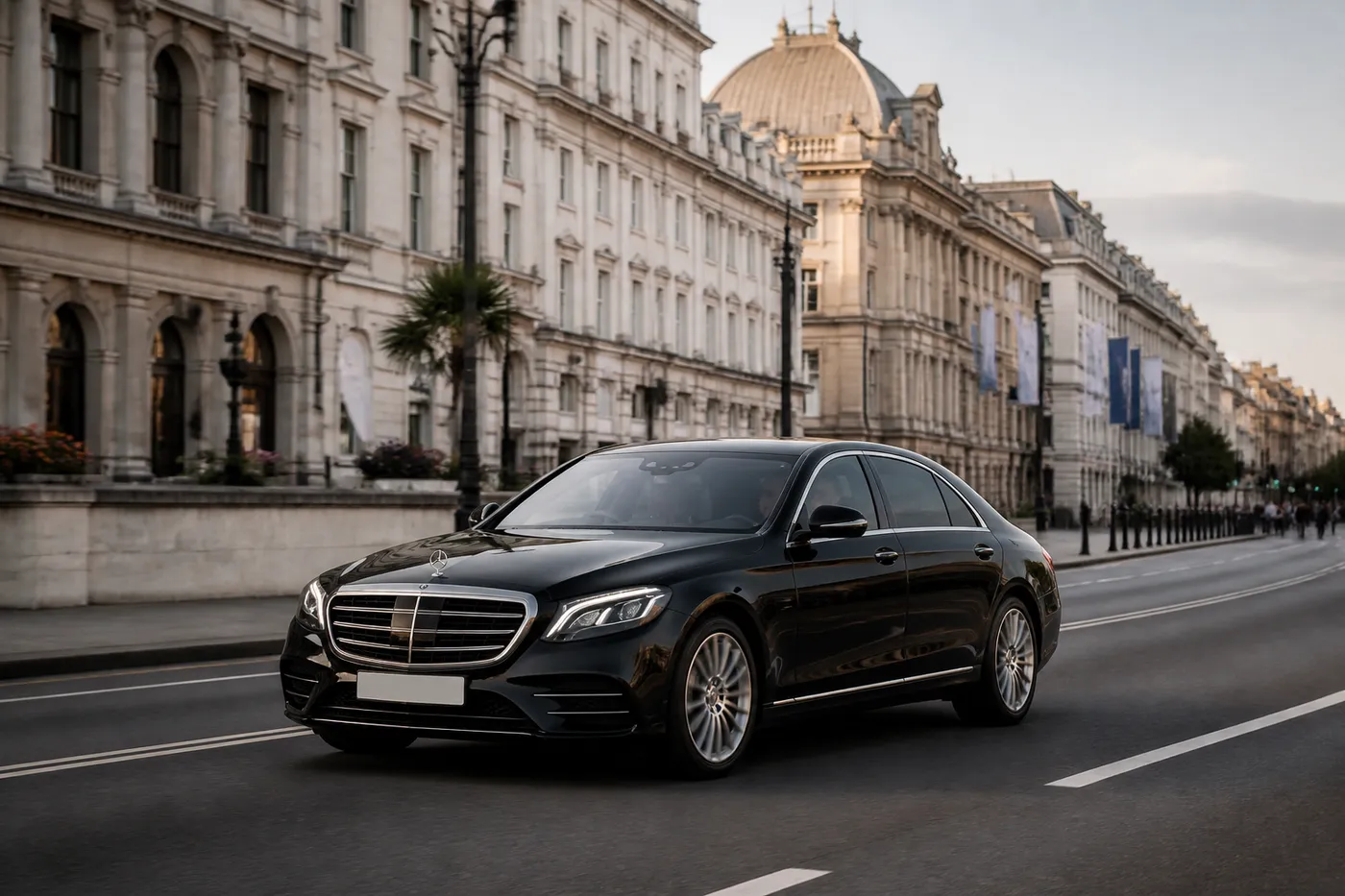
07Detail

Working the ground segment

Where a car waits when it cannot wait outside

LF-02Where a car waits when it cannot wait outside

Where a car waits when it cannot wait outside

Almost no city-centre office has a kerb a car can sit on. Red routes forbid stopping outright, loading bays are for loading, and most of the rest is permit parking with a warden walking it every twenty minutes. The question on every hourly booking is therefore not whether the chauffeur waits, but where they wait and how quickly they can get back.

The answer is usually a car park within three or four minutes, or a quieter street two turns away. The chauffeur works that out on arrival rather than at the moment you call, and the practical effect is that you send a message when you are five minutes from finishing and the car is at the door as you reach the pavement.

This is also why a specific building entrance is worth giving us. Large offices frequently have a main door on one street and a working entrance on another, and the one with the taxi drop is not always the one you will emerge from at half past six. Naming it converts a two-minute wait in the rain into no wait at all.

08Detail

What to expect

LF-03A day that moves after it has started

A day that moves after it has started

No plan survives a morning of meetings. Someone runs twenty minutes over, a lunch gets added, the afternoon site visit is cancelled and replaced with a call taken from the car. A booking that cannot absorb any of that becomes an administrative problem at exactly the moment you have no attention to spare for administration. The cost of that friction is usually larger than the cost of the car.

Hourly hire exists for precisely this. The chauffeur is yours for the block, so changing the order of the day is a sentence rather than a new booking, and the car simply goes where you say next. Where the change is large, an extra hour tacked onto the end or a second city added, the chauffeur will tell you what is possible before it becomes a problem.

Fixed transfers suit the opposite kind of day. Two known points, a known time, a fixed price, and nothing in between that needs a car. Trying to run a fluid day on transfer pricing is where clients end up feeling nickel-and-dimed by the third booking, and we would rather quote the block honestly at the start than collect four fares from one afternoon.

09Vehicles

The cars usually sent for this

Seats and cases for each car, taken from the vehicle itself. Nothing below is a class average.

Cabin

Mercedes-Benz E-Class

3 passengers, 2 large cases

Passengers
Up to 3
Large cases
2, plus cabin bags
Cabin class
Cabin

First Saloon

Mercedes-Benz S-Class

3 passengers, 3 large cases

Passengers
Up to 3
Large cases
3, plus cabin bags
Cabin class
First Saloon

First Saloon

BMW i7

3 passengers, 3 large cases

Passengers
Up to 3
Large cases
3, plus cabin bags
Cabin class
First Saloon

Suite

Mercedes-Benz Jet Class

4 passengers, 5 large cases

Passengers
Up to 4
Large cases
5, plus cabin bags
Cabin class
Suite

No standing price list. Send the journey on WhatsApp and the written quotation confirms the price, what it includes and any applicable tax. Compare every vehicle if none of these is quite right.

10Detail

Behind the booking

The first car of the morning

LF-04The first car of the morning

The first car of the morning

Early collections are their own discipline. A 05:15 from a home address means the chauffeur has been awake since four and has checked the route for overnight closures, because the M25 and the urban motorways do most of their roadworks between midnight and five. A closure nobody checked for costs twenty minutes at exactly the wrong hour of the day.

Nobody rings a doorbell at that hour on our jobs. The car arrives, the chauffeur sends a message, and you come out when you are ready. Boot open, cases in, away. Where a hotel is involved, the chauffeur will be in the lobby rather than outside if that is what you have asked for, which most people do after the first time.

The other early-morning discipline is fuel and cleanliness the night before. A car that needs twelve minutes at a service station on the way to Heathrow at half past five is a car that was not prepared, and that is not a problem a client should ever be asked to share. The same applies to a windscreen that nobody cleaned before setting off.

11Detail

On the day

Two cities before dinner

LF-05Two cities before dinner

Two cities before dinner

A working day that starts in Birmingham and finishes in Manchester, or takes in Bristol and Cardiff between breakfast and the evening, is straightforward by road and awkward by almost any other means. One chauffeur, one car, and the bags stay in the boot between stops instead of being carried in and out of stations. The car is the only thing that does not change.

Distance changes the arithmetic rather than the service. Long days are quoted as a block with the mileage understood, and the chauffeur’s own hours are planned properly, because a driver who has been at the wheel since five in the morning should not be starting a three-hour run home at nine at night. Where a day genuinely needs two chauffeurs, we say so and price it.

Coverage runs the length of the country and the standard does not thin out with distance. An arrival at a business park outside Aberdeen gets the same car, the same brief and the same early arrival as a collection from a Mayfair address on a Tuesday morning. Geography changes the drive time and nothing else about how the booking is run.

12Coverage

Where we drive

London based, driving the whole of the United Kingdom. Pick a region for the towns inside it, or a terminal to see where the chauffeur stands.

13Detail

Practical notes

The same chauffeur, the second time

LF-06The same chauffeur, the second time

The same chauffeur, the second time

Repetition is where a chauffeur service gets genuinely good. The second time someone drives you, they know the gate code, which entrance the security desk actually watches, that you prefer the front nearside window down, and that your Thursday meeting always overruns by a quarter of an hour. None of that can be written into a first booking. It has to be learned.

Where a client asks for a named chauffeur we hold to it as far as the diary allows, and we say so honestly when we cannot. Availability is a real constraint on any operator, and pretending otherwise leads to a substitution nobody was told about, which is a good deal worse than the substitution itself. A name on a confirmation is a promise or it is nothing.

When a different chauffeur does take the job, the notes travel with it. Entrances, preferences, the small things that took three journeys to learn: all of it sits on the booking rather than in one person’s head, so the fourth journey does not start from zero and nothing has to be spelled out again. Explaining yourself twice is the thing clients quietly resent most.

14Detail

Before you confirm

LF-07Evenings, and the return that gets forgotten

Evenings, and the return that gets forgotten

People book the outbound leg carefully and treat the return as an afterthought. It is the wrong way round. The morning journey has a hard deadline and everybody concentrates on it; the evening journey happens when you are tired, when it is raining, and when every private hire car within two miles is already busy. That is the leg worth booking.

A booked return is the cheapest comfort in this business. The chauffeur is there when the dinner finishes, the car is warm, and the day ends without a queue or an application telling you the wait is eleven minutes. On hourly bookings the end of the day is simply the end of the block, and an overrun is agreed rather than argued about.

Late finishes also change the vehicle question. After a long evening most people want the quietest cabin available rather than the largest one, which is why the S-Class and the BMW i7 do more evening work than anything else we run. The i7 in particular is close to silent at motorway speed, which matters more at eleven at night than at nine in the morning.

15What it costs

How this is quoted

One message with the shape of the job, and a fixed figure in writing before you commit to anything.
Smallest cabin
Mercedes-Benz E-Class
Seats
Up to 3
Large cases
2
Quoted
In writing, before you travel

No standing price list. Send the journey on WhatsApp and the written quotation confirms the price, what it includes and any applicable tax. The pricing page sets out what moves a figure, and a message on WhatsApp fixes the figure for your date, your pick-up and your car.

What a written quotation for a working day says

LF-08What a written quotation for a working day says

What a written quotation for a working day says

A quotation for an executive day names the vehicle, the start time and address, the basis of charge and the total. The cabin is the largest single lever on that total — the E-Class at the bottom, the S-Class or BMW i7 a rung up, the Jet Class conversion of the V-Class higher again — and most as-directed bookings are taken from a stated minimum block. Your written quotation confirms the final price, what it includes and any applicable tax.

Where a day is genuinely unusual, the quotation says how the unusual part is handled. An overnight stay for the chauffeur on a two-day job, a 04:00 start, a run that ends three hundred miles from where it began: each of those has a cost, and it is better on the paperwork than in a conversation afterwards that starts with somebody saying they had assumed otherwise.

Published rates for every vehicle sit on the pricing page, and they do not change because a client is new or because the request came in at four o’clock on a Friday. The figure you are quoted for a Tuesday is the figure for a Tuesday, and it is written down so that neither of us has to rely on remembering it.

18Answers

Questions about executive travel

Six answers that come up on almost every enquiry of this kind.

Should I book by the hour or as individual transfers?

By the hour when the day is fluid or the car is needed between appointments, and as transfers when there are two fixed points and nothing in between. Hourly work is taken from four hours on most vehicles. If you describe the day we will tell you which comes out better rather than defaulting to the one that bills more.

What happens if my meeting overruns?

On an hourly booking, nothing. The chauffeur is holding nearby and comes to the door when you message. If the overrun pushes the day past the booked block, the chauffeur will tell you what is available before the end rather than after it, and any extension is agreed rather than assumed.

Can the car stay with me all day?

That is what as-directed hire is. The vehicle and chauffeur are assigned to you for the block, luggage and coats stay in the boot, and the car waits in a legal position between stops. It works out considerably better than four separate transfers once you are making more than two or three moves.

Will I get the same chauffeur each time?

Wherever the diary allows it, and we will tell you plainly when it does not. Continuity is worth having because a chauffeur who has driven you before knows the entrances, the timings and your preferences. Where someone else takes the job, the notes from previous bookings go with it.

Do you cover the whole country or only London?

The business is London based and drives the whole of the United Kingdom. Days that cross the country, such as Birmingham to Manchester or Bristol to Cardiff, are ordinary work. On very long days we plan the chauffeur’s hours properly and will tell you if a second chauffeur is the right answer.

Can you collect from an airport at the start of a day?

Yes, and it is usually neater as one booking. The flight is tracked, you are met inside the terminal, and the same chauffeur then stays with you for the meetings that follow rather than handing you to somebody else at the kerb.

FCReservations

Ready to book executive travel?

Send the date, the pick-up and where you are going. A fixed written quotation comes back with the car, the chauffeur's arrival time and what the figure covers.

Hours
Reservations answered around the clock, every day of the year.
CallGet a quote