Skip to content
FCFirst ClassCHAUFFEURS

SVBusiness travel

Corporate chauffeur service for a company that moves in numbers

When a company moves several people on the same day, the difficulty is never the driving. It is knowing which car is where, and getting the order right.

  • One reservation for many cars
  • Standing bookings held
  • Named chauffeurs where possible
  • Written quotation per movement
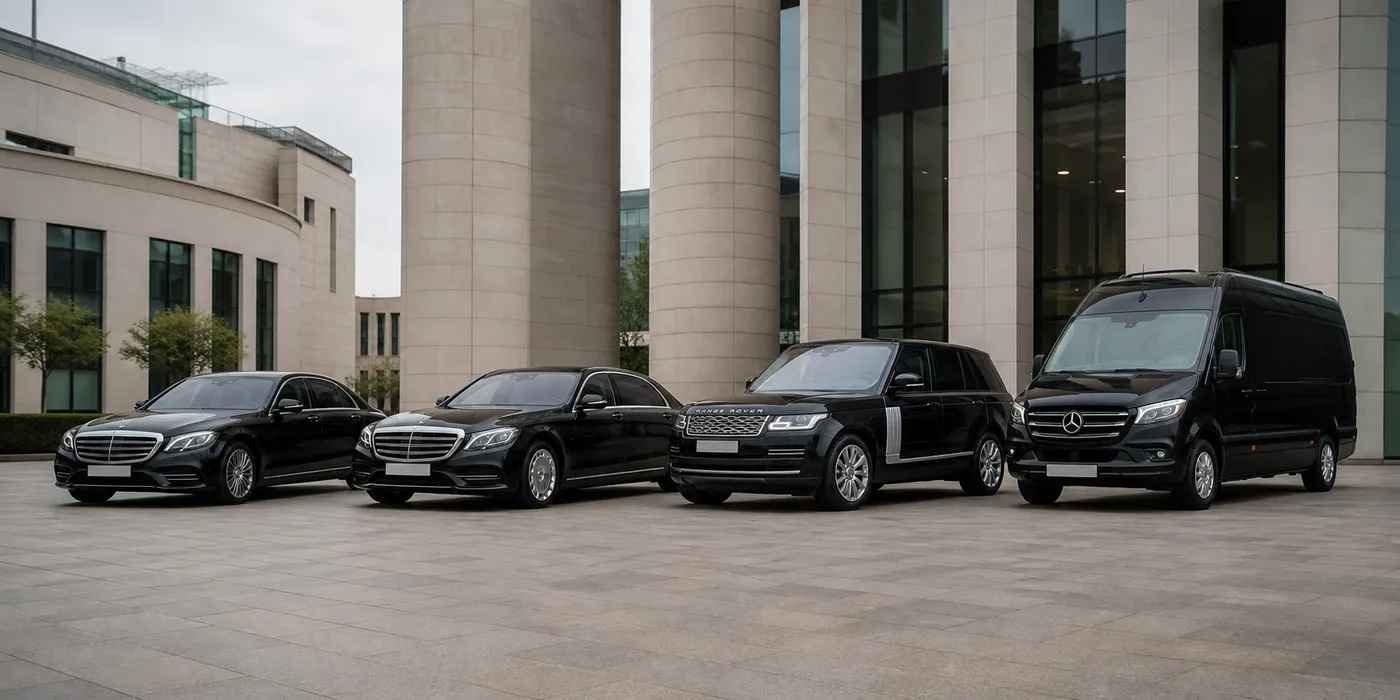
Four car fleet lineup

Written quotation, usually within the hour

Corporate chauffeur service: summary

First Class Chauffeurs handles the ground logistics of company travel: multiple vehicles on the same day, arrivals from several airports, movements between offices and hotels, standing weekly bookings and one-off group movements. A day involving more than one car is planned as a single movement rather than as separate transfers, with a running order, a named contact and chauffeurs who know what happens after their own leg. Flights are tracked so a late arrival re-sequences the cars instead of stranding people, standing bookings hold the same chauffeur where the diary allows, and every movement is quoted in writing before it runs. Coverage extends to every UK city, airport and business park, not only to the head office postcode.

Bookings

One-off, standing or whole-day movements

Contact

Reservations answered around the clock

Vehicles

E-Class to Sprinter, mixed on one job

Coverage

Every UK city, airport and business park

01Overview

What this covers

A single transfer is easy. Nine of them on the same Monday, from four airports, into two hotels and one head office, with three of the flights late and one of the visitors carrying a stand for an exhibition, is a different exercise entirely. That coordination is the work, and it is what a company is really buying when it puts its ground travel in one place.

We run it as one plan rather than nine bookings. There is a movement sheet for the day, a running order for the cars, and one number to ring when something changes. Chauffeurs know who else is on the job and what happens after their own leg, which is why a delayed flight at Stansted does not leave somebody standing in a lobby in Reading.

02At a glance

The detail in brief

What a reservations clerk would tell you in the first thirty seconds of the call.
Bookings
One-off, standing or whole-day movements
Contact
Reservations answered around the clock
Vehicles
E-Class to Sprinter, mixed on one job
Coverage
Every UK city, airport and business park

03Included as standard

What corporate accounts includes

  • 01

    A movement sheet, not a pile of bookings

    Every car on the day sits on one plan with a running order, so the sequence is deliberate rather than accidental.

  • 02

    One number for the day

    Whoever is coordinating the visit rings one line and gets someone who can see all the cars, not a call centre reading a single reference.

  • 03

    Flights tracked across the group

    Six arrivals into four airports are all watched. A delay re-orders the cars rather than leaving one passenger waiting for a vehicle that is elsewhere.

  • 04

    Standing arrangements

    The Tuesday collection that happens every week is set up once and repeats, with the same chauffeur when the diary allows.

  • 05

    Mixed vehicles on one job

    Saloons for the individual movements, a V-Class for the group leg and a Sprinter for the party of twelve, all on the same reservation.

  • 06

    Changes absorbed on the day

    A meeting that moves, a visitor who misses a connection, an extra passenger. The plan is rebuilt around it rather than restarted.

04Who books it

Who asks for this

Four kinds of enquiry arrive for this work, and each wants something slightly different from it.
  • 01

    Executive assistants and office managers

    The people who actually build these days. One conversation covers eight movements instead of eight separate confirmations to chase.

  • 02

    Companies hosting visitors

    Colleagues in from overseas offices who need meeting at the terminal, moving between sites and returning to the airport on the Friday.

  • 03

    Firms with regular routes

    The same run to the same site every week, at the same hour, without rebooking it every Monday morning.

  • 04

    Teams running an event or a launch

    Speakers, clients and equipment moving between a hotel, a venue and a station in a defined order across a single afternoon.

05How it works

From the first message to the last mile

The same sequence every time, so nobody is left guessing what happens next.
  1. Step 01

    Send the day, however rough

    Names, flights, addresses and rough times. A messy list is a perfectly good starting point; we will turn it into a running order.

  2. Step 02

    We build the movement plan

    Which car goes where, in what order, with which chauffeur, and where the slack sits if a flight is late.

  3. Step 03

    Written quotation for the whole day

    Priced per movement so the arithmetic is checkable, with the vehicles named and the waiting terms stated.

  4. Step 04

    The day runs from one contact

    Your coordinator has one number. Chauffeurs are given the wider picture, not just their own leg.

  5. Step 05

    Set it to repeat, if it repeats

    Regular movements become standing bookings after the first one, so the same day next month takes a single message.

06Detail

In detail

Nine people, four airports, one Monday

LF-01Nine people, four airports, one Monday

Nine people, four airports, one Monday

This is the shape of a real corporate day. Two arrivals into Heathrow ninety minutes apart, one into London City, one into Luton, and five people already in the country who need collecting from three different hotels. The meeting starts at eleven. Everybody has to be in the same room, unhurried and with their coats off, before it does. That is the whole brief.

Planned as nine separate transfers, that day has nine chances to go wrong and no way of noticing until somebody is already late. Planned as one movement, it has a running order: which car collects first, which one absorbs a delay, which passenger can be paired with another if a flight slips, and who gets told when it does. The order is the product.

The sequencing itself is unglamorous work done the day before. It takes about twenty minutes at a desk, it costs the client nothing extra, and it is the difference between a smooth arrival and four people standing in a lobby comparing notes about their journeys while the eleven o’clock quietly becomes the half past. Nobody thanks you for it, which is how you know it worked.

07Detail

Working the ground segment

LF-02One number, and the person who answers it

One number, and the person who answers it

The single most useful thing about putting a company’s ground travel in one place is that changes take one call. An assistant rearranging a visit does not want to identify eight separate references in order to move a lunch by an hour; they want to say the lunch has moved and have somebody else deal with all of the consequences.

Reservations are answered around the clock, every day of the year, which matters on the days that go wrong rather than the days that go right. A flight that diverts at eleven at night is exactly when a number that rings out becomes an expensive kind of saving, and it is the moment a client decides who they will call next time.

Chauffeurs on a multi-car job are briefed on the whole movement, not only their own leg. If a colleague is running late at Terminal 5, the chauffeur waiting at the hotel already knows, and the passenger in their car is told before they start wondering why the schedule has changed. Information travelling sideways is what makes a movement feel organised.

08Detail

What to expect

Sequencing arrivals so nobody sits in a lobby

LF-03Sequencing arrivals so nobody sits in a lobby

Sequencing arrivals so nobody sits in a lobby

The instinct is to send a car for every passenger at the moment they land. The better plan usually holds one or two vehicles back. Two flights landing twenty minutes apart at the same terminal often merge into one car with two passengers who are pleased to see each other, which is quicker for both of them and cheaper for you.

Where merging does not suit, the cars are ordered by what happens next rather than by who lands first. The visitor with the eleven o’clock meeting goes ahead of the one whose afternoon is free, even if the second landed earlier, because the meeting is the fixed point in the day and the flight is only the way somebody got here.

Tracking makes all of this live rather than theoretical. When one aircraft is forty minutes late, the movement sheet is rebuilt around it in a couple of minutes and the affected chauffeurs are told directly, so the change reaches the road before it reaches anybody’s inbox. That gap, between knowing and acting, is where most multi-car days fall apart, and it is usually measured in minutes.

09Vehicles

The cars usually sent for this

Seats and cases for each car, taken from the vehicle itself. Nothing below is a class average.

Cabin

Mercedes-Benz E-Class

3 passengers, 2 large cases

Passengers
Up to 3
Large cases
2, plus cabin bags
Cabin class
Cabin

Cabin MPV

Mercedes-Benz V-Class

7 passengers, 5 large cases

Passengers
Up to 7
Large cases
5, plus cabin bags
Cabin class
Cabin MPV

First Saloon

Mercedes-Benz S-Class

3 passengers, 3 large cases

Passengers
Up to 3
Large cases
3, plus cabin bags
Cabin class
First Saloon

Signature

Mercedes-Benz Luxury Sprinter

16 passengers, 10 large cases

Passengers
Up to 16
Large cases
10, plus cabin bags
Cabin class
Signature

No standing price list. Send the journey on WhatsApp and the written quotation confirms the price, what it includes and any applicable tax. Compare every vehicle if none of these is quite right.

10Detail

Behind the booking

Standing bookings and the weeks they repeat

LF-04Standing bookings and the weeks they repeat

Standing bookings and the weeks they repeat

A great deal of company travel is the same journey over and over. The Monday morning run to a site in the Thames Valley, the Thursday collection from a home address for an early flight, the fortnightly board day where four people arrive within an hour of each other from four different directions. All three are the same booking every time.

Once a movement has run twice, it should not need explaining again. Standing bookings hold the addresses, the entrances, the vehicle preference and the chauffeur, and they run until somebody says otherwise. Changing one week is a message; cancelling a fortnight because the office is closed is another, and neither requires rebuilding the arrangement from scratch. That is the entire point of setting one up.

The gain is not only administrative. A chauffeur doing the same run weekly learns the barrier at the site entrance, the fact that the visitor car park fills by half past eight, and which of the three roundabouts backs up in the rain. That knowledge is worth several minutes a week and it accrues quietly, without anybody having to ask for it.

11Detail

On the day

LF-05Changes after the plan is set

Changes after the plan is set

Corporate days move. A meeting is pushed two hours, an extra person joins the trip, a return flight is rebooked to the following morning, or the group decides at four o’clock that dinner is now in an entirely different part of town. None of it is unusual and all of it has to reach the cars quickly, usually within the hour.

Because the whole day sits on one plan, a change is a re-plan rather than a set of cancellations and rebookings. We will tell you what it costs, if it costs anything at all. Adding an hour to an as-directed car is generally trivial; sending a second vehicle across a city in the evening peak is not, and it is better to know that in advance.

What we try never to do is let a change arrive as a surprise on the day itself. If a plan has gone from tight to unworkable, saying so at four in the afternoon is a great deal more useful than discovering it at six with everybody standing outside a venue in the cold, wondering which of them is going to ring somebody.

12Coverage

Where we drive

London based, driving the whole of the United Kingdom. Pick a region for the towns inside it, or a terminal to see where the chauffeur stands.

13Detail

Practical notes

Visitors who have never been to the city before

LF-06Visitors who have never been to the city before

Visitors who have never been to the city before

A colleague arriving from another country has none of the local knowledge that makes a British city navigable. They do not know that the address on the invitation is one of three entrances, that the hotel sits on a one-way system, or that the site they are visiting is eleven miles from a station with no realistic taxi supply at eight in the morning.

Meeting them inside the terminal removes the first problem. Sending the chauffeur’s name and number to the person hosting them removes the second, because the host can see the visitor is on their way without having to ring anybody or apologise for asking. The rest is simply knowing the addresses, which is our job and not the visitor’s or the host’s.

It also spares the visitor from the small indignities that colour a first impression of a company. Nobody who has flown eleven hours enjoys standing at a rank in the rain outside a terminal with a phone that will not connect, and no host enjoys hearing about it in detail at the start of a meeting they had hoped would begin differently.

14Detail

Before you confirm

Coverage beyond the head office

LF-07Coverage beyond the head office

Coverage beyond the head office

Company travel is rarely confined to one city. A firm with a London office and a plant in the Midlands, a fund with an Edinburgh presence, or a group with sites in Bristol, Leeds and Belfast needs the same standard in all of them, and usually needs it at a few days’ notice. That is a coverage question before it is a service question.

We drive the whole of the United Kingdom, which means a movement in Glasgow is arranged by the same office and to the same brief as one in Mayfair. The chauffeur meeting a director at Aberdeen airport carries the same instructions about early arrival and waiting position as the one holding outside a bank in the City. There is no regional version of the brief.

Cross-country days follow the same logic. Somebody flying into Manchester for a morning and continuing to a site outside Sheffield in the afternoon is one booking with one chauffeur, rather than a handover in a service station car park to a firm nobody has spoken to. Handovers are where the standard drops, so we avoid them wherever the hours allow.

15What it costs

How this is quoted

One message with the shape of the job, and a fixed figure in writing before you commit to anything.
Smallest cabin
Mercedes-Benz E-Class
Seats
Up to 3
Large cases
2
Quoted
In writing, before you travel

No standing price list. Send the journey on WhatsApp and the written quotation confirms the price, what it includes and any applicable tax. The pricing page sets out what moves a figure, and a message on WhatsApp fixes the figure for your date, your pick-up and your car.

How a company day is quoted

LF-08How a company day is quoted

How a company day is quoted

Multi-car days are quoted movement by movement so the arithmetic can be checked, then totalled at the bottom. Each line names the vehicle, the time, the route and the figure, which makes it obvious where a day is expensive and where a small change to the schedule would make it noticeably cheaper without anybody losing anything. Very few operators show it that way.

Nothing is published as a price list, and the reason is that a printed figure cannot know your day. What it can be is consistent: the same vehicle, the same hours and the same routing are quoted the same way for every client on every day of the week, and the written quotation confirms the final price, what it includes and any applicable tax.

Where a day could sensibly be run either as hourly hire or as separate transfers, we will show both rather than choosing the more expensive one on your behalf. Days with a lot of waiting almost always come out better as as-directed blocks, and days with two long legs and nothing in between almost always do not. The comparison takes a minute and is worth having.

18Answers

Questions about corporate accounts

Six answers that come up on almost every enquiry of this kind.

How do you handle several cars on the same day?

As one movement plan rather than separate bookings. There is a running order, a note of where the slack sits if a flight is late, and chauffeurs who know what happens after their own leg. Your coordinator rings one number to change any of it, and the cars are re-sequenced from there.

Can we set up journeys that repeat every week?

Yes. Once a movement has run and the details are right, it becomes a standing booking with the addresses, entrances, vehicle and chauffeur held. It repeats until you say otherwise, and changing or skipping a single week takes one message rather than a fresh booking.

What happens when one visitor’s flight is badly delayed?

The plan is rebuilt around it. Because every arrival on the day is tracked, we usually know before the passenger does. Sometimes the answer is to hold that car and merge two passengers who are now landing together; sometimes it is to re-time the onward legs. Either way the affected chauffeurs are told directly.

Do you provide different vehicles on the same booking?

Routinely. A typical corporate day mixes saloons for individual movements, a V-Class where four people and their luggage travel together, and a Sprinter for a larger group leg. They sit on one reservation with one running order rather than being ordered separately.

Can our visitors be met inside the terminal?

Yes, and on our arrival bookings that is standard rather than an option. The chauffeur waits at the exit from baggage reclaim with a board that usually carries your company name rather than the visitor’s, which is what the guest will be looking for.

Do you cover sites outside the major cities?

Business parks, plants, distribution centres and rural sites are a large part of this work, because they are exactly the places public transport does not reach. Give us the postcode and the gate, and if access is complicated the chauffeur will have checked it before the day rather than at the barrier.

FCReservations

Ready to book corporate accounts?

Send the date, the pick-up and where you are going. A fixed written quotation comes back with the car, the chauffeur's arrival time and what the figure covers.

Hours
Reservations answered around the clock, every day of the year.
CallGet a quote