Skip to content
FCFirst ClassCHAUFFEURS

GDFleet guide

One vehicle or two, for a group of six

Six people who want to talk, against six who want to arrive separately. The step-in height, the conversation, and the price.

6 min readPublished 15 July 2025
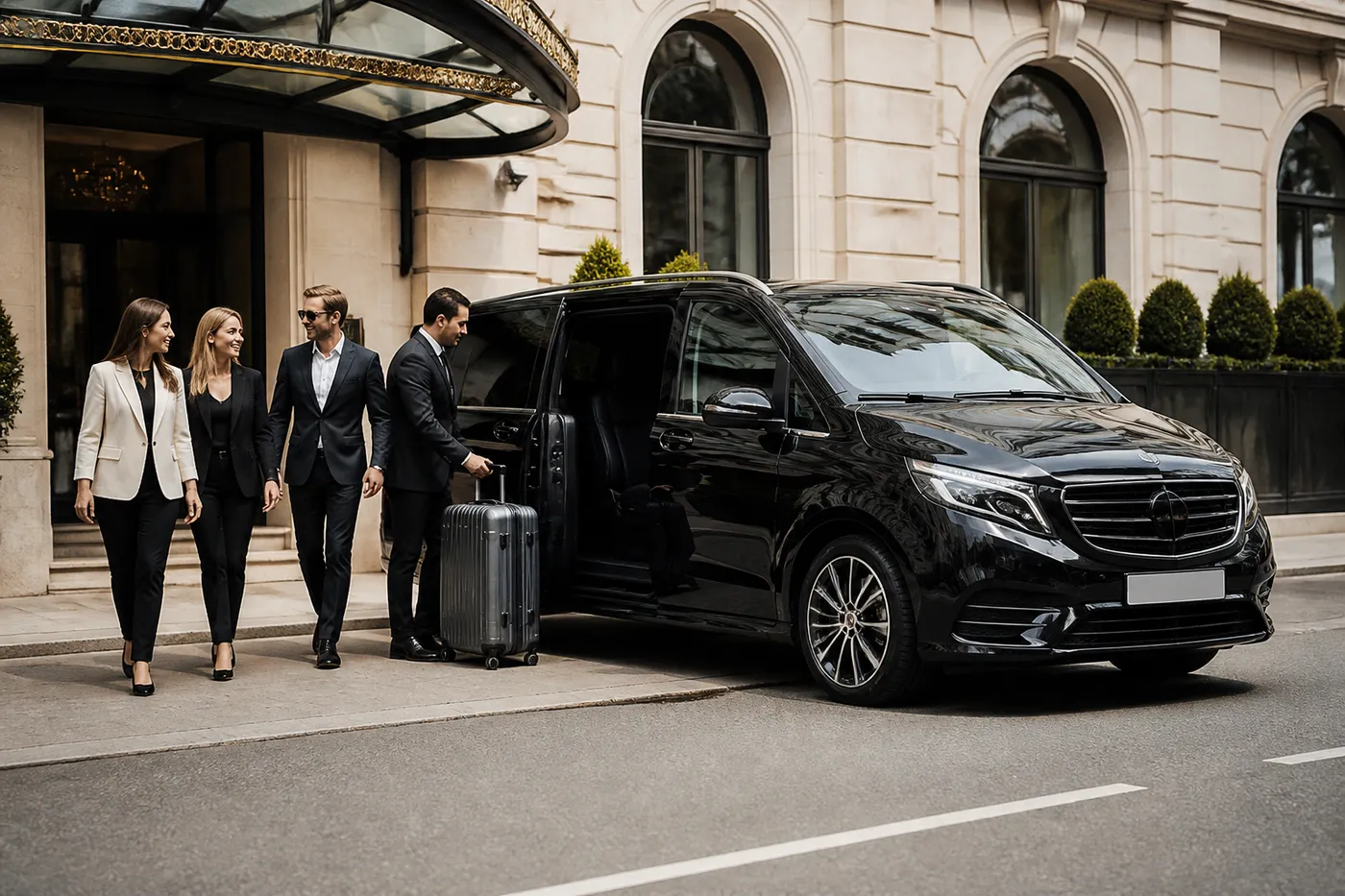
Executive van hotel group

Written quotation, usually within the hour

When one people carrier beats two saloons

Six people who want to talk, against six who want to arrive separately. The step-in height, the conversation, and the price. Six people need either a people carrier or two saloons, and the choice is usually made on price, which is the least interesting of the three or four things that actually differ. From Heathrow to central London a single V-Class is comfortably cheaper than two E-Class cars, and that appears to settle it. It does not settle it, because the two arrangements produce quite different journeys, and on some days the more expensive one is plainly better. This piece is about the cases where the single vehicle is the right answer and, at the end, the cases where it is not, which are more numerous than the price difference suggests.

Category

Fleet

Published

15 July 2025

Sections

7 sections

Category
Fleet
Reading time
6 minutes
Published
15 July 2025
Sections
7 sections

01The short version

When one people carrier beats two saloons

Six people need either a people carrier or two saloons, and the choice is usually made on price, which is the least interesting of the three or four things that actually differ. From Heathrow to central London a single V-Class is comfortably cheaper than two E-Class cars, and that appears to settle it.

It does not settle it, because the two arrangements produce quite different journeys, and on some days the more expensive one is plainly better. This piece is about the cases where the single vehicle is the right answer and, at the end, the cases where it is not, which are more numerous than the price difference suggests.

The conversation, which is the main event

GD-01The conversation, which is the main event

The conversation, which is the main event

A group of six in one vehicle can talk to each other. A group of six in two cars cannot, and on a ninety-minute drive to a wedding or an event that is not a small loss. In a V-Class the second row can turn to face the third, or the seats can be configured so that four people are effectively sitting round a space, and it becomes a room that happens to be moving.

This is the whole argument for the single vehicle and it is the one that never appears in a price comparison. If the point of the journey is that the group arrives together, having spent the journey together, then splitting them across two cars has defeated the purpose before anybody has started the engine.

GD-02Getting in and out

Getting in and out

Sliding doors are underrated until you use them. In a tight London street a saloon door opens into traffic and a sliding door does not, which matters at a restaurant kerb on a Friday evening. The step-in height of a V-Class is higher than a saloon, so most people step across rather than dropping down, and for anyone with a hip or a knee that is considerably easier.

The exception is anyone who finds a step up difficult. A V-Class has a step and grab handles; a saloon has a low seat and a wide aperture. Which is easier genuinely depends on the person, and it is worth asking rather than assuming that the larger vehicle is automatically the accessible one.

  • Sliding doors that do not open into traffic
  • A step across rather than a drop down into the seat
  • Grab handles at the aperture, which help most people
  • Not automatically easier for someone who struggles with a step

GD-03Luggage, where the arithmetic reverses

Luggage, where the arithmetic reverses

Six passengers in a V-Class means four large cases behind the rear row. Six passengers in two E-Class cars means four large cases too, two in each boot, plus more room for coats and soft bags. So on pure volume the two arrangements are closer than people expect, and the two-car version has the advantage of two separate boots.

Where the single vehicle wins is awkward shapes, because a V-Class with a row folded takes things no saloon will take. Where the two-car version wins is a group with a lot of hand luggage, because there is simply more cabin to put it in. Neither is dramatically better, which is why luggage is rarely the deciding factor at six passengers.

The arrival

GD-04The arrival

The arrival

Two cars arriving at a venue is two sets of doors opening and a group assembling on a pavement. One vehicle is one door and a group that is already together. For a wedding, an event or anything with a photographer, that difference is worth more than the saving.

It works the other way at a hotel with a small forecourt. Two saloons can be dealt with one at a time; a V-Class blocking a narrow entrance while six people get out and four cases are unloaded is a slower and more conspicuous operation. On a tight London hotel frontage the two-car version is sometimes genuinely smoother.

GD-05Where two saloons are the better answer

Where two saloons are the better answer

When the group is not really a group. Six colleagues who have spent all day together, two of whom want to sleep and four of whom want to talk, are better served by two cars. So is a party where half are going to one hotel and half to another, or where two people are leaving at nine and four at midnight.

On a long journey, two saloons are more comfortable than one people carrier. A V-Class is taller, noisier at seventy and less settled on a poor surface than an E-Class, and over three hours that becomes the dominant fact. For anything over about ninety minutes with six passengers, two saloons will produce a better arrival even though they cost more.

And when the day involves several stops in central London, two cars is often more flexible: a saloon can wait in places a V-Class cannot, and parking a large vehicle in the City on a weekday is a genuine constraint on how an itinerary runs.

GD-06Above six, where it stops being a choice

Above six, where it stops being a choice

Seven or eight passengers is either a Sprinter or two vehicles, because the V-Class seating in chauffeur configuration is six. Ten to twelve is a Sprinter, or two V-Class for well under half the money, and the two-vehicle answer is much the cheaper one. The Sprinter earns its money when the group needs to be together and the journey is long.

Below four passengers the question does not arise: an E-Class carries four including the front and does it better than a people carrier would. The V-Class is a genuinely narrow answer to a genuinely common problem, which is why it is the second most-booked car in the fleet after the E-Class.

  • Six is the practical V-Class limit in chauffeur configuration
  • Ten to twelve: a Sprinter, or two V-Class for well under half
  • Under four passengers, a saloon is simply better
  • Over ninety minutes with six people, two saloons ride better
How to decide for your particular six

GD-07How to decide for your particular six

How to decide for your particular six

Ask two questions. Is the point of this journey that everybody arrives together, and is the journey longer than about ninety minutes. Together and short is a V-Class. Together and long is a difficult call, and often two saloons with an agreed meeting point at the far end.

Then ask whether the group will stay a group at the other end. If they split after dinner, or leave at different times, or are staying in different places, the two-car answer removes a problem that the single vehicle would create later in the evening. It is the second half of the day that usually decides this rather than the first.

02If you read nothing else

The points that matter most

  1. 01

    The conversation, which is the main event

    A group of six in one vehicle can talk to each other.

  2. 02

    Getting in and out

    Sliding doors are underrated until you use them.

  3. 03

    Luggage, where the arithmetic reverses

    Six passengers in a V-Class means four large cases behind the rear row.

  4. 04

    The arrival

    Two cars arriving at a venue is two sets of doors opening and a group assembling on a pavement.

  5. 05

    Where two saloons are the better answer

    When the group is not really a group.

  6. 06

    Above six, where it stops being a choice

    Seven or eight passengers is either a Sprinter or two vehicles, because the V-Class seating in chauffeur configuration is six.

06Answers

Questions this guide gets asked

The same answers we would give on the phone, written down.

How many passengers does a V-Class carry in chauffeur configuration?

Six, comfortably, in individual seats across two rows behind the chauffeur, with four large cases behind the rear row. Seven or eight passengers means a Sprinter or two vehicles. Below four passengers a saloon is simply the better car, which is why the V-Class is a narrow but very common answer.

Is one V-Class cheaper than two E-Class cars?

Yes, comfortably, on a Heathrow transfer. The question is whether the single vehicle produces the better journey, and on anything over about ninety minutes with six people the two saloons often do, because a V-Class is taller and noisier at motorway speed.

Can the seats be arranged so we can face each other?

In the V-Class the second row can turn to face the third in the usual chauffeur configuration, which makes it a room rather than a back seat. That is the whole argument for a single vehicle on a journey to an event, and it is the thing a price comparison between one car and two never captures.

Is a people carrier easier for an older passenger to get into?

Usually, because you step across rather than dropping down, and there are grab handles at the aperture. But it does have a step, and for somebody who struggles with a step a saloon with a low seat and a wide door can be easier. It is worth asking the person rather than assuming the larger vehicle is the accessible one.

FCReservations

Tell us the journey. We will send the price in writing.

Message us the date, the pick-up and where you are going. You will get a fixed written quotation with the vehicle, the chauffeur’s arrival time and what the figure includes — no form to fill in, and no estimate that moves later.

Hours
Reservations answered around the clock, every day of the year.
CallGet a quote