Skip to content
FCFirst ClassCHAUFFEURS

GDFleet guide

Choosing between a saloon and a people carrier

Three adults and three cases is the question that decides most bookings. The answer changes with the airport, and with the third shoulder.

6 min readPublished 18 March 2025
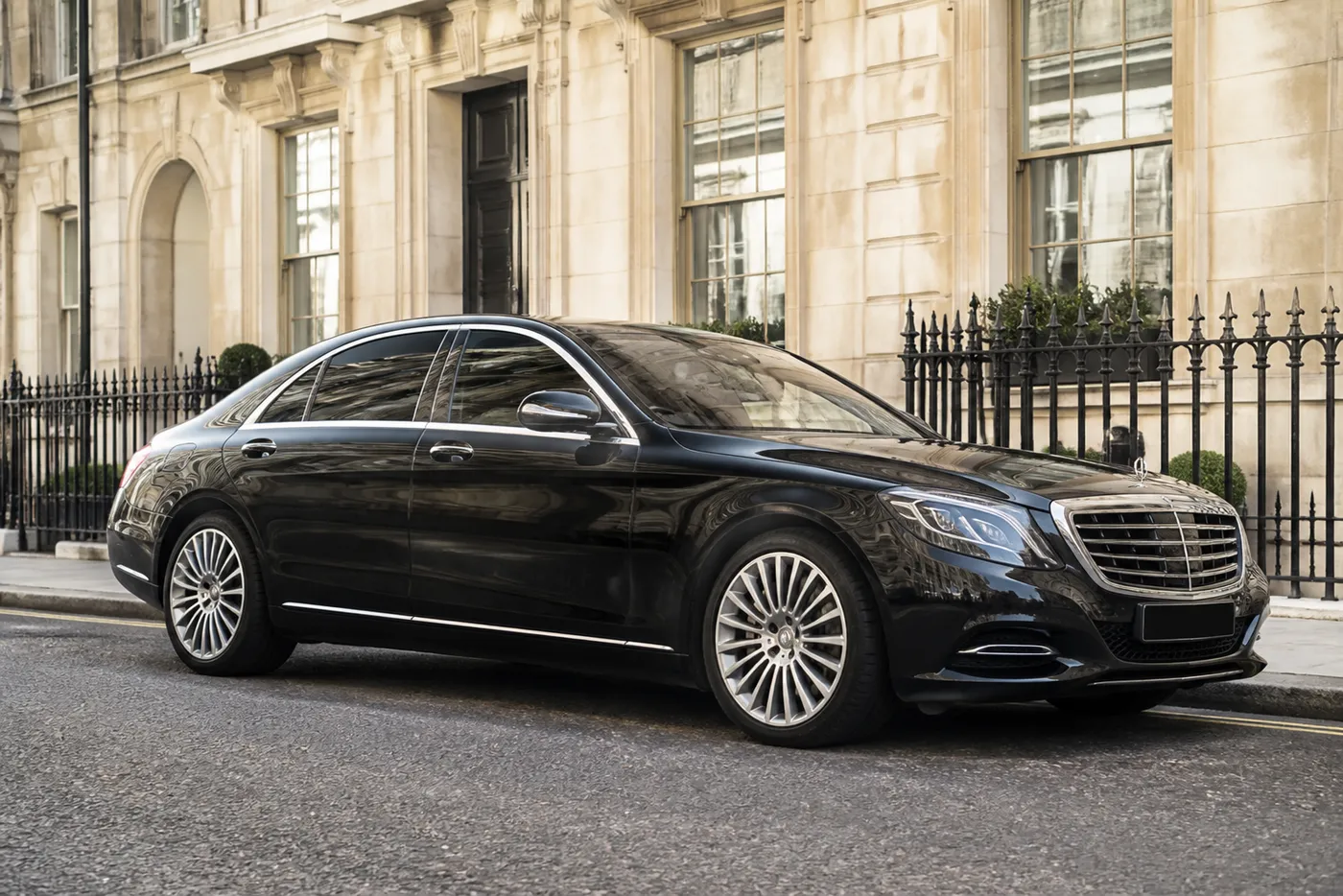
Executive saloon mayfair street

Written quotation, usually within the hour

Saloon or people carrier: choosing without guessing

Three adults and three cases is the question that decides most bookings. The answer changes with the airport, and with the third shoulder. Most bookings come down to this one decision, and most of them are made on the passenger count alone, which is the wrong input. A saloon seats four including the front, so three passengers fits on paper. Whether it fits in practice depends on how big the three people are, what they are carrying, how long the journey is, and whether the third of them ends up in the middle of a rear bench designed for two. The two vehicles in question are the E-Class, which is the least expensive car in the fleet, and the V-Class, which sits one rung above it. Very little separates them on a typical airport run. What follows is when that step up is the best money in the booking and when it is money spent on empty seats.

Category

Fleet

Published

18 March 2025

Sections

7 sections

Category
Fleet
Reading time
6 minutes
Published
18 March 2025
Sections
7 sections

01The short version

Saloon or people carrier: choosing without guessing

Most bookings come down to this one decision, and most of them are made on the passenger count alone, which is the wrong input. A saloon seats four including the front, so three passengers fits on paper. Whether it fits in practice depends on how big the three people are, what they are carrying, how long the journey is, and whether the third of them ends up in the middle of a rear bench designed for two.

The two vehicles in question are the E-Class, which is the least expensive car in the fleet, and the V-Class, which sits one rung above it. Very little separates them on a typical airport run. What follows is when that step up is the best money in the booking and when it is money spent on empty seats.

What actually fits in a saloon

GD-01What actually fits in a saloon

What actually fits in a saloon

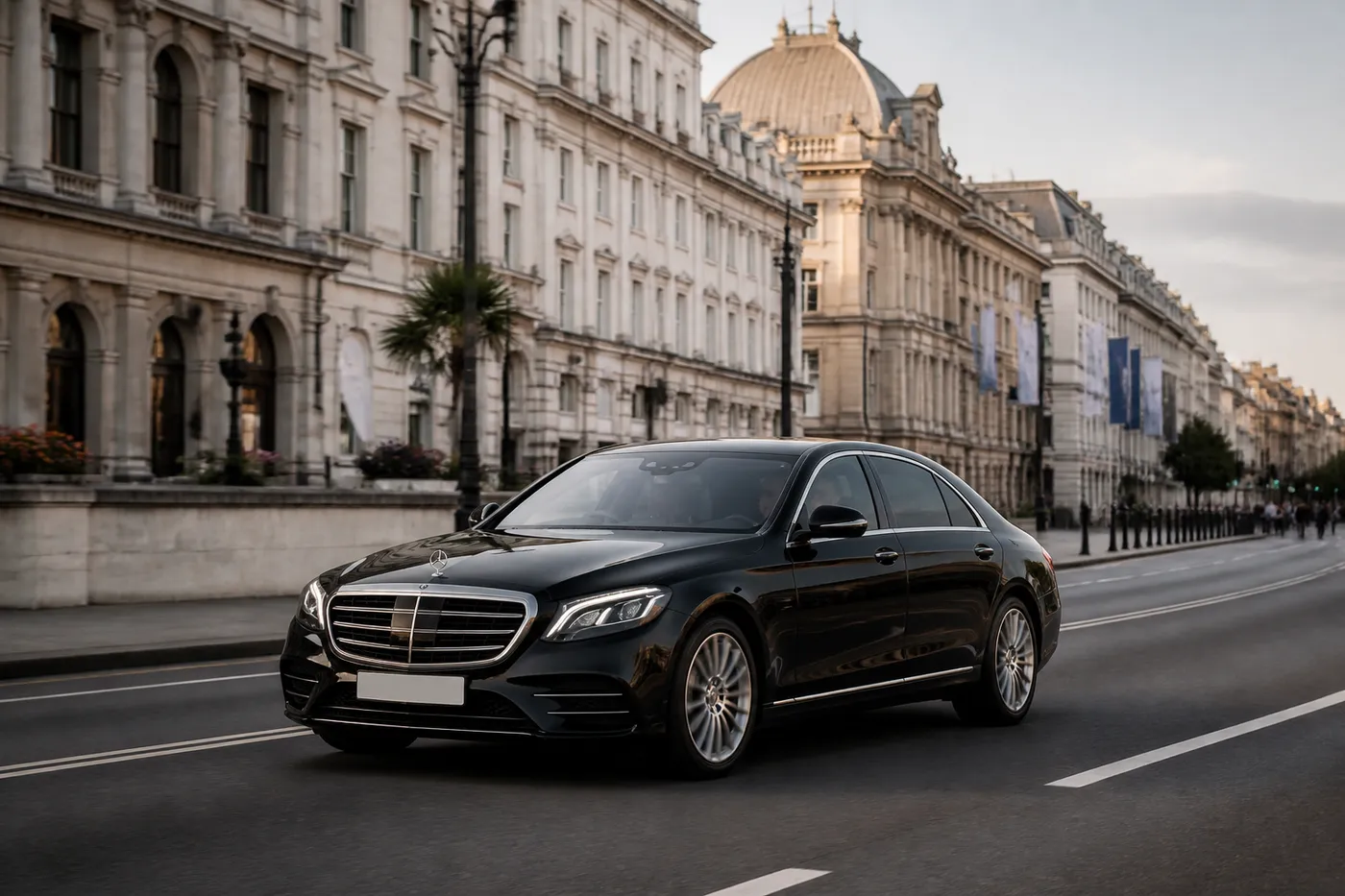
Two adults in the back of an E-Class are comfortable for any journey length. Three adults across that bench are fine for twenty minutes and increasingly not fine after forty, because the middle position sits over the transmission tunnel with less shoulder room on both sides and a less supportive seat. On a run from a hotel to a restaurant nobody cares. On a two-hour drive to a wedding, the person in the middle will remember it.

The boot takes two large cases and two cabin bags. That is the working limit rather than a cautious estimate, and it is set by the shape of the aperture rather than by volume. Three large cases go in only with the front passenger seat empty and nothing else in the car, which means a saloon carrying three people with three cases is already at its limit before anybody has brought a coat.
GD-02What the people carrier changes

What the people carrier changes

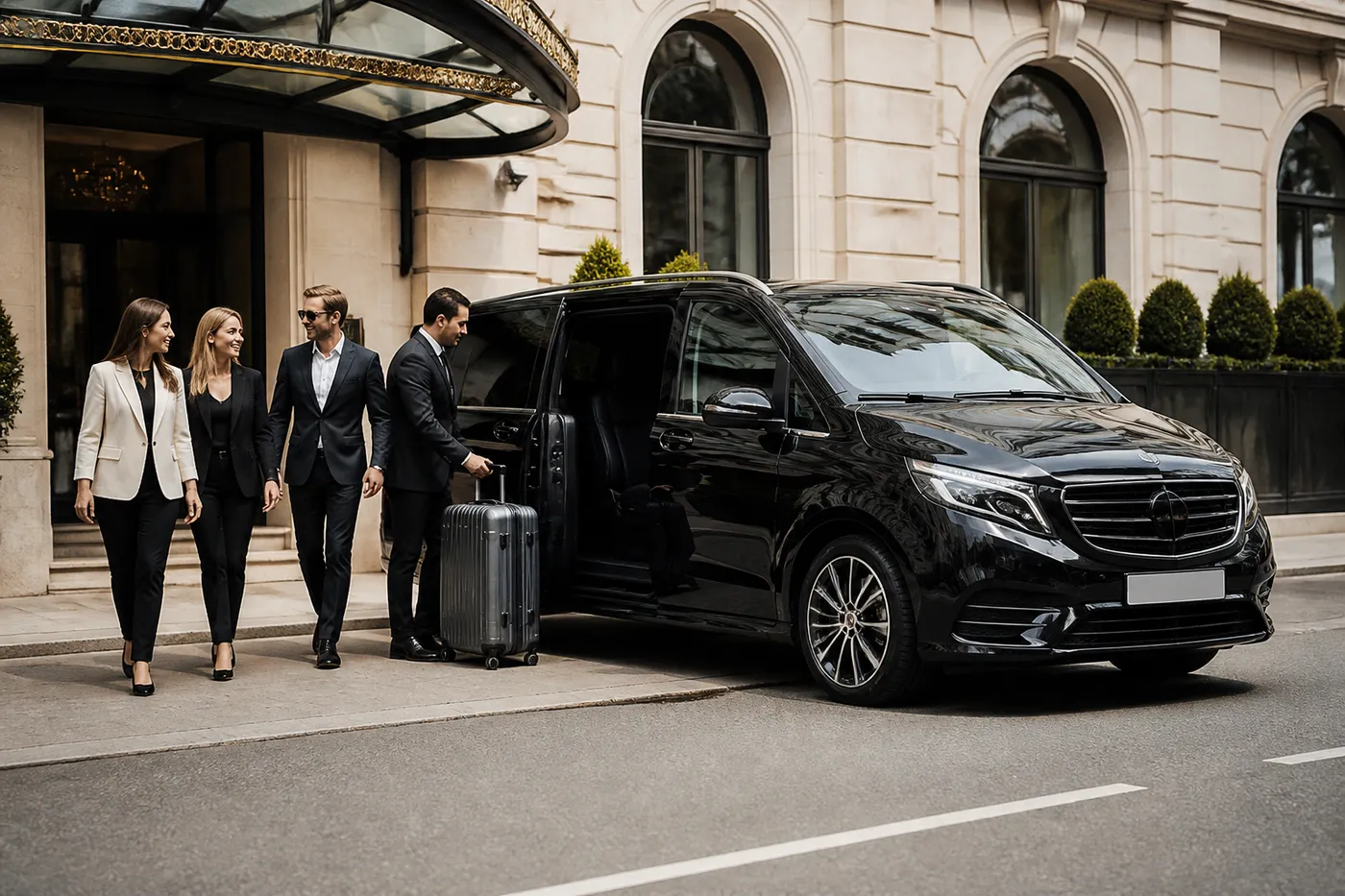
Three things, and only one of them is seats. The obvious change is that six passengers travel with everybody in a proper individual seat rather than a bench. The second is the boot: four large cases behind the rear row, with all six seats still in use, which is roughly double what a saloon manages.

The third is the one people notice most and mention least: getting in and out. Sliding doors and a step-in height that does not require you to drop into a seat make an enormous difference to anybody with a stiff knee, a long coat or a small child on their hip. On a wet evening outside a restaurant that alone is worth the difference.

  • Six individual seats rather than four including a middle
  • Four large cases with every seat still occupied
  • Sliding doors and a higher, easier step-in
  • Room to turn round and talk to the people behind you

GD-03The three-passenger question, answered honestly

The three-passenger question, answered honestly

Three adults with hand luggage on a short journey is a saloon, comfortably, and paying for a V-Class is paying for two empty seats. Three adults with three hold cases is a V-Class, because the boot is the constraint rather than the seats. Three adults on a journey over about an hour is a V-Class if you can, because the middle seat stops being tolerable somewhere in the second half-hour.

The version that catches people out is three adults who are all six feet tall. A saloon rear bench is 1.4 metres or so of usable width, which is fine for two and a genuine squeeze for three large adults in winter coats. If the party is physically big, treat three as a people carrier job whatever the journey length.

When the saloon is plainly the right answer

GD-04When the saloon is plainly the right answer

When the saloon is plainly the right answer

One or two passengers, any journey, any distance. There is no argument for a larger vehicle and the saloon is quieter, more comfortable at speed and easier to get in and out of at a kerb in central London. Booking a V-Class for two people is a fairly common way to spend thirty pounds on nothing at all.

It is also the right answer for anything where the arrival matters visually. A saloon at a hotel entrance or a restaurant door reads differently from a people carrier, and there is no version of the V-Class that changes that. If the journey ends somewhere the car will be seen, and there are two of you, the saloon is the better piece of theatre as well as the cheaper option.

GD-05When the people carrier is not the answer either

When the people carrier is not the answer either

Four passengers with eight large cases is not a V-Class, it is two cars or a Sprinter. The rear row is where the luggage would otherwise go, and once you have six people in a V-Class you have four cases of boot rather than eight. That is the honest ceiling and it is worth knowing before rather than after.

On very long journeys the saloon is often better even with three passengers. A V-Class is a comfortable vehicle but it is taller, noisier at motorway speed and less settled on a poor surface than an S-Class. Three people going from London to Edinburgh will have a better day in a large saloon with one of them in the front than in a people carrier, and the seat quality over eight hours matters more than the extra shoulder room.

And where a group genuinely wants to sit facing each other and talk, neither is right; that is a Sprinter with a proper cabin layout, and it costs considerably more.

GD-06The price difference in context

The price difference in context

On a Heathrow run the gap is small. On as-directed work it is a modest hourly difference, which over a four-hour block is still modest. On a Gatwick transfer it widens, because the extra mileage magnifies everything. None of those gaps is large in the context of a journey people are already paying properly for.

The useful way to think about it is per person. Six people in a V-Class from Heathrow costs well under half per head what three people in an E-Class costs. On a per-head basis the larger vehicle is nearly always the better value, which is the opposite of how people instinctively price it.

  • Heathrow to central London: a small step up for the van
  • Gatwick to central London: a wider step, because of the mileage
  • Half-day hire: a modest hourly difference over the block
  • Per passenger, the larger vehicle is usually cheaper
How to decide in ten seconds

GD-07How to decide in ten seconds

How to decide in ten seconds

Count the large cases first, not the people. Two or fewer, and there are two or three of you, take the saloon. Three or more large cases, or four or more passengers, take the people carrier. Add a child seat and it counts as an adult; add a folded buggy and it counts as a large case.

Then check the journey time. Anything over an hour with three in the back moves the answer towards the people carrier regardless of the luggage. Anything under twenty minutes moves it back towards the saloon, because nobody is uncomfortable for twenty minutes and the smaller car is easier at both ends.

02If you read nothing else

The points that matter most

  1. 01

    What actually fits in a saloon

    Two adults in the back of an E-Class are comfortable for any journey length.

  2. 02

    What the people carrier changes

    Three things, and only one of them is seats.

  3. 03

    The three-passenger question, answered honestly

    Three adults with hand luggage on a short journey is a saloon, comfortably, and paying for a V-Class is paying for two empty seats.

  4. 04

    When the saloon is plainly the right answer

    One or two passengers, any journey, any distance.

  5. 05

    When the people carrier is not the answer either

    Four passengers with eight large cases is not a V-Class, it is two cars or a Sprinter.

  6. 06

    The price difference in context

    On a Heathrow run the gap is small.

06Answers

Questions this guide gets asked

The same answers we would give on the phone, written down.

Can three adults travel comfortably in the back of an E-Class?

For twenty minutes, yes. For two hours, not really. The middle position sits over the transmission tunnel with less shoulder room on either side and a firmer seat, and the rear bench is about 1.4 metres of usable width. If the party is tall or the journey is long, the V-Class is the better answer.

Does a V-Class cost much more than a saloon?

A small step on a Heathrow transfer, a wider one on a Gatwick transfer, and a modest hourly difference on as-directed work. Per passenger it is usually the cheaper vehicle: six people in a V-Class works out at well under half per head what three people in an E-Class does.

Is a people carrier better on a long motorway journey?

Not necessarily. It is taller, noisier at speed and less settled on a poor surface than a large saloon. Three people going a long distance will often have a better day in an S-Class with one in the front. The people carrier wins on luggage and on getting in and out, not on ride quality at seventy.

How many suitcases will a V-Class take with all the seats in use?

Four large cases behind the rear row, which is roughly double a saloon. Fold or remove a row and it takes considerably more, including skis or a boxed bicycle. Six passengers and six large cases does not fit, and that is the point at which two cars or a Sprinter becomes the answer.

FCReservations

Tell us the journey. We will send the price in writing.

Message us the date, the pick-up and where you are going. You will get a fixed written quotation with the vehicle, the chauffeur’s arrival time and what the figure includes — no form to fill in, and no estimate that moves later.

Hours
Reservations answered around the clock, every day of the year.
CallGet a quote