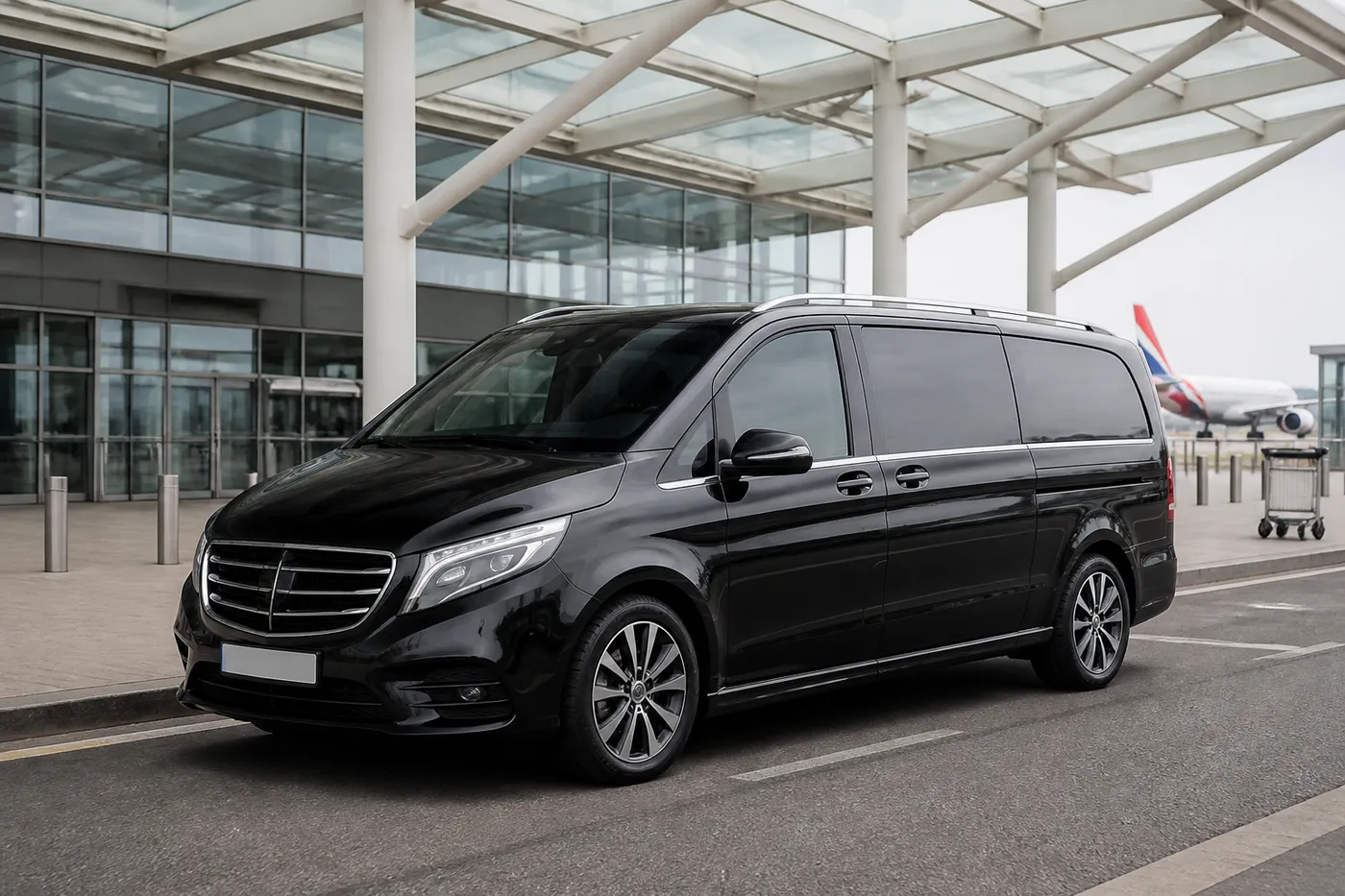
Six passengers and six large cases is a harder problem than six passengers
The combinations that work, the ones that do not, and why the rear row of a people carrier is where the luggage was going to go. Six seats is easy. Almost every people carrier in the country has six seats, and a booking for six passengers is one of the simplest we take. Six seats and six large suitcases is a different problem entirely, and it is one that people discover at an airport because the booking form asked for the passenger count first and the luggage second. The reason is geometric rather than commercial. In a people carrier the space behind the rear row is where four large cases go, and once six people are sitting down there is no other space. What follows is which combinations actually work, in vehicles and in numbers, and what the alternatives cost.
Category
Fleet
Published
28 October 2025
Sections
7 sections
Category
Fleet
Reading time
6 minutes
Published
28 October 2025
Sections
7 sections
01/The short version
Six passengers and six large cases is a harder problem than six passengers
Six seats is easy. Almost every people carrier in the country has six seats, and a booking for six passengers is one of the simplest we take. Six seats and six large suitcases is a different problem entirely, and it is one that people discover at an airport because the booking form asked for the passenger count first and the luggage second.
The reason is geometric rather than commercial. In a people carrier the space behind the rear row is where four large cases go, and once six people are sitting down there is no other space. What follows is which combinations actually work, in vehicles and in numbers, and what the alternatives cost.
GD-01/The V-Class ceiling, stated plainly
The V-Class ceiling, stated plainly
Six passengers and four large cases. That is the working limit with every seat occupied, and it is a genuine limit rather than a conservative one. Add two more cases and there is nowhere for them: the aisle is not a load space, the front passenger seat is not a load space, and a case on somebody knees for an hour is not an answer.
With one row folded or removed the picture changes completely: three or four passengers and eight or more large cases, or skis, or a boxed bicycle. That is often the useful configuration for a family, because the third row was never going to be used and the boot doubles.
Six passengers, four large cases: fine
Six passengers, six large cases: does not fit
Four passengers, one row folded: eight cases or more
The aisle and the front seat are not load space
GD-02/What two saloons actually carry
What two saloons actually carry
Two E-Class cars carry six people, four large cases and a good deal of soft luggage, and cost appreciably more than a single V-Class. So for the two extra cases you are paying a premium and losing the ability for the group to talk to each other, which is a real trade rather than an obvious win.
Where the two-car answer becomes clearly better is at seven or eight cases, or where the load includes something long. Two boots is more usable than one large one for awkward items, because you can put the clubs in one and the cases in the other rather than trying to make them coexist.
GD-03/The Sprinter, and what the step up buys
The Sprinter, and what the step up buys
A luxury Sprinter is the most expensive vehicle here on a Heathrow run, and it carries a longer minimum block on as-directed work. It carries six people and their luggage without any difficulty at all, and it carries twelve people and their luggage, which is really what it is for. At six passengers it is an expensive way to solve a luggage problem.
The case for it at six is a long journey where the group must stay together and the load is genuinely large: a ski party, a shooting party, a family moving a student into a university. On that journey it is the only single vehicle that works, and the price is what it is.
GD-04/The trailer question
The trailer question
A luggage trailer behind a people carrier is a real option and it is used for exactly this problem in the airport trade. It solves the volume completely and it costs less than a second vehicle. It also changes the driving: manoeuvring, parking and reversing all become harder, some car parks are impractical, and a trailer at a busy terminal drop-off is a slow operation.
We would use one for a group with a fixed route and a lot of luggage, and we would not use one for a day with several stops in central London. It is a specific tool for a specific job rather than a general answer.
GD-05/The combinations that do not work
The combinations that do not work
Six people and six large cases in a V-Class. Four people and a set of skis in any saloon. Six people and a boxed bicycle in anything other than a Sprinter or a V-Class with a row out. Eight people in a V-Class, whatever the seat count says on paper for the passenger version.
The other one worth naming is six people and six cases in two saloons where one of the cases is oversized. Two boots is more capacity than one, but neither boot is any longer than a saloon boot, so a ski bag or a golf travel case still will not go in. Volume and shape are different problems and only the shape problem needs a bigger vehicle rather than more vehicles.
When one of these arrives at a kerb the honest answer is a second vehicle within the hour at a second fare, or leaving something behind. Neither is a good evening, and both are prevented by describing the load rather than counting the bags.
GD-06/How to work out what you need
How to work out what you need
Count large cases first. Add one for every folded buggy, one for every car seat travelling as luggage, and one for every four winter coats. Then count passengers. If large cases plus passengers exceeds ten, you are outside a single V-Class and into two vehicles or a Sprinter.
That is a crude rule and it is right most of the time. Where it is marginal, describe the load in a sentence and let us make the call, because we load these vehicles daily and the answer is usually obvious to somebody who does. The one thing not to do is decide optimistically and find out at a terminal.
Large cases plus passengers over ten: two vehicles or a Sprinter
A folded buggy or a spare car seat counts as a large case
Four winter coats count as one more
Describe the load in a sentence rather than counting bags
GD-07/What we would book for the common cases
What we would book for the common cases
A family of five returning from a fortnight abroad: V-Class, and the third row folded if only five are travelling. Six colleagues with hand luggage: V-Class comfortably. Six people arriving from a cruise: two saloons, because cruise luggage is heavier and bulkier than air luggage and four cases will not cover it.
A ski party of six: a Sprinter, or two V-Class if the group can split. A golf four: an E-Class will not do it, a V-Class will, and two saloons is often the most comfortable answer because the clubs get a boot of their own. Those five cover the great majority of six-passenger enquiries we see.
02/If you read nothing else
The points that matter most
01
The V-Class ceiling, stated plainly
Six passengers and four large cases.
02
What two saloons actually carry
Two E-Class cars carry six people, four large cases and a good deal of soft luggage, and cost appreciably more than a single V-Class.
03
The Sprinter, and what the step up buys
A luxury Sprinter is the most expensive vehicle here on a Heathrow run, and it carries a longer minimum block on as-directed work.
04
The trailer question
A luggage trailer behind a people carrier is a real option and it is used for exactly this problem in the airport trade.
05
The combinations that do not work
Six people and six large cases in a V-Class.
06
How to work out what you need
Count large cases first.
03/Where this leads
Pages worth opening next
Each of these covers a part of this guide in more depth, on the page that owns it.
The same answers we would give on the phone, written down.
Will six people and six large suitcases fit in a V-Class?
+
No. Six passengers and four large cases is the working limit with every seat occupied, and the space behind the rear row is where those four go. There is no other load space: the aisle is not one, the front passenger seat is not one, and a case on somebody knees is not an answer for an hour.
What is the cheapest way to move six people and six cases?
+
Two E-Class cars from Heathrow cost a third of what a Sprinter does. You lose the ability for the group to talk to each other and you gain two boots, which is more usable than one large one for awkward items. A luggage trailer behind a people carrier is the other option and it suits a fixed route rather than a day of stops.
When is a Sprinter worth it for only six people?
+
When the journey is long, the group must stay together, and the load is genuinely large: a ski party, a shooting party, a family moving somebody into university. On those it is the only single vehicle that works. For six people with normal luggage on a short transfer it is an expensive way to solve the problem.
How do I work out whether my group needs two vehicles?
+
Count large cases, add one for every folded buggy, spare car seat and four winter coats, then add the passenger count. If the total exceeds ten you are outside a single V-Class. It is crude and it is right most of the time. Where it is marginal, describe the load and we will make the call.
Tell us the journey. We will send the price in writing.
Message us the date, the pick-up and where you are going. You will get a fixed written quotation with the vehicle, the chauffeur’s arrival time and what the figure includes — no form to fill in, and no estimate that moves later.