Boot volume is the wrong number. What decides capacity is the shape of the opening, the height of the parcel shelf and the order things go in. Manufacturers publish boot capacity in litres, which is a measurement taken by filling the space with small blocks. It tells you almost nothing useful, because suitcases are large rigid rectangles and the number that matters is whether one will go through the opening and lie flat once it is in. A boot of 540 litres with a narrow aperture holds less real luggage than one of 480 litres with a wide one. What follows is the practical version, worked out by people who load these cars several times a day. It covers what a case actually measures, why the same boot takes three of one size and two of another, and the loading order that produces more space than any amount of pushing.
Category
Fleet
Published
15 April 2025
Sections
7 sections
Category
Fleet
Reading time
6 minutes
Published
15 April 2025
Sections
7 sections
01/The short version
How much luggage a boot really takes
Manufacturers publish boot capacity in litres, which is a measurement taken by filling the space with small blocks. It tells you almost nothing useful, because suitcases are large rigid rectangles and the number that matters is whether one will go through the opening and lie flat once it is in. A boot of 540 litres with a narrow aperture holds less real luggage than one of 480 litres with a wide one.
What follows is the practical version, worked out by people who load these cars several times a day. It covers what a case actually measures, why the same boot takes three of one size and two of another, and the loading order that produces more space than any amount of pushing.
GD-01/What a suitcase actually measures
What a suitcase actually measures
The sizes people quote are the ones printed on luggage: a 29 or 30-inch case is the large one that goes in the hold on a long trip, roughly 75 to 80 centimetres tall including its wheels, and around 50 wide and 32 deep. A 26 or 27-inch case is the medium, about 68 centimetres. A cabin bag is 55 by 40 by 20 or thereabouts.
The dimension that causes trouble is the depth, because a large case is over thirty centimetres thick and a saloon boot is not tall. Two large cases lie flat side by side in an E-Class. A third has to go on top, which is where the parcel shelf and the closing line of the boot lid decide whether it happens.
Large: about 78cm tall, 50 wide, 32 deep with wheels
Medium: about 68cm tall, and noticeably easier to stack
Cabin: 55 by 40 by 20, and it fills gaps rather than making them
The depth is what stops you, not the height
GD-02/The aperture, not the volume
The aperture, not the volume
A saloon boot opening is a rectangle roughly a metre wide and forty centimetres tall, and everything has to pass through it lying down. That is why a boot with a large published volume can still refuse a third case: the space is there, at the back, and there is no way to get a rigid object into it once two are already lying flat.
Estates and people carriers have a tailgate rather than a lid, which changes the geometry completely. The opening is the full height of the load space, so cases can be stood upright and stacked, and the same volume takes half again as much. It is the single biggest difference between vehicle types and it never appears in a brochure comparison.
GD-03/What each of ours takes, in cases
What each of ours takes, in cases
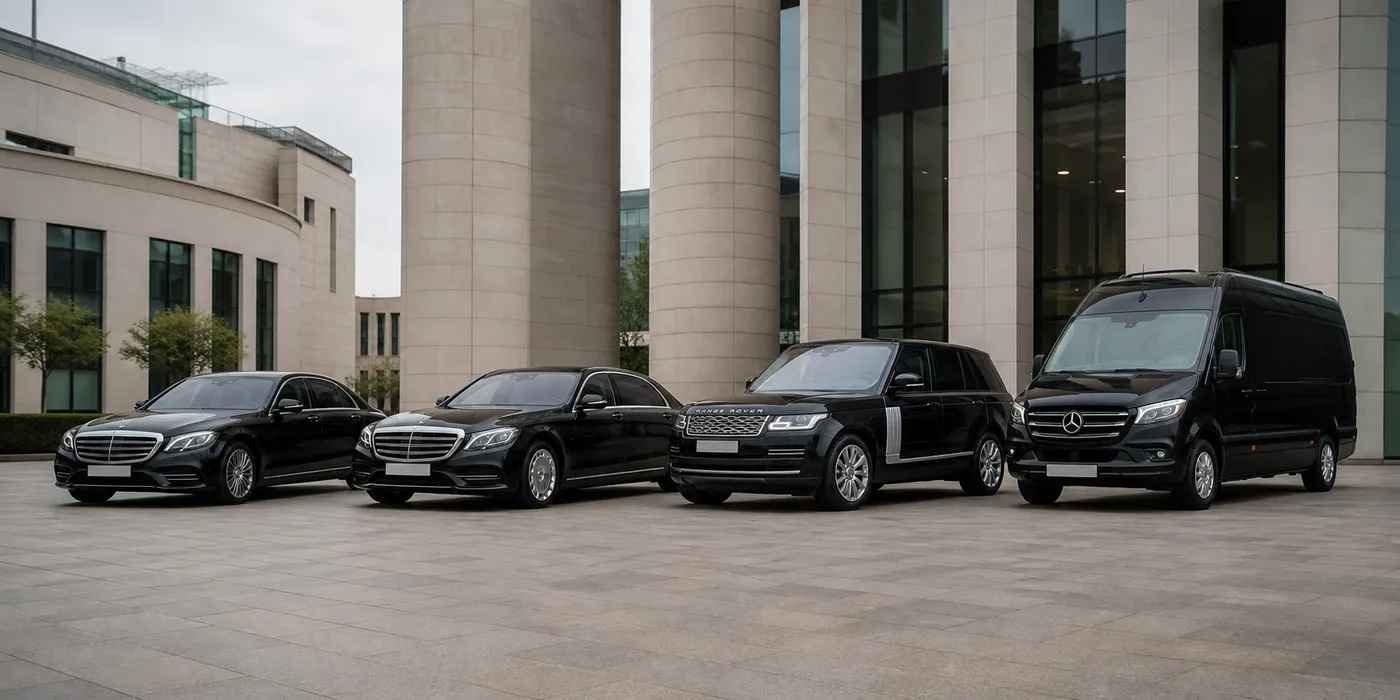
E-Class: two large plus two cabin, or three large with nothing else. S-Class and i7: much the same, and the i7 slightly less because the battery packaging raises the floor. Range Rover: three large at a squeeze, which surprises people who expect an SUV to swallow anything. Defender 110: more than the Range Rover, because the shape is squarer.
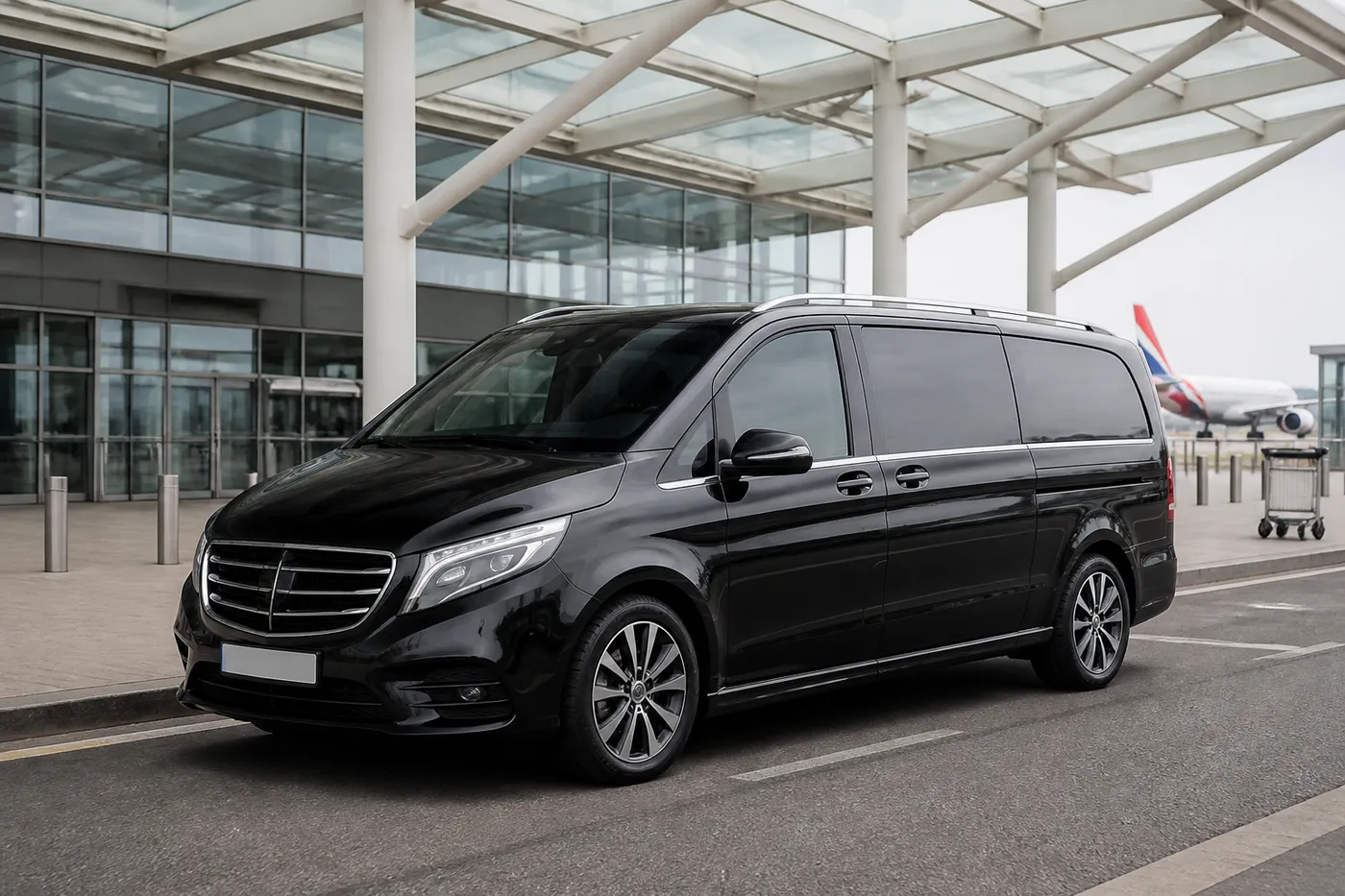
V-Class: four large behind the rear row with six seats occupied, and eight or more with a row folded. Maybach and Ghost: two large plus soft bags, because both prioritise rear cabin length over load space. Phantom: two large, and it is not the car you would choose for a luggage problem. Luxury Sprinter: everything, within reason.
GD-04/Loading order, which is most of the trick
Loading order, which is most of the trick
Long and rigid goes in first, lying along the length of the space. Large hard cases go in flat, wheels towards the opening, largest at the back. Soft bags fill the corners afterwards, and anything fragile goes on top rather than underneath. Doing it in that order gets roughly one more case into a saloon than doing it in the order the bags arrive on the trolley.
The consequence for the passenger is worth knowing: a properly loaded boot cannot be reorganised at a service station without unloading half of it. Anything you will want during the journey should stay in the cabin, and it is better to say so at the kerb than to discover it ninety miles later.
GD-05/The things that eat space invisibly
The things that eat space invisibly
Coats. Four winter coats occupy about the volume of a cabin bag and nobody counts them. Duty free, in a rigid bag that will not compress. A laptop rucksack per person. A folded buggy, which is a large case in a different shape. A car seat travelling as luggage, which is another one.
The other invisible one is the return leg of a holiday. Outbound luggage and inbound luggage are not the same volume, because things get bought, and a family who fitted into a vehicle comfortably on the way out will not necessarily fit on the way back. If you are booking both legs, size the return one.
GD-06/When more car does not mean more boot
When more car does not mean more boot
This is the part worth being blunt about. Upgrading from an E-Class to an S-Class costs more on a Heathrow transfer and buys you almost no extra luggage space; what it buys is rear legroom and a quieter cabin. Upgrading to a Maybach costs a great deal more again and buys considerably less boot than the E-Class you started with, because the extra length went into the rear seat.
The same is true of the Signature cars. A Phantom is nearly six metres long and takes two large cases, which is less than a family hatchback. If your problem is luggage, the answer is a V-Class or two cars, and no amount of spending on a more prestigious saloon will solve it.
The SUVs are the other misconception. A Range Rover looks like the answer to a luggage question and is not: the load space is tall but short, and it takes about what a big saloon does. Where it genuinely helps is with awkward shapes rather than with quantity.
A bigger saloon is not a bigger boot
The Maybach and Phantom take less than an E-Class
An SUV helps with shape, not with quantity
The people carrier is the only real answer to a volume problem
GD-07/What to do when it will not fit
What to do when it will not fit
The chauffeur will tell you at the car rather than force it, because a boot lid closed on a case damages both, and a bag on a rear seat beside a passenger is a genuine hazard under braking. From there the options are a second car, sending something separately, or leaving something behind, and none of them is a good option at a kerb.
The prevention is a sentence at booking describing the load rather than counting it. Ten seconds of accuracy at that point is worth an hour of improvisation at an airport, and it costs nothing at all to be honest about how much you are actually bringing.
02/If you read nothing else
The points that matter most
01
What a suitcase actually measures
The sizes people quote are the ones printed on luggage: a 29 or 30-inch case is the large one that goes in the hold on a long trip, roughly 75 to 80 centimetres tall including its wheels, and around 50 wide and 32 deep.
02
The aperture, not the volume
A saloon boot opening is a rectangle roughly a metre wide and forty centimetres tall, and everything has to pass through it lying down.
03
What each of ours takes, in cases
E-Class: two large plus two cabin, or three large with nothing else.
04
Loading order, which is most of the trick
Long and rigid goes in first, lying along the length of the space.
05
The things that eat space invisibly
Coats.
06
When more car does not mean more boot
This is the part worth being blunt about.
03/Where this leads
Pages worth opening next
Each of these covers a part of this guide in more depth, on the page that owns it.
The same answers we would give on the phone, written down.
Why does boot volume in litres not tell me how many cases will fit?
+
Because the number is measured by filling the space with small blocks, and suitcases are large rigid rectangles that have to pass through an opening. A saloon boot aperture is about a metre wide and forty centimetres tall, so a third large case often cannot be got into space that physically exists behind the first two.
Does a Maybach hold more luggage than an E-Class?
+
Less. The extra length in a Maybach went into the rear cabin rather than the boot, so it takes two large cases plus soft bags against the E-Class two large plus two cabin bags. If luggage is the constraint, spending more on a prestige saloon makes the problem slightly worse rather than better.
Why can the boot not be rearranged at a service station?
+
Because a properly loaded boot is packed in an order: long and rigid first, hard cases flat with wheels outward, soft bags in the corners. Getting to something in the middle means unloading most of it. Keep anything you will want during the journey in the cabin and say so at the kerb.
How much do coats and hand luggage really add?
+
More than anybody counts. Four winter coats are roughly a cabin bag of volume, and a laptop rucksack each is another. A family of four with four cases arrives with about a large case of extra soft luggage that appeared on no booking form, which is why describing the load beats counting the bags.
Tell us the journey. We will send the price in writing.
Message us the date, the pick-up and where you are going. You will get a fixed written quotation with the vehicle, the chauffeur’s arrival time and what the figure includes — no form to fill in, and no estimate that moves later.