Skip to content
FCFirst ClassCHAUFFEURS

LDLondon to Oxford

London to Oxford: an hour and twenty on the M40, then a city with bus gates

Sixty miles on one of the better motorways out of London, and then a city that has spent thirty years making itself difficult to drive into.

  • 60 miles
  • 1 hr 20 mins to 2 hrs
  • M40 · A40 · A34
  • Fixed price per journey
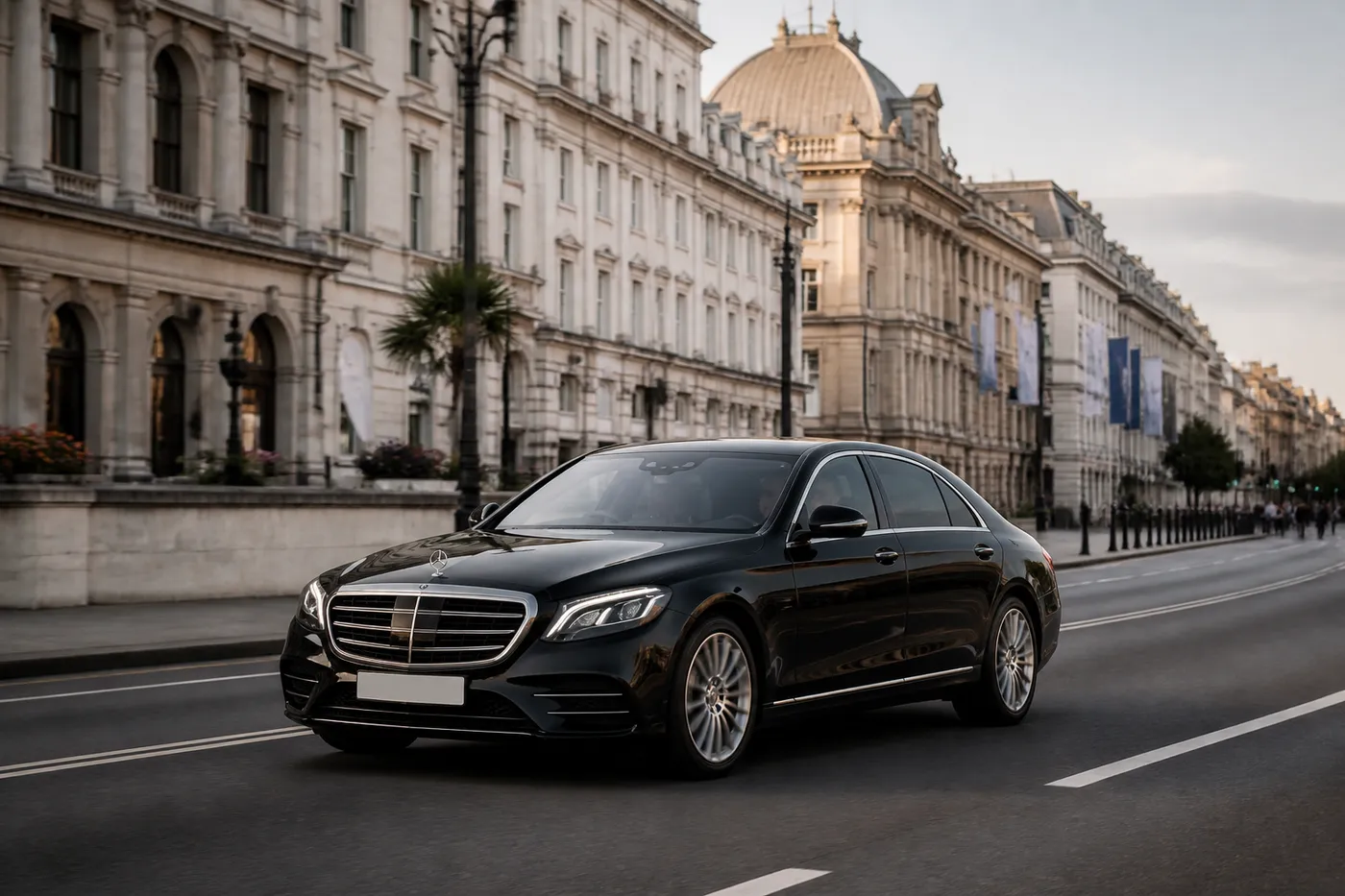
A chauffeur car on a dual carriageway approaching a city of spires

Written quotation, usually within the hour

London to Oxford by chauffeur: summary

London to Oxford is around sixty miles by the M40 to junction 8 and the A40, taking an hour and twenty minutes to two hours. First Class Chauffeurs drives the route without a stop and sets down at the edge of the city centre, since bus gates and restricted streets keep private cars out of much of the middle. Trains from Paddington and Marylebone take about an hour. The car suits luggage, groups, college and school runs, and destinations across Oxfordshire and the Cotswold edge where the railway does not reach. Rates are guide figures.

Distance

About 60 miles

Driving time

1 hr 20 to 2 hrs

Main roads

M40, A40

Junction

M40 junction 8

01Overview

The London to Oxford run, in plain figures

The M40 to junction 8 and then the A40 is the whole route, and outside the peaks it takes an hour and twenty minutes. It is one of the most consistent short runs from London, largely because the M40 carries less traffic than the M1, M4 or M25 and has fewer places to go wrong.

Oxford itself is the interesting part. The city has bus gates on several central streets that private vehicles cannot pass, a ring road that is the practical way round, and five park-and-ride sites on the approaches. A car can get you to the edge of the centre quickly and no further, which for most journeys is exactly what is wanted.

02At a glance

London to Oxford in four figures

Distance
About 60 miles
Driving time
1 hr 20 to 2 hrs
Main roads
M40, A40
Junction
M40 junction 8

03The roads

Which roads a London to Oxford journey actually uses

Leg by leg, with what each stretch is like rather than only what it is called.
M40, junctions 1 to 4
The London end, out past Denham, Beaconsfield and High Wycombe. This is where the time varies, and where a departure at eight rather than seven costs half an hour.
M40, junctions 4 to 8
Through the Chilterns, over the Stokenchurch gap and down the escarpment into Oxfordshire. The view as the road drops is the best thing about any motorway within an hour of London.
A40 into Oxford
Six miles from junction 8 into the eastern edge of the city past Headington. Busy at both peaks and the only real bottleneck on the route.
The ring road and the A34
For north Oxford, Summertown or anywhere on the western side, the ring road and the A34 are the way round rather than through. Crossing the centre is not an option a car has.
  • M40
  • A40
  • A34
  • A420

04The stops

Where a London to Oxford run realistically breaks

Placed where the driver can also read the road ahead, not only where the coffee is.

Break

None, normally

At under ninety minutes this is a run that does not need a break, and passengers rarely want one. Where a stop is wanted, Beaconsfield services at junction 2 is the only sensible option and it is very early in the journey.

Break

Oxford Services, M40 junction 8A

Right at the end of the motorway section, five minutes before the A40 turn. Useful for a passenger who wants to arrive tidy rather than for a break, and it is the last place to stop before the city traffic.

05In detail

What decides a London to Oxford journey time

The M40 is the good one

LD-01The M40 is the good one

The M40 is the good one

Of the motorways leaving London, the M40 is the least troublesome. It carries less freight than the M1, it does not serve an airport like the M4, and the Chiltern section through the Stokenchurch cutting is genuinely pleasant to drive.

The consequence is a narrower time range than any comparable route. An hour and twenty is realistic most of the day, and two hours is the worst it does short of an incident. That reliability makes it a good choice when there is a fixed appointment at the far end.

Bus gates, and what they mean for a drop

LD-02Bus gates, and what they mean for a drop

Bus gates, and what they mean for a drop

Several streets in central Oxford are closed to private cars by bus gates, enforced by camera, and the arrangement has been extended over time. A driver who does not know where they are will collect a penalty and a passenger will get a long walk.

What works is a set-down at a known point on the edge of the centre and a short walk in. St Giles, the top of the High and the area near the station all serve different parts of the city, and the choice depends on which college or building you are heading for.

The start and end of term

LD-03The start and end of term

The start and end of term

Two weekends a term, Oxford fills with families delivering or collecting students and a great deal of luggage. It is one of the busiest recurring patterns in our Oxfordshire work and it is entirely predictable.

A saloon takes one student and their term’s belongings at a squeeze. Two students, or one with a bicycle, needs the V-Class. The colleges have their own arrangements for vehicle access on move-in days and they are worth checking, because they change.

06Against the railway

Should you be driven london to oxford at all?

The comparison most chauffeur companies leave out, written the way we would answer it on the telephone.

Paddington and Marylebone both run to Oxford in about an hour, which for one person with a bag is quicker than the road and considerably cheaper. There is no argument against it for a straightforward city-centre trip. The car earns its place on three grounds. Luggage, which matters enormously at the start and end of university terms. Destinations off the line, which in Oxfordshire means most of the county: Woodstock, Burford, Henley, Thame, Chipping Norton and every school and country house between them. And journeys with several stops in a day, which a car handles without a timetable.

07Further detail

Planning a London to Oxford day properly

The county beyond the city

LD-04The county beyond the city

The county beyond the city

Oxfordshire spreads a long way from its station. Woodstock and Blenheim are eight miles north on the A44, Burford is on the Cotswold edge twenty miles west, Henley sits on the Thames to the south-east and Bicester is up the A34.

None of those are reachable from Oxford station without a further journey, and several of the schools and country houses in the county are a genuine taxi ride from anywhere. That is the part of this route where the car is not a preference.

Oxford Parkway and the park-and-ride

LD-05Oxford Parkway and the park-and-ride

Oxford Parkway and the park-and-ride

The city has five park-and-ride sites on its approaches and a second station at Oxford Parkway to the north, which serves the Marylebone line and sits beside the ring road.

For some journeys, particularly during term or on a match day at Twickenham weekend, being driven to Parkway rather than into the middle is quicker and less bother. We would rather suggest that than deliver you into a queue on the Banbury Road.

08The cars

Vehicles used on the London to Oxford run

On a journey of this length the boot and the rear cabin matter more than anything on the specification sheet.

First Saloon

Mercedes-Benz S-Class

3 passengers · 3 cases

Passengers
Up to 3
Large cases
3, plus cabin bags
Cabin class
First Saloon

Cabin

Mercedes-Benz E-Class

3 passengers · 2 cases

Passengers
Up to 3
Large cases
2, plus cabin bags
Cabin class
Cabin

Cabin MPV

Mercedes-Benz V-Class

7 passengers · 5 cases

Passengers
Up to 7
Large cases
5, plus cabin bags
Cabin class
Cabin MPV

09What it costs

Pricing London to Oxford

Long-distance journeys are quoted as a single fixed figure covering the whole movement rather than charged by the hour. That matters on a road where an accident can add ninety minutes: the price agreed in the morning is the price at the end, and nobody in the back is watching a meter while the motorway sits still.

The hourly figures shown above and on the pricing page are there for comparison rather than as the basis for this journey. Where a run needs an overnight for the chauffeur or two drivers, the quotation says which applies before anybody sets off.

10Worth knowing

Departure times and the London to Oxford return leg

A morning meeting and back by lunch

LD-06A morning meeting and back by lunch

A morning meeting and back by lunch

At under ninety minutes each way, Oxford is one of the few destinations outside London where a morning appointment and a return for lunch is genuinely comfortable. A seven o clock departure has you there for half past eight.

The car waits during the meeting rather than making two separate journeys, which for a three-hour visit is both cheaper and considerably less trouble than booking a transfer in each direction.

Combining Oxford with the Cotswolds

LD-07Combining Oxford with the Cotswolds

Combining Oxford with the Cotswolds

Burford sits twenty minutes west of the city on the A40 and is the eastern gateway to the Cotswolds, which makes it easy to add an afternoon in the villages to a morning in Oxford.

It is one of the more satisfying day arrangements we run: colleges and the Bodleian before lunch, then honey-coloured stone and lanes afterwards, and home on the M40 in an hour and a half from Burford.

15Answers

London to Oxford: the questions we get

Times, stops, the train, and what a fixed price actually covers.

How long does it take to drive from London to Oxford?

An hour and twenty minutes off-peak and up to two hours in traffic, for around sixty miles on the M40. It is one of the more predictable short runs from London because the M40 carries less traffic than the alternatives and has few places to go wrong.

Can the car take us into the centre of Oxford?

To the edge of it. Several central streets have bus gates that private vehicles cannot pass, enforced by camera. We set down at a point chosen for your destination — St Giles, the top of the High or near the station — and the walk from any of them is a few minutes.

Is the train not quicker?

For one person with a small bag, yes: about an hour from Paddington or Marylebone. The car is the better answer for luggage, for groups, for anywhere in the county away from the line — Woodstock, Burford, Henley, Thame — and for a day with several appointments in it.

Do you handle university term start and end?

Regularly, and it is one of the busiest patterns in our Oxfordshire work. A student with a full term’s belongings needs more room than people expect; one student fills a saloon and two need the V-Class. College vehicle access on move-in days has its own rules, which we check beforehand.

Can you wait during a meeting rather than making two trips?

Yes, and for anything under about four hours it is the sensible arrangement. Two separate transfers means the car drives back to London and returns, which costs more and is far less flexible if the meeting overruns. Hourly hire covers the whole visit.

FCReservations

Send us the two addresses and the day. We will price London to Oxford in writing.

Give us where you are starting, where you are going, the date and roughly what time you need to arrive. You will get a fixed written quotation for the whole journey — and, if the train would serve you better that day, we will say so before you book.

Hours
Reservations answered around the clock, every day of the year.
CallGet a quote