Skip to content
FCFirst ClassCHAUFFEURS

LDLondon to Bath

London to Bath, off at junction 18 and down the A46

A hundred and fifteen miles of the M4 and then ten miles of A road down into a bowl in the hills. The last ten are prettier and slower than the first hundred and five.

  • 115 miles
  • 2 hrs 15 mins to 3 hrs
  • M4 · A46 · A4
  • Fixed price per journey
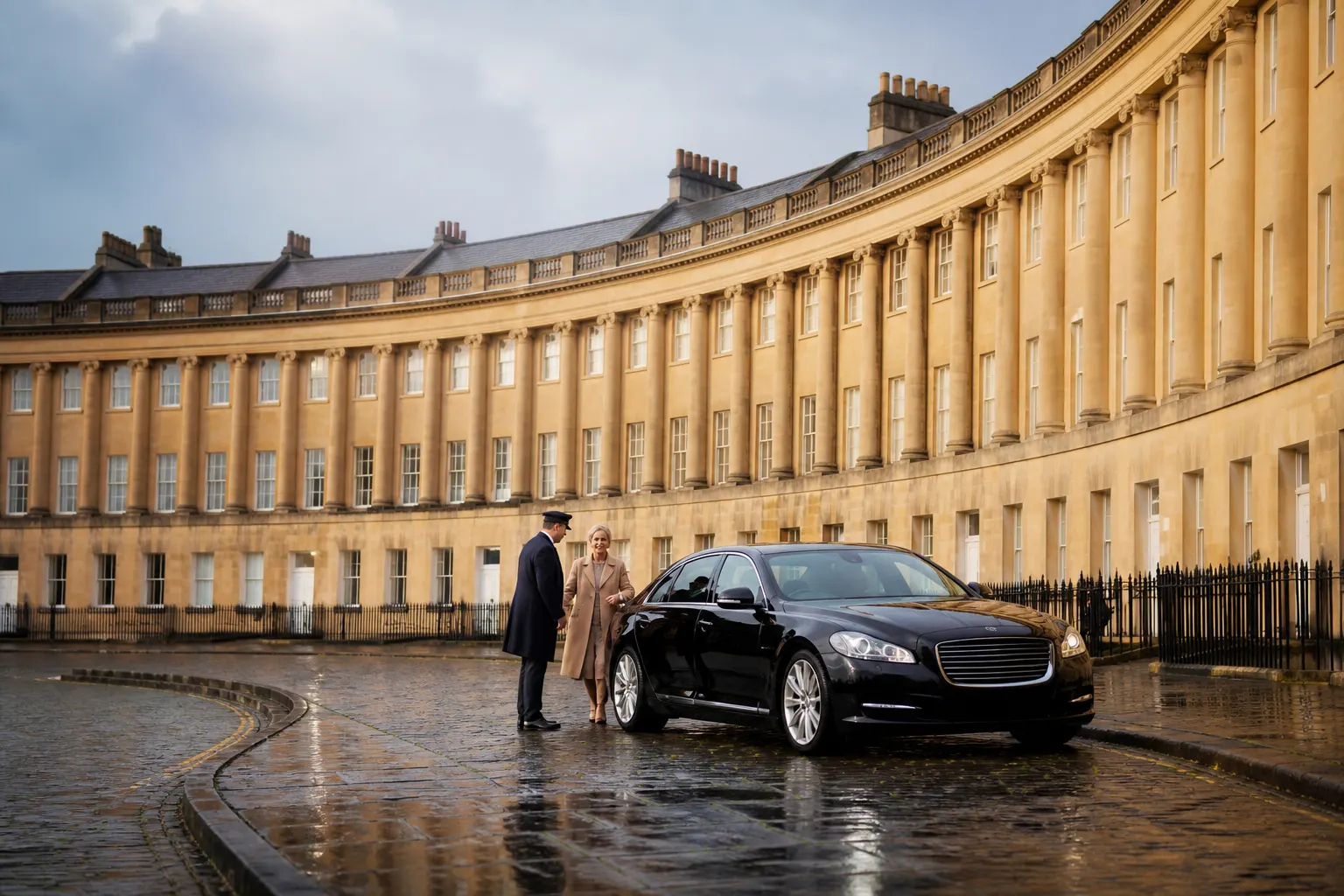
A chauffeur car on a Georgian street of honey-coloured stone buildings

Written quotation, usually within the hour

London to Bath by chauffeur: summary

London to Bath is around a hundred and fifteen miles on the M4, leaving at junction 18 for the A46 down into the city, and takes two and a quarter to three hours. First Class Chauffeurs drives the route without a stop and sets down at the edge of the compact Georgian centre, which has narrow streets, steep gradients and a charging zone covering several vehicle categories. Trains from Paddington reach Bath Spa in about an hour and twenty-five minutes. The car suits luggage, groups and destinations across Wiltshire and Somerset. Rates are guide figures.

Distance

About 115 miles

Driving time

2 hrs 15 to 3 hrs

Main roads

M4, A46

Junction

M4 junction 18

01Overview

The London to Bath run, in plain figures

Junction 18 of the M4 sits above Tormarton on the Cotswold edge, and the A46 runs south from there down into Bath through Cold Ashton and Swainswick. It is a good road and a busy one, and it drops into the city from the north with the whole Georgian bowl laid out below.

Two and a quarter hours is a clean run. Three is what the M4 through Reading costs at the wrong hour. Once you arrive, Bath asks the same question every historic city asks: the centre is compact, the streets are eighteenth-century, and a car is welcome only at the edges.

02At a glance

London to Bath in four figures

Distance
About 115 miles
Driving time
2 hrs 15 to 3 hrs
Main roads
M4, A46
Junction
M4 junction 18

03The roads

Which roads a London to Bath journey actually uses

Leg by leg, with what each stretch is like rather than only what it is called.
M4, junctions 1 to 12
The London end past Heathrow, Slough and Reading. Slow between seven and ten and after four, and responsible for most of the difference between a good run and a bad one.
M4, junctions 12 to 17
Across the Berkshire and Wiltshire downs past Newbury and Swindon. Open, quick and reliable, with Membury and Leigh Delamere for a break if one is wanted.
M4 junction 18 and the A46
Ten miles south from the Cotswold edge down into the city. Single carriageway for most of it, busy with local traffic, and slower than the mileage suggests.
The approach into Bath
Down through Swainswick and Larkhall into the northern side of the city. The A4 London Road is the way in; the centre beyond it is narrow, one-way in places and steep everywhere.
A36 and A4 for the wider area
For Bradford-on-Avon, Trowbridge and Wiltshire the A36 runs south-east; for Bristol the A4 runs west. Neither goes through the middle of the city, which is the point.
  • M4
  • A46
  • A4
  • A36

04The stops

Where a London to Bath run realistically breaks

Placed where the driver can also read the road ahead, not only where the coffee is.

Break

Membury, M4 junctions 14 to 15

An hour and a quarter out of London and past halfway. Most passengers on a two-and-a-quarter hour run would rather not stop at all, but it is the right place if the day started early.

Break

Leigh Delamere, M4 junctions 17 to 18

An hour and three quarters out with around half an hour left. It sits immediately before the junction 18 turn, which makes it the last easy stop before the A46 and the city.

05In detail

What decides a London to Bath journey time

The last ten miles are the interesting ones

LD-01The last ten miles are the interesting ones

The last ten miles are the interesting ones

The M4 does its job for a hundred and five miles and then hands you to the A46, which runs down off the Cotswold escarpment through Cold Ashton and Swainswick into the valley. It is single carriageway, it carries local traffic, and it takes twenty minutes to cover ten miles.

It is also the best part of the journey. The descent into Bath from the north gives you the whole city at once, honey-coloured and laid out in a bowl, which is the arrival the railway does not offer.
A city that goes uphill

LD-02A city that goes uphill

A city that goes uphill

Bath is built on the sides of a valley, and the difference in height between the river and the Royal Crescent is considerable. Everything looks close together on a map and a good deal of it involves a climb.

That matters for where a car stops. A set-down at the bottom near the Abbey is fine if you are visiting the Baths; it is a twenty-minute uphill walk if your hotel is on Lansdown Road. We ask for the address and choose the drop accordingly.

The charging zone, and being straight about it

LD-03The charging zone, and being straight about it

The charging zone, and being straight about it

Bath operates a charging zone in the city centre that covers several categories of vehicle. The details have been adjusted since it was introduced and we would rather check what currently applies than quote a figure from memory and be wrong.

Whatever it comes to appears in the written quotation before you travel. That is the only defensible way to handle a charge a passenger cannot verify from the back seat, and it is how we treat every scheme of this kind.

06Against the railway

Should you be driven london to bath at all?

The comparison most chauffeur companies leave out, written the way we would answer it on the telephone.

Paddington to Bath Spa takes about an hour and twenty-five minutes and the station is at the bottom of the city, five minutes from the Abbey and the Roman Baths. For a single traveller it is faster and cheaper than the road and we would not pretend otherwise. Where the car changes things is the topography and the county. Bath climbs steeply from the river to the Royal Crescent and Lansdown, and a hotel on the upper slopes is a serious walk from the station. Beyond the city, Castle Combe, Lacock, Bradford-on-Avon, Longleat and the whole of north Wiltshire are effectively unreachable by rail.

07Further detail

Planning a London to Bath day properly

North Wiltshire, which has no railway worth the name

LD-04North Wiltshire, which has no railway worth the name

North Wiltshire, which has no railway worth the name

Castle Combe, Lacock, Corsham and Bradford-on-Avon are all within half an hour of Bath and none of them are meaningfully served by rail. The same is true of Longleat, of the villages along the By Brook, and of a great many country houses in between.

For a weekend based in Bath with a day out into the county, the car is what makes the second half possible. It is also why a good proportion of our Bath work is a day rate rather than a transfer.

Stonehenge is closer from here than from London

LD-05Stonehenge is closer from here than from London

Stonehenge is closer from here than from London

The stones sit about forty miles south-east of Bath, an hour by the A36 and A303 or across the plain by Warminster. From London it is two hours, which is why our combined Bath and Stonehenge tour runs the day in that order.

For anyone spending a night in Bath, a morning at Stonehenge and an afternoon back in the city is a considerably more relaxed arrangement than the single-day version from London, which is twelve hours of work for the same two visits.

08The cars

Vehicles used on the London to Bath run

On a journey of this length the boot and the rear cabin matter more than anything on the specification sheet.

First Saloon

Mercedes-Benz S-Class

3 passengers · 3 cases

Passengers
Up to 3
Large cases
3, plus cabin bags
Cabin class
First Saloon

Cabin MPV

Mercedes-Benz V-Class

7 passengers · 5 cases

Passengers
Up to 7
Large cases
5, plus cabin bags
Cabin class
Cabin MPV

First SUV

Range Rover Autobiography

4 passengers · 4 cases

Passengers
Up to 4
Large cases
4, plus cabin bags
Cabin class
First SUV

09What it costs

Pricing London to Bath

Long-distance journeys are quoted as a single fixed figure covering the whole movement rather than charged by the hour. That matters on a road where an accident can add ninety minutes: the price agreed in the morning is the price at the end, and nobody in the back is watching a meter while the motorway sits still.

The hourly figures shown above and on the pricing page are there for comparison rather than as the basis for this journey. Where a run needs an overnight for the chauffeur or two drivers, the quotation says which applies before anybody sets off.

10Worth knowing

Departure times and the London to Bath return leg

Weekends, and when to leave

LD-06Weekends, and when to leave

Weekends, and when to leave

Bath fills at weekends and so does the A46. Friday afternoons westbound and Sunday afternoons eastbound are the two periods to avoid, and both can add an hour to a journey that ought to take two and a quarter.

Leaving London on a Friday before eleven, or after seven, makes a substantial difference. Coming back on a Sunday, before two or after eight. It is the same advice as every westbound route from London and it is worth repeating because so few people act on it.

Bath and Bristol in one arrangement

LD-07Bath and Bristol in one arrangement

Bath and Bristol in one arrangement

The two cities are twelve miles apart and share the same motorway exit pair, and a great many journeys take in both. Meetings in Bristol and a hotel in Bath is a common shape, and the car makes the daily hop trivial.

By rail it means changing stations and working to a timetable that does not much care about a six o clock finish. By road it is twenty-five minutes on the A4 or a little more on the ring road, and the same car handles it.

15Answers

London to Bath: the questions we get

Times, stops, the train, and what a fixed price actually covers.

How long does it take to drive from London to Bath?

Two and a quarter hours on a clear run and up to three in traffic, for around a hundred and fifteen miles. The M4 west of Reading is dependable; the last ten miles down the A46 from junction 18 are single carriageway and take twenty minutes on their own.

Is the train from Paddington quicker?

Yes, at about an hour and twenty-five minutes to Bath Spa, and the station is right in the centre. The car is the better choice for a hotel on the upper slopes, for luggage, for groups, and for anywhere in north Wiltshire — Castle Combe, Lacock, Longleat — which rail does not usefully reach.

Is there a charge for driving into Bath?

A city-centre charging zone applies to several categories of vehicle and the details have been adjusted since it began. We check what currently applies rather than quoting from memory, and whatever is payable appears in the written quotation before you travel.

Where does the car set down in Bath?

At a point chosen for your address rather than a general drop in the middle. The city climbs steeply from the river to the Royal Crescent, so a set-down near the Abbey that suits the Roman Baths can be a twenty-minute uphill walk from a hotel on Lansdown.

Can you combine Bath with Stonehenge?

Yes, and it works far better from Bath than from London. The stones are about an hour south-east by the A36 and A303. A morning at Stonehenge and an afternoon back in Bath is a comfortable day; the same two visits done from London and back is twelve hours.

FCReservations

Send us the two addresses and the day. We will price London to Bath in writing.

Give us where you are starting, where you are going, the date and roughly what time you need to arrive. You will get a fixed written quotation for the whole journey — and, if the train would serve you better that day, we will say so before you book.

Hours
Reservations answered around the clock, every day of the year.
CallGet a quote