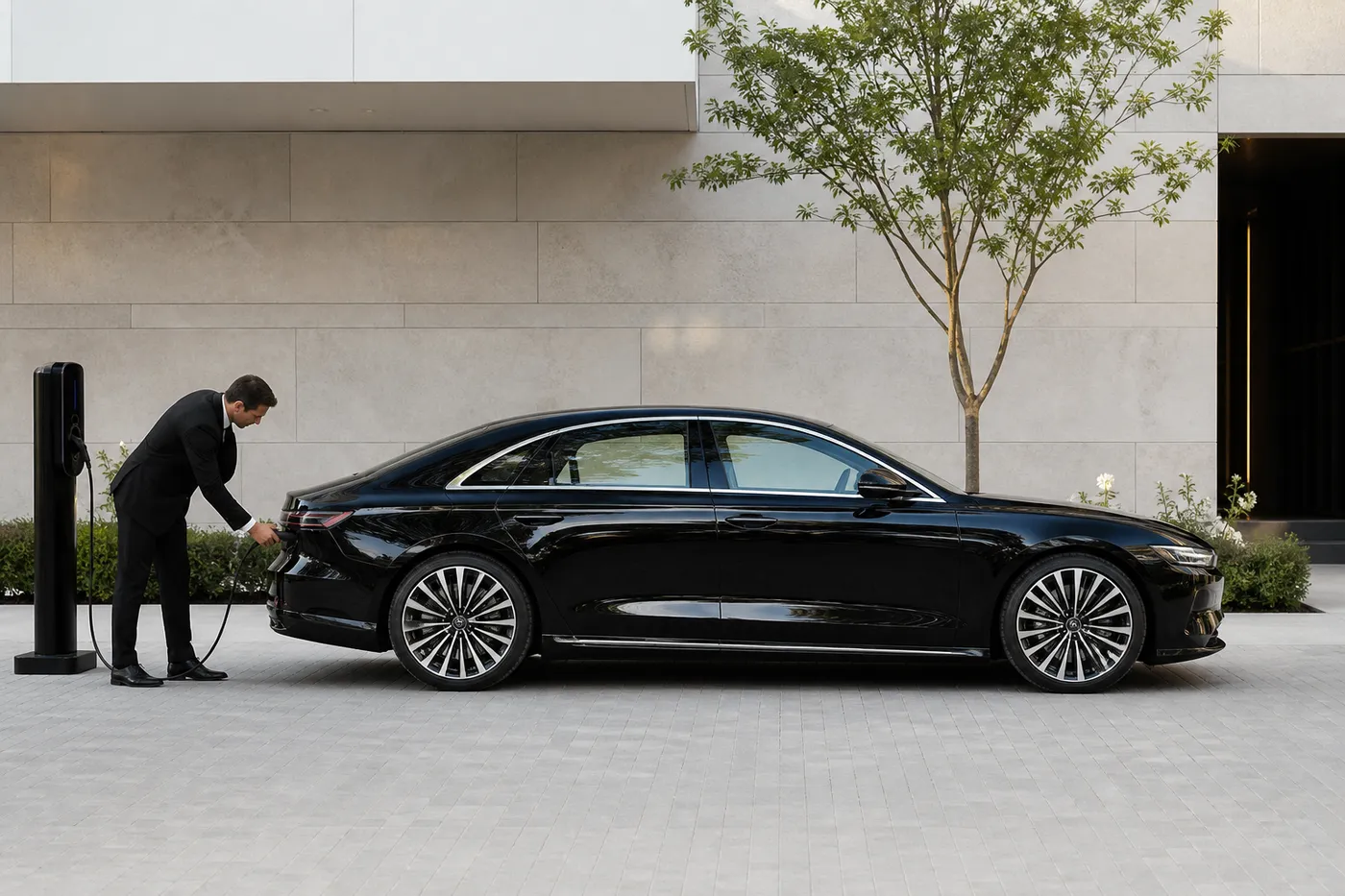
Long-term chauffeur hire from First Class Chauffeurs reserves one vehicle and a named chauffeur for a continuous period, most often from two weeks upwards. The car is taken out of general circulation for the duration, positioned overnight wherever the work requires, and driven to the client's own schedule rather than to a shared rota. A second chauffeur is briefed at the start so that rest days, leave and illness do not interrupt the arrangement, and driving hours are managed so no single chauffeur works beyond a safe day. The service is used for relocations, secondments, film and television production, long courses of medical treatment and extended visits to the United Kingdom. Terms, including the vehicle, the daily hours covered and the arrangements at the end of the period, are set out in a written quotation before the first day.
Minimum period
Two weeks in most cases
Vehicle
One car held for the whole booking
Chauffeur
Named, with a briefed second for cover
Overnight
Car positioned near the work, not returned to base
Coverage
Anywhere in the United Kingdom
Terms
Written, with extension and end arrangements stated
01/Overview
What this covers
Long-term hire takes the car out of general circulation. For the length of the booking it belongs to you, parked where you need it overnight, driven by a chauffeur who is on your schedule rather than on a rota. It is what relocations, film productions, long treatment courses and extended visits tend to need once the third week of separate bookings starts to grate.
Periods usually start at two weeks. Because the vehicle is held rather than shared, the arrangement is priced as a block for the period rather than as a run of unrelated day rates, and the quotation states the vehicle, the daily hours it covers, the cover arrangements and what happens at the end.
02/At a glance
The detail in brief
What a reservations clerk would tell you in the first thirty seconds of the call.
Minimum period
Two weeks in most cases
Vehicle
One car held for the whole booking
Chauffeur
Named, with a briefed second for cover
Overnight
Car positioned near the work, not returned to base
Coverage
Anywhere in the United Kingdom
Terms
Written, with extension and end arrangements stated
03/Included as standard
What long-term hire includes
01
A car reserved, not shared
The same vehicle for the whole period, so nothing has to be moved out of the boot on a Friday and back in on a Monday.
02
A chauffeur on your schedule
Daily hours set to the shape of the work rather than to a standard shift, with the start and finish agreed in advance.
03
Cover already briefed
A second chauffeur is introduced at the beginning of the booking and knows the routine before the day they are needed.
04
Overnight positioning
The car parks near the next morning's first job rather than driving home to London and back at dawn.
05
Servicing handled around you
Routine maintenance is scheduled into gaps in your week, with an equivalent car in place for the hours it takes.
06
One agreed rate
A figure for the period, with the treatment of additional hours and long-distance days written into the same document.
04/Who books it
Who asks for this
Four kinds of enquiry arrive for this work, and each wants something slightly different from it.
01
Relocations and secondments
Executives and families spending three months in the UK before the housing, schools and licences are settled.
02
Film and television production
Unit moves, cast collections and location days that run to a call sheet nobody sees more than a day ahead.
03
Extended medical treatment
Courses of treatment that run for weeks, where the same car and driver are part of what makes the routine bearable.
04
Long UK visits
Families and delegations in the country for a season who want ground travel settled once rather than arranged forty times.
05/How it works
From the first message to the last mile
The same sequence every time, so nobody is left guessing what happens next.
Step 01
Scope the period
Dates, likely daily hours, the area the work sits in and how much of it is long-distance. Precision helps; certainty is not required.
Step 02
Match car and chauffeur
One vehicle proposed against the load the work carries, and a chauffeur whose availability covers the period.
Step 03
Agree the terms in writing
Rate, hours, cover, overnight arrangements, extension and notice. All of it before the car turns up.
Step 04
Run it week by week
A rolling schedule confirmed each week rather than a fixed one written in month one and immediately out of date.
Step 05
Extend or close
Extensions are agreed on the same terms where the car is free. Endings are simply the last day on the schedule.
06/Detail
In detail
LF-01/What a long-term booking actually fixes
What a long-term booking actually fixes
Three separate problems disappear at once. The car stops being re-briefed every morning, the chauffeur stops being a stranger by the second week, and the administration of forty individual bookings collapses into one arrangement with a rolling schedule.
The second of those is the one clients mention afterwards. A driver who has been with a production or a family for a month knows which gate the crew actually uses, which supermarket car park has height clearance for the equipment case, and how long the run from the unit base to the location really takes at seven in the morning rather than what the map says.
There is a practical benefit too. Long bookings are easier to schedule than short ones, so the car available for a month is often a better car than the one available for a Tuesday.
07/Detail
Working the ground segment
LF-02/Weekly, monthly and the shape in between
Weekly, monthly and the shape in between
Two weeks is the usual starting point. Below that the arrangement behaves like a series of day bookings and is better quoted that way, because holding a car out of circulation for four days costs more than it saves.
Above two weeks the shape matters more than the length. A month of ten-hour days is a different arrangement from a month with three heavy days a week and four quiet ones, and both are different again from a month that is mostly standby with two long-distance runs in it. We quote against the shape rather than against a calendar.
Open-ended bookings are taken on a rolling basis with a stated notice period at each end. Nobody has to guess in January how long a project will still be running in April.
08/Detail
What to expect
LF-03/One car for the duration, and when to change it
One car for the duration, and when to change it
The vehicle assigned at the start stays for the period. That consistency is worth more than it sounds: the child seat stays fitted, the case that lives in the boot stays in the boot, and nobody has to work out where the charging cable went.
Cars are changed for two reasons. The first is servicing, which is scheduled into a gap in your week with an equivalent car standing in for the hours it takes. The second is that the work changed shape, which happens often enough that we do not treat the first choice as permanent.
A booking that starts as an S-Class and becomes a V-Class in week three because the passenger count doubled is a normal adjustment, priced on the new vehicle from the day it changes rather than backdated across the whole period.
09/Vehicles
The cars usually sent for this
Seats and cases for each car, taken from the vehicle itself. Nothing below is a class average.
No standing price list. Send the journey on WhatsApp and the written quotation confirms the price, what it includes and any applicable tax. Compare every vehicle if none of these is quite right.
10/Detail
Behind the booking
LF-04/Rest breaks, cover drivers and the law on hours
Rest breaks, cover drivers and the law on hours
A long booking is where driver hours stop being an abstraction. One chauffeur cannot work fourteen-hour days for a month, and a company that tells you otherwise is either not doing it or not doing it safely. We build the cover into the arrangement at the beginning, not when somebody is exhausted in week three.
In practice that means a named second chauffeur introduced early, at least one full day off in each week, and a plan for the days the schedule runs long at both ends. On production work, where call times move nightly, the cover chauffeur often takes the early starts so the primary can take the late finishes.
Where the work genuinely runs around the clock, the honest answer is two chauffeurs from day one. It costs more and it is the only version that works past the first fortnight.
11/Detail
On the day
LF-05/Relocations, secondments and production runs
Relocations, secondments and production runs
The three biggest sources of long-term work all share a shape: an intense period in an unfamiliar place with no settled transport at either end. A family arriving from Singapore in September has no car, no licence exchange, no idea which route to the school works and no wish to buy a vehicle in the first month.
Production work has a different rhythm again, driven by call sheets that arrive the night before. The car has to be at a unit base at five, then hold, then move a cast member across a county at four in the afternoon on an hour's notice. Long-term hire is the only structure that absorbs that without a fresh booking every day.
Corporate secondments sit between the two. Predictable working days, unpredictable evenings, and a period long enough that the same chauffeur becomes part of how the week runs.
12/Coverage
Where we drive
London based, driving the whole of the United Kingdom. Pick a region for the towns inside it, or a terminal to see where the chauffeur stands.
Each airport page names the meeting point terminal by terminal. See all airports.
13/Detail
Practical notes
LF-06/Where the car lives overnight
Where the car lives overnight
On a long booking the car does not go home each night. It parks near the next morning's first job, which removes an hour of positioning from each end of the day and makes an early start genuinely early rather than a chauffeur who left at four.
Parking is arranged by us unless the client has somewhere. Hotel car parks, secure compounds and unit base parking all get used. Where the vehicle is electric, overnight charging is part of choosing the parking rather than an afternoon interruption to the schedule.
For bookings well outside London, the chauffeur usually stays near the car. That is written into the quotation from the start rather than appearing as a surprise line later.
14/Detail
Before you confirm
LF-07/Mileage, fuel and what happens on a long week
Mileage, fuel and what happens on a long week
Long bookings are not capped on mileage in the way a self-drive rental is, because the chauffeur is doing the driving and the schedule is agreed rather than open. What the quotation does state is the expected daily pattern, and it says how a week that goes substantially beyond it is treated.
A month of London days at forty miles a day is a very different vehicle cost from a month with four Scottish runs in it, so we would rather know in week one that Aberdeen is on the horizon. Fuel and charging sit inside the agreed rate unless the quotation says otherwise.
Tolls, city charges and airport drop fees are handled by the chauffeur as they occur and reconciled at the end of the period rather than settled in cash at a barrier.
15/What it costs
How this is quoted
One message with the shape of the job, and a fixed figure in writing before you commit to anything.
Smallest cabin
Mercedes-Benz E-Class
Seats
Up to 3
Large cases
2
Quoted
In writing, before you travel
No standing price list. Send the journey on WhatsApp and the written quotation confirms the price, what it includes and any applicable tax. The pricing page sets out what moves a figure, and a message on WhatsApp fixes the figure for your date, your pick-up and your car.
LF-08/Ending or extending a long booking
Ending or extending a long booking
Extensions are common and usually easy, provided the car has not been promised to someone else from the day after yours ends. Telling us two weeks out that a project has slipped is the difference between the same car continuing and an equivalent one arriving.
Ending is simply the last date on the schedule, with the notice period from the written terms applying to an early finish. There is no vehicle inspection, no excess and no damage assessment, because the car has been driven by our chauffeur throughout.
Where a long booking ends but the need does not fully go away, most clients move to a standing personal arrangement or to occasional day bookings, which we set up on the same account without starting again.
16/Related services
Other ways we are booked
Journeys that sit either side of this one, and often appear on the same itinerary.
Six answers that come up on almost every enquiry of this kind.
What counts as long-term?
+
Two weeks upwards in most cases. Below that, holding a car out of general circulation costs more than it saves and the work is better quoted as a run of day bookings instead.
Do we keep the same vehicle for the whole period?
+
Yes. The car assigned on day one stays for the booking, with an equivalent standing in only for the hours a routine service takes. If the work changes shape and a different vehicle suits it better, we change it and price it from that day.
What happens on the chauffeur's days off?
+
A named second chauffeur is briefed at the start of the booking and has usually driven with you in the first week. Rest days are planned into the arrangement rather than discovered when someone has been working thirteen days straight.
Is there a mileage limit on a monthly booking?
+
There is no cap in the sense a self-drive rental has one. The quotation is built against the expected daily pattern, and it states how a week that runs well beyond that pattern is handled.
Where does the car park overnight?
+
Near the following morning's first job rather than back at base, which takes an hour of positioning off each end of the day. Hotel parking, secure compounds and production unit parking are all used, and electric cars are charged where they sleep.
Can a long-term booking be extended part way through?
+
Usually, and on the same terms. The limiting factor is whether the vehicle has already been committed elsewhere from the day your period ends, so two weeks of warning makes it far more likely the same car continues.
Send the date, the pick-up and where you are going. A fixed written quotation comes back with the car, the chauffeur's arrival time and what the figure covers.