Skip to content
FCFirst ClassCHAUFFEURS

SVPrivate and personal

Accessible chauffeur travel

Assisted travel in an ordinary luxury car: a transfer into the seat done properly, the chair stowed, and a driver who has asked the right questions before arriving.

  • Assisted transfer into the vehicle seat
  • Folding chairs, frames and scooters stowed
  • Assistance dogs carried at no extra charge
  • Fixed written quotation
Accessible chauffeur service

Written quotation, usually within the hour

Accessible chauffeur service: summary

Accessible chauffeur travel from First Class Chauffeurs covers passengers who transfer from a wheelchair, frame or scooter into a standard vehicle seat, driven in a Mercedes E-Class, V-Class or S-Class rather than in a converted ramp vehicle. Chauffeurs assist with the transfer at a level agreed in advance, set the seat and door position before arrival, and stow folding chairs, walking frames and mobility scooters that break down. Collections are made at the door where the kerb allows, including hospital ward entrances and airport assistance desks. Assistance dogs travel at no additional charge. The service does not include travelling seated in a powered wheelchair, which requires a ramp-equipped vehicle we do not operate, and that is stated at enquiry rather than on the day. Every booking is quoted on the same basis as any other and confirmed in writing.

Vehicle type

Standard saloon or MPV, not a ramp conversion

Transfer assistance

Agreed in advance, at the level you specify

Stowage

Folding chairs, frames and dismantled scooters

Assistance dogs

Carried, at no extra charge

Collection points

Ward entrances, assistance desks, private doors

Smallest cabin

Mercedes E-Class, three seats

01Overview

What this covers

Accessible travel here means a saloon or an MPV with a chauffeur trained to assist, rather than a converted vehicle with a ramp. Most passengers who use this service transfer out of a wheelchair and into a car seat, and the difference between that being easy and being awkward is almost entirely about preparation: the right kerb, the right door, the seat set back before you arrive.

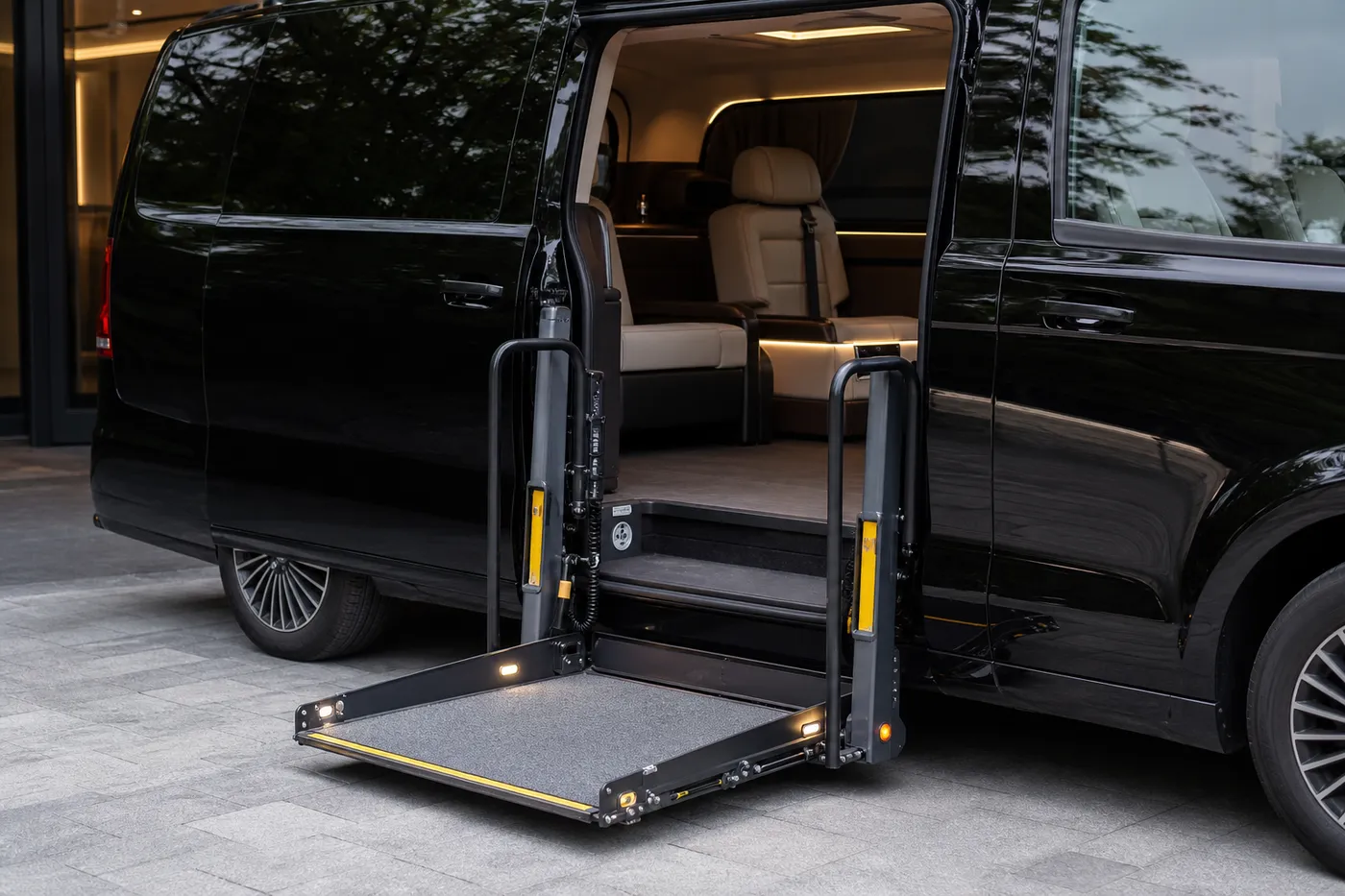
What we do not have is a ramp vehicle for travelling seated in a powered chair, and we say so at the enquiry rather than at the kerb. Where that is what a journey needs, we will tell you plainly so you can book an operator who has one, instead of finding out when the car turns up.

02At a glance

The detail in brief

What a reservations clerk would tell you in the first thirty seconds of the call.
Vehicle type
Standard saloon or MPV, not a ramp conversion
Transfer assistance
Agreed in advance, at the level you specify
Stowage
Folding chairs, frames and dismantled scooters
Assistance dogs
Carried, at no extra charge
Collection points
Ward entrances, assistance desks, private doors
Smallest cabin
Mercedes E-Class, three seats

03Included as standard

What accessible travel includes

  • 01

    A conversation before the booking

    Height of the seat, which side you transfer to, how much support you want and what the chair does. Five minutes on the phone rather than guesswork.

  • 02

    The car set up on arrival

    Seat slid back, cushion removed if it helps, door held at the angle that gives the most room, engine off.

  • 03

    Assisted transfer

    A steadying arm, a hand on the door frame, or more where you have asked for it. Nothing done without being asked first.

  • 04

    Chair and equipment stowed

    Folding chairs and frames go in the boot. Scooters that dismantle travel in the V-Class. Oxygen and equipment cases are secured rather than loose.

  • 05

    Collection at the actual door

    Ward entrance, side door, assistance desk. Wherever the shortest walk is, rather than wherever parking is convenient.

  • 06

    Time to do it properly

    Bookings are built with the extra minutes in them, so nobody is being hurried into a car by a driver watching a clock.

04Who books it

Who asks for this

Four kinds of enquiry arrive for this work, and each wants something slightly different from it.
  • 01

    Passengers with limited mobility

    People who walk short distances with a stick or a frame and find the gap between a car park and a door the hardest part of any trip.

  • 02

    Wheelchair users who transfer

    Manual chair users who move into a car seat and want the chair to go with them without a discussion about the boot.

  • 03

    Patients and their families

    Discharge days, outpatient courses and appointments where the return time is genuinely unknown until it happens.

  • 04

    Older travellers on long journeys

    Cross-country trips where a car with planned stops is simply easier than a station, a concourse and a change.

05How it works

From the first message to the last mile

The same sequence every time, so nobody is left guessing what happens next.
  1. Step 01

    Tell us what the journey needs

    The equipment, the transfer, the doorway at each end and anything about the day that has to be got right.

  2. Step 02

    We match the vehicle

    Saloon for a straightforward transfer and a folding chair, V-Class where there is a scooter, a companion and a lot of equipment.

  3. Step 03

    The chauffeur is briefed by name

    Your notes go to the person driving, not into a general instruction. They arrive knowing which side you transfer to.

  4. Step 04

    Collection at the door

    The car comes as close as the kerb legally allows, and the chauffeur walks to the door rather than waiting for you to find them.

  5. Step 05

    The return is held open

    On hospital days the car waits, or comes back on a call, rather than holding you to a return time nobody could have known.

06Detail

In detail

The transfer from wheelchair to seat

LF-01The transfer from wheelchair to seat

The transfer from wheelchair to seat

Most of the difficulty in an assisted transfer is geometry, and most of that is fixed before the passenger arrives. The seat goes back on its runners, the head restraint comes up or out, and the door is opened to its full stop rather than the polite half most drivers use. That alone changes the height and the angle of the move.

What kind of help you want is agreed at the booking, and the chauffeur will confirm it again before touching anything. Some passengers want a hand to steady against the door frame and nothing else. Others want a firm arm and a count of three. A few want the chauffeur to stand back entirely and simply hold the chair still.

Nobody is lifted. Our chauffeurs are not trained in manual handling of a person and will not attempt a lift, because getting that wrong injures the passenger as often as it injures the driver. Where a hoist or a two-person transfer is required, that is a service with different equipment and we will say so.

07Detail

Working the ground segment

Stowing a chair, a frame or a scooter

LF-02Stowing a chair, a frame or a scooter

Stowing a chair, a frame or a scooter

A folding manual wheelchair goes into an E-Class boot with room left for a case, provided the boot is not already full. A rigid-frame chair with quick-release wheels is easier still. Walking frames and rollators fold flat and go in beside them without argument.

Mobility scooters are the awkward category. A scooter that dismantles into a seat, a base and a battery travels in the V-Class. One that does not dismantle will not fit in any car we operate, and that is a conversation worth having before the booking rather than in a hospital car park.

Tell us the folded dimensions if you know them, or send a photograph. It is a far more reliable way to answer the question than a description over the phone, and it takes thirty seconds.

08Detail

What to expect

LF-03Questions worth asking before you book anyone

Questions worth asking before you book anyone

Six questions separate an operator who has thought about this from one who has not. What exactly will the chauffeur do to help me transfer. Where will the car actually stop. Will the same driver handle the return. What happens to my chair while I am in the car. How long can the car wait if the appointment overruns. And what will you not do.

That last one matters most. An operator willing to say plainly that they do not lift passengers and do not carry a ramp is an operator you can plan around. One that answers every question with reassurance is one that will improvise on the day.

Ask about the return leg specifically. A great many accessible journeys go well in the morning and badly in the afternoon, because the outbound was booked carefully and the return was assumed.

09Vehicles

The cars usually sent for this

Seats and cases for each car, taken from the vehicle itself. Nothing below is a class average.

Cabin

Mercedes-Benz E-Class

3 passengers, 2 large cases

Passengers
Up to 3
Large cases
2, plus cabin bags
Cabin class
Cabin

Cabin MPV

Mercedes-Benz V-Class

7 passengers, 5 large cases

Passengers
Up to 7
Large cases
5, plus cabin bags
Cabin class
Cabin MPV

First Saloon

Mercedes-Benz S-Class

3 passengers, 3 large cases

Passengers
Up to 3
Large cases
3, plus cabin bags
Cabin class
First Saloon

No standing price list. Send the journey on WhatsApp and the written quotation confirms the price, what it includes and any applicable tax. Compare every vehicle if none of these is quite right.

10Detail

Behind the booking

Kerbs, dropped kerbs and where we can actually stop

LF-04Kerbs, dropped kerbs and where we can actually stop

Kerbs, dropped kerbs and where we can actually stop

The height of a kerb changes a transfer more than the model of car does. A standard 125mm kerb puts the passenger above the seat, which for most people is helpful. A dropped kerb at a crossing puts them level with it, which is harder. A high Victorian kerb outside a London townhouse is higher still and can be too much.

For that reason we ask about the specific doorway, not the street. Your chauffeur will look at the collection point on the way, and where the obvious spot is wrong they will suggest a better one twenty yards along and walk you to it rather than making the transfer somewhere unsuitable.

Hospitals are their own problem. Main entrances have five-minute drop-off bays with cameras, side entrances often have none at all, and the ward you have been discharged from may be a long way from either. We plan the collection point with the ward name in hand.

11Detail

On the day

Travelling with a companion or a carer

LF-05Travelling with a companion or a carer

Travelling with a companion or a carer

A companion travelling with you does not change the quotation, because the price is for the car rather than per seat. What it does change is where everyone sits, and that is worth deciding in advance rather than in the road.

Where a carer needs to sit beside the passenger, the front passenger seat comes forward and the pair travel together in the back. Where the passenger transfers more easily into the front, the carer takes the rear and the chauffeur adjusts the mirror accordingly. Small things, agreed in a sentence at booking.

On longer journeys, tell us if the passenger needs to stop more often than most. It changes the route rather than the price, and a chauffeur who knows to plan for a break every ninety minutes will choose services with a genuinely accessible layout rather than the next one on the motorway.

12Coverage

Where we drive

London based, driving the whole of the United Kingdom. Pick a region for the towns inside it, or a terminal to see where the chauffeur stands.

13Detail

Practical notes

Hospital appointments and discharge days

LF-06Hospital appointments and discharge days

Hospital appointments and discharge days

Hospital work is unpredictable in one direction only: appointments finish late far more often than early. For that reason we build hospital bookings as hourly hire rather than as two transfers, so the car is already there when you are ready and nobody is waiting in a corridor for a return call to be answered.

Discharge days are the sharpest version of this. A discharge time given at ten in the morning has a way of becoming half past three, and by then a pre-booked car has usually been and gone. The car waits, or holds nearby and returns within minutes.

Where medication, equipment or a package of supplies comes home with the patient, mention it. It affects which car we send far more than the number of passengers does.

14Detail

Before you confirm

Assistance dogs in the car

LF-07Assistance dogs in the car

Assistance dogs in the car

Assistance dogs travel with their handler, in the vehicle, at no additional charge, and no advance notice is required. Telling us anyway is useful because it changes which car we send and how it is prepared.

A guide dog is most comfortable in the footwell of a car with a flat rear floor, which is one of the reasons the V-Class gets used for this work. The chauffeur will bring a blanket for the floor and will not put the dog in the boot under any circumstances.

Chauffeurs are asked not to greet, feed or distract a working dog, which sounds obvious and is the mistake most often made. The dog is at work; the handler decides when it is not.

15What it costs

How this is quoted

One message with the shape of the job, and a fixed figure in writing before you commit to anything.
Smallest cabin
Mercedes-Benz E-Class
Seats
Up to 3
Large cases
2
Quoted
In writing, before you travel

No standing price list. Send the journey on WhatsApp and the written quotation confirms the price, what it includes and any applicable tax. The pricing page sets out what moves a figure, and a message on WhatsApp fixes the figure for your date, your pick-up and your car.

Airports, assistance desks and the long walk

LF-08Airports, assistance desks and the long walk

Airports, assistance desks and the long walk

Airport assistance and a chauffeur solve two halves of the same problem, and they meet at a specific point. Special assistance takes you from the aircraft to the arrivals hall; the chauffeur takes you from there to the car. Agreeing exactly where that handover happens is what stops a passenger sitting in a wheelchair by a lift for half an hour.

At Heathrow the meeting point is usually the assistance desk in the arrivals hall of the relevant terminal rather than the general meeting area, and the chauffeur will wait there rather than at the barrier. Departures work the other way: the car stops at the drop-off, and the chauffeur takes you and the bags to the assistance desk inside before leaving.

Book the airline assistance separately and early. It is a free service, it has to be requested at least 48 hours ahead to be reliable, and no chauffeur company can arrange it on your behalf.

18Answers

Questions about accessible travel

Six answers that come up on almost every enquiry of this kind.

Can your chauffeur help me transfer from a wheelchair into the seat?

Yes, at a level agreed when you book. That ranges from steadying the chair to offering a firm arm. Our chauffeurs do not lift passengers, because they are not trained in manual handling of a person and an attempted lift injures people.

Do you carry a wheelchair-accessible vehicle with a ramp?

No. Every car we operate is a standard saloon or MPV, so travelling while seated in a powered wheelchair is not something we can do. We say that at the enquiry so you can book an operator with a ramp vehicle rather than discovering it on the day.

Will a folding wheelchair fit in the boot alongside luggage?

A folding manual chair and one large case fit an E-Class comfortably. A rigid chair with quick-release wheels is easier again. If there is a chair, a frame and luggage for two, the V-Class is the sensible choice.

Can a carer or companion travel with me at no extra charge?

Yes. The quotation is for the vehicle rather than per seat, so a companion or carer travelling with you does not change the price. Tell us at booking so the seating can be arranged before the car arrives.

Are assistance dogs welcome in the car?

Always, with no notice needed and nothing added to the fare. Mentioning it in advance means we can send a car with a flat rear floor and have a blanket ready. A working dog is never put in the boot.

Can you collect from a hospital ward rather than the main entrance?

Wherever the shortest walk is. Give us the ward or department name and the chauffeur will find the nearest legal stopping point to that door, then come in to meet you rather than waiting for you to find the car.

FCReservations

Ready to book accessible travel?

Send the date, the pick-up and where you are going. A fixed written quotation comes back with the car, the chauffeur's arrival time and what the figure covers.

Hours
Reservations answered around the clock, every day of the year.
CallGet a quote