Skip to content
FCFirst ClassCHAUFFEURS

JNVehicles

The rear seat is a designed object

Somebody sat in a studio and decided how far your knees would be from the seat in front. Most of them got it wrong.

From the journal
Executive saloon rear interior

Written quotation, usually within the hour

The rear seat is a designed object: summary

Somebody sat in a studio and decided how far your knees would be from the seat in front. Most of them got it wrong. Somebody sat in a studio and decided how far your knees would be from the seat in front, what angle the cushion sits at, and how high the sill is that you swing your legs over. Those three decisions account for most of what a rear seat is like to use, and they are made years before anybody sits in one. Judging a car from the driver’s seat is how most reviews are written and it tells you almost nothing about the part that matters here. The chauffeured car is judged from behind.

Filed under

Vehicles

Published

6 October 2024

Sections

8

Reading time

4 minutes

01Opening

Where this starts

Somebody sat in a studio and decided how far your knees would be from the seat in front, what angle the cushion sits at, and how high the sill is that you swing your legs over. Those three decisions account for most of what a rear seat is like to use, and they are made years before anybody sits in one.

Judging a car from the driver’s seat is how most reviews are written and it tells you almost nothing about the part that matters here. The chauffeured car is judged from behind.

02At a glance

What this piece is

Filed under
Vehicles
Published
6 October 2024
Sections
8
Reading time
4 minutes

03The piece

The rear seat is a designed object

Cushion angle beats legroom

JN-01Cushion angle beats legroom

Cushion angle beats legroom

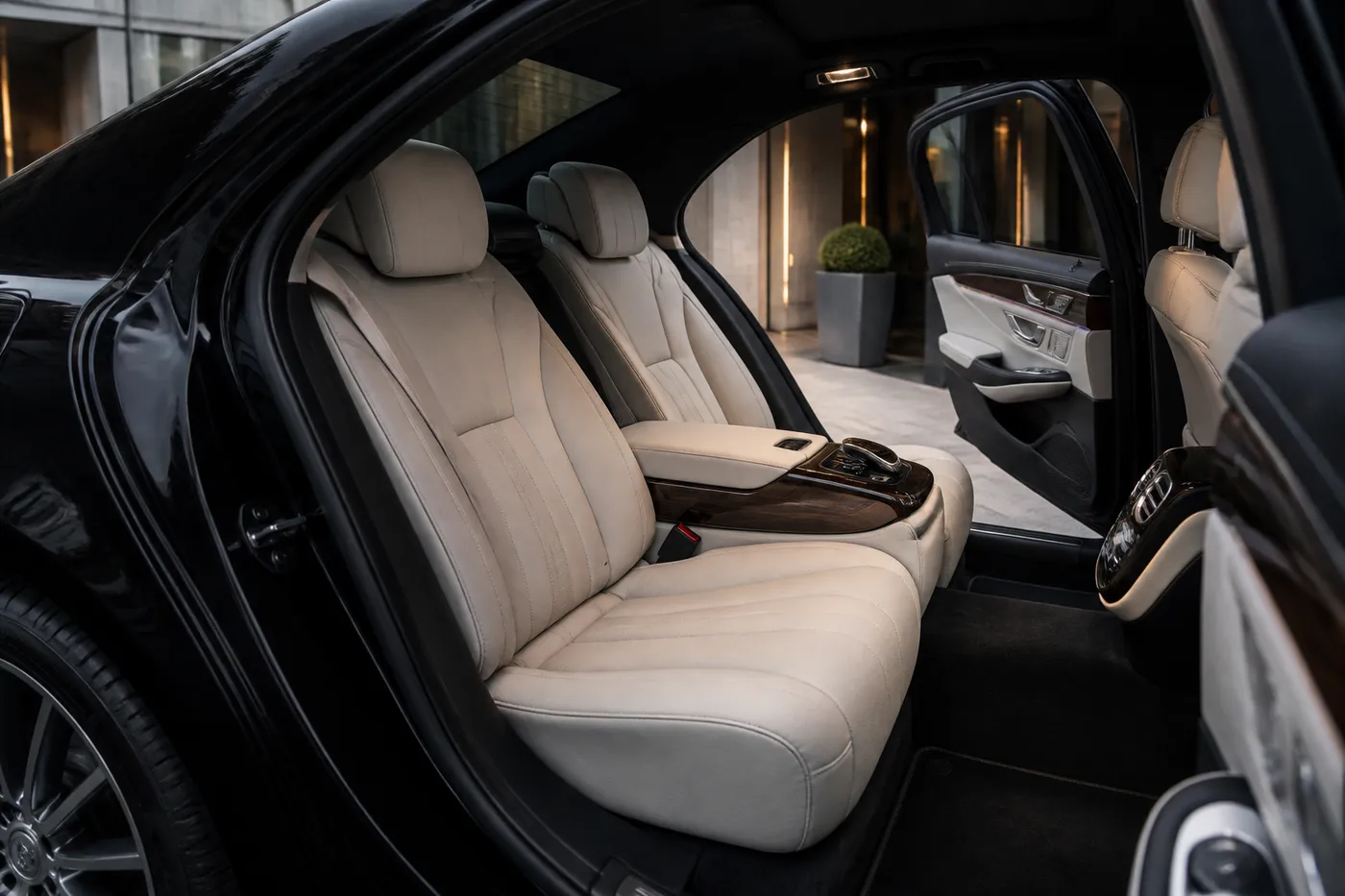
The most consequential dimension in a rear seat is one that never appears in any specification and cannot easily be expressed as a number. It is the angle between the seat base and the horizontal, and it determines whether a passenger is held in place by the geometry of the seat or by their own muscles for the length of the journey.

A seat base that is too flat pushes you forward and makes a long journey tiring. A base with a proper rearward tilt supports the thighs and holds you in place under braking without any effort from the passenger.

It is the single most underrated dimension in a car and it never appears in a specification sheet, because it is difficult to reduce to a number and easy to feel within ten minutes.
JN-02Entry height decides more than comfort

Entry height decides more than comfort

The second dimension that matters is the height of the seat cushion above the pavement, and its effect is felt in the four seconds at each end of a journey rather than in the hours between them. Those four seconds are also the moments a passenger is most likely to remember, which is a poor trade for a car that gets the rest of it right.

Getting into a low saloon requires a drop and a twist. Getting into a high SUV requires a step up. Both are fine for most people and both are a problem for somebody with a knee, a hip or a long formal dress.

The most comfortable cars to get in and out of are the ones where the seat is roughly at the height of a dining chair, which is a boringly domestic benchmark and a very reliable one.

JN-03Where the armrest sits

Where the armrest sits

Armrests are the most reliably badly judged component in a car interior. There are two of them for each passenger, one on the door and one in the centre, and they need to be at roughly the same height as each other and at roughly the height of a relaxed elbow, which sounds simple and is achieved surprisingly rarely.

A centre armrest that is too low leaves an elbow unsupported, which is worse than no armrest at all because it invites you to lean on it. Door armrests have the same problem and are less often fixed.

When both are at the right height, a passenger sits square and relaxed. When they are not, you get the slight lean that people adopt in cars and blame on the seat.

Light and glass

JN-04Light and glass

Light and glass

How large a cabin feels has only a loose relationship with how large it actually is. Two cars with identical interior dimensions can feel entirely different to sit in for two hours, and the variable is how much daylight reaches the rear seat and what colour the surfaces around it are.

A rear cabin with small windows and a high beltline feels enclosed regardless of how much space it actually has. One with a large glass area and a light headlining feels bigger than its dimensions.

That is why some smaller executive saloons feel more pleasant in the back than larger cars with dark interiors, and it is worth more on a long run than a few centimetres of legroom.

05The piece, continued

Further down the page

JN-05Somewhere to put things

Somewhere to put things

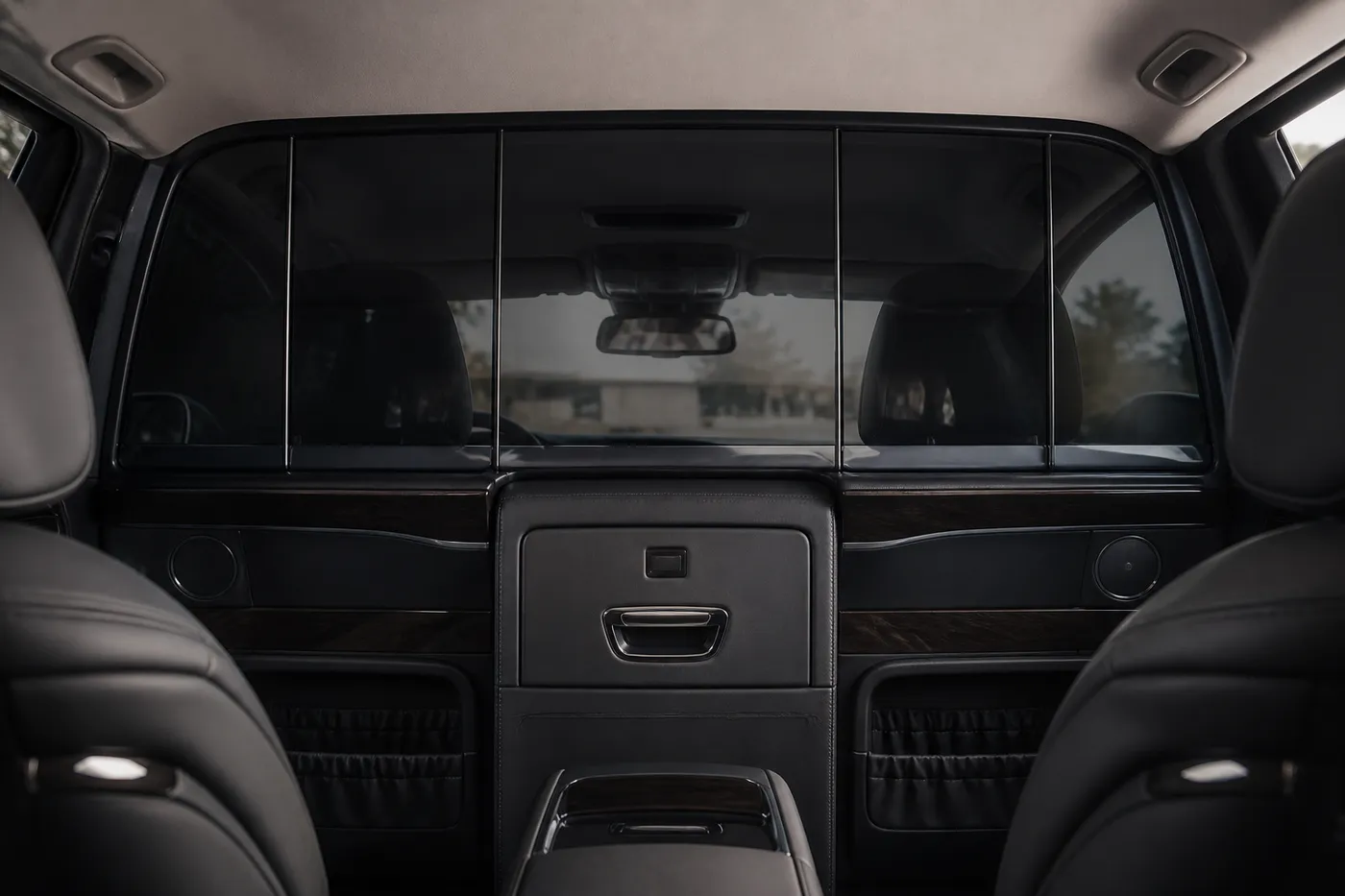
A rear cabin is a place where people work, and working requires somewhere to put things down. It is remarkable how many otherwise excellent cars provide almost nowhere: a shallow door bin, a cup holder under a lid, and a centre armrest too narrow to take a laptop.

A phone, a coffee, a set of keys and a laptop. Four objects, and a surprising number of expensive cars have nowhere sensible for any of them. A shallow door pocket and a cup holder under an armrest lid is not a solution.

Passengers work in these cars. A flat surface at the right height is worth more than another driving mode.

JN-06The test that actually matters

The test that actually matters

None of the above requires any equipment to assess and none of it is captured by the way cars are conventionally reviewed, which is from the driving seat by somebody interested in how it corners.

Sit in the back for ninety minutes with a laptop, then get out and see how you feel. That is the test, and it is the one that almost no vehicle assessment performs.

Everything in the fleet is chosen against roughly that standard rather than against a specification sheet, which is why the list is shorter than it might be.

Two seats, one bench

JN-07Two seats, one bench

Two seats, one bench

Most rear seats are designed around a bench that occasionally has to take three people and usually takes two, and the compromise shows. Individual rear seats with a fixed console between them are a considerably better arrangement for the way these cars are actually used, and they appear only at the top of the range.

The intermediate solution, a bench with a wide folding armrest, works well until somebody needs the middle seat and then works badly for everybody.

JN-08Controls the passenger can actually find

Controls the passenger can actually find

A rear cabin now has a surprising number of things to operate: climate, seats, blinds, lighting and occasionally the seat in front. How they are presented matters enormously, and the current fashion for putting all of it behind a small screen in an armrest is not an improvement for somebody using the car once.

A physical control that does one thing is found immediately by a passenger who has never sat in that car before, which is most of them.

08Answers

Questions this piece raises

Asked often enough that the answers belong on the page rather than in a reply.

Which car has the best rear seat?

It depends on the passenger more than the badge. Cushion angle, entry height and armrest position matter more than headline legroom, and the right answer differs for a tall passenger and one with a stiff knee.

Is a larger car always more comfortable in the back?

No. A smaller cabin with good glass and a well-angled seat is frequently more pleasant on a long run than a large one with a dark interior and a flat base.

Can I try a vehicle before booking it for a long journey?

Tell us what the journey involves and we will recommend against the wrong car. For a regular arrangement it is reasonable to try one on a shorter booking first.

FCReservations

Every piece here ends at the same place: a car, a time and a name.

Send the date, the pick-up point and where you are going. A written quotation comes back with the vehicle, the chauffeur's arrival time and what the figure covers.

Hours
Reservations answered around the clock, every day of the year.
CallGet a quote