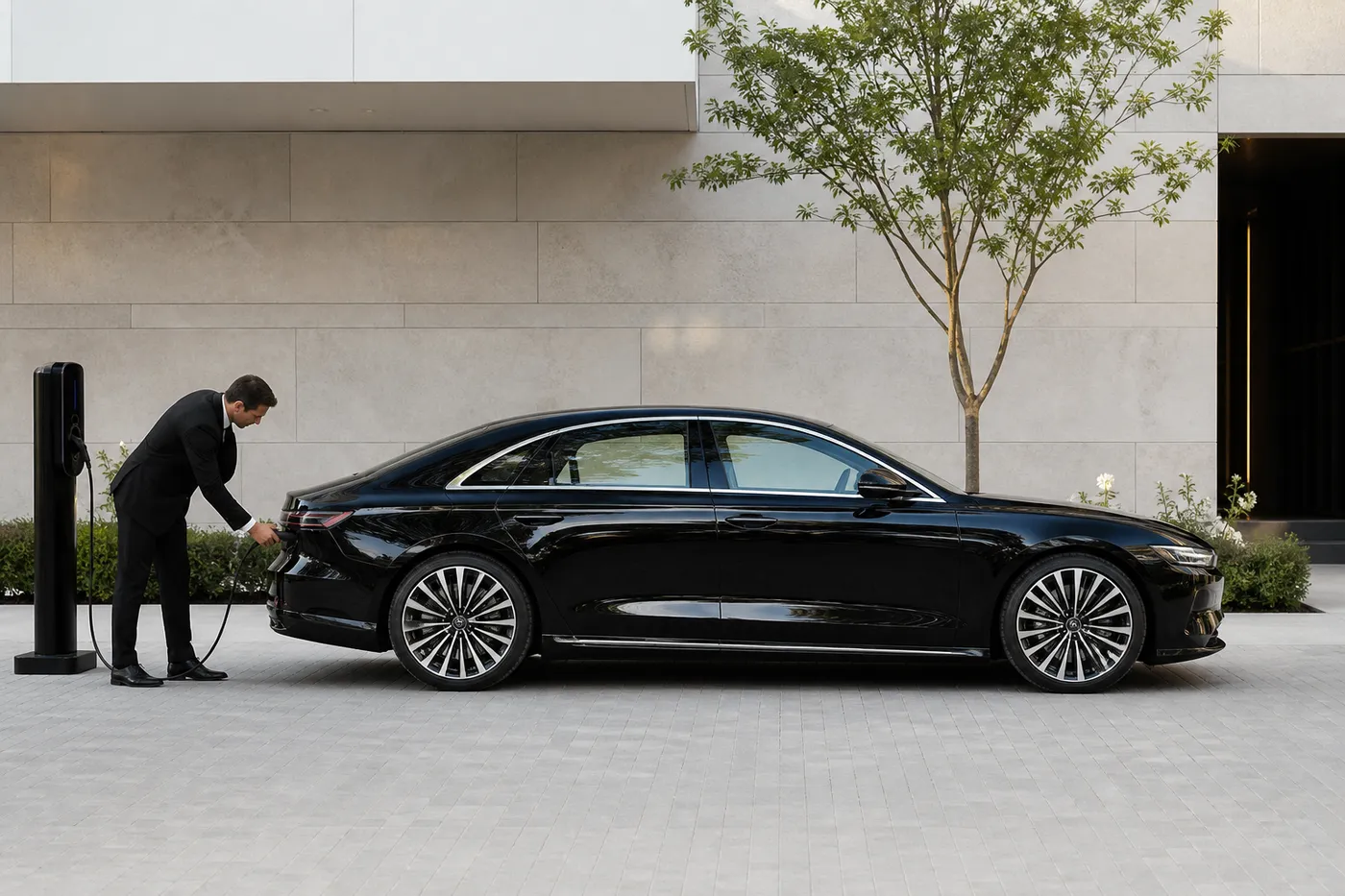
Litres is how boot space is sold, and litres tell you almost nothing useful about whether four suitcases will fit. Litres. That is how boot space is sold, and litres tell you almost nothing about suitcases. A boot measured with polystyrene beads can be a large number and still refuse to take a fourth hard case, because cases are rigid and beads are not. What matters is shape: the width between the arches, the height under the parcel shelf, and whether the opening is as big as the space behind it. None of the three is on a brochure.
Filed under
Vehicles
Published
18 April 2026
Sections
8
Reading time
4 minutes
01/Opening
Where this starts
Litres. That is how boot space is sold, and litres tell you almost nothing about suitcases. A boot measured with polystyrene beads can be a large number and still refuse to take a fourth hard case, because cases are rigid and beads are not.
What matters is shape: the width between the arches, the height under the parcel shelf, and whether the opening is as big as the space behind it. None of the three is on a brochure.
02/At a glance
What this piece is
Filed under
Vehicles
Published
18 April 2026
Sections
8
Reading time
4 minutes
03/The piece
Boot capacity is measured wrong
JN-01/The arch width is the limiting dimension
The arch width is the limiting dimension
There is one measurement that determines how many large cases a saloon will actually take, and it is not depth, height or the published volume. It is the clear width between the rear wheel arches, because a full-size case is close to that width and once it is in there is no room to turn it.
Most saloons are limited by the distance between the wheel arches, because a large case will not turn once it is in. A boot that is very deep but narrow will take two big cases side by side and then refuse the third, whatever the litre figure claims.
This is why estate cars and vans carry far more than their numbers suggest and why some large saloons carry less.
JN-02/Aperture beats volume
Aperture beats volume
The second constraint is the opening rather than the space behind it. A boot lid that produces a shallow letterbox with a high sill can leave a large volume behind it entirely inaccessible to anything rigid, and the cars that suffer most from this are frequently the expensive ones with the most elegant rear ends.
A boot lid that opens to a narrow letterbox makes a large space useless for anything rigid. Cars with a high sill and a shallow opening are the worst offenders, and they are frequently the expensive ones.
A van or people carrier with a tall square opening will swallow things that no saloon will take, which is the whole practical argument for them on airport work.
JN-03/The hard case has changed the arithmetic
The hard case has changed the arithmetic
The figures on your quotation were more useful when luggage was softer. A generation ago most cases had some give in them, could be squeezed into an awkward corner and would settle into a space of roughly the right size. Modern luggage does none of that, and the change has made volume figures considerably less predictive than they used to be.
Twenty years ago most luggage had some give in it. Modern four-wheel hard cases do not, so a boot either takes them or it does not, and there is no persuading involved.
That has made published capacities less useful rather than more, and it is why we describe cars by the number of large cases they actually take rather than by volume.
A large case is roughly a full-size check-in bag.
Two cabin bags occupy about the space of one large case.
Anything soft can be packed around the rest; nothing else can.
JN-04/What defeats every saloon
What defeats every saloon
There is a short list of ordinary items that no saloon boot will accommodate, and every one of them is something people travel with regularly. What they share is length: they are all longer than any boot is deep, and folding a rear seat is not an option when somebody is sitting on it.
Skis, golf clubs and pushchairs, in that order. Skis will not go in a saloon boot at all and folding a rear seat is not a solution on a chauffeured job, since somebody is sitting on it.
A set of clubs will fit some saloons diagonally and it is not something to discover at a kerb. The booking asks about it because the answer changes the vehicle.
04/Referenced here
Pages this piece touches
The services, terminals and vehicles named above, each with a page of its own.
The figures on your quotation assume an empty cabin, which no chauffeured journey has. Every additional passenger brings a coat, a hand bag and frequently a laptop case, and all of that has to go somewhere. In practice it goes in the boot and reduces the space available for the luggage that was actually counted.
Four people in a saloon leaves less usable boot than three, because somebody’s coat and bag end up in it. That is obvious and it is routinely forgotten when a booking is made from a specification.
The honest rule is that a car carrying its maximum passengers is not also carrying its maximum luggage.
JN-06/How we describe it instead
How we describe it instead
Given all of that, the sensible approach is to abandon the industry’s preferred unit entirely and describe a car by what it will actually carry.
Passengers and large cases, per vehicle, as a plain pair of numbers. It is less precise than litres and considerably more useful, because it answers the question a client is actually asking.
The fleet pages carry those figures for every car, and where a booking is close to the limit the sensible answer is the next size up.
JN-07/The electric complication
The electric complication
Battery packs have to go somewhere and in most electric saloons they go under the floor, which lifts the whole cabin slightly and occasionally intrudes on the boot. Some models compensate with additional storage under the bonnet, which is genuinely useful for small items and no help at all with a full-size case.
It is worth checking rather than assuming, because two cars of the same external size can differ considerably once the drivetrain is taken into account.
JN-08/When a trailer is the answer
When a trailer is the answer
For a large group with a great deal of luggage there is a solution that most clients have never considered, which is a second vehicle or a luggage trailer travelling with the party. It sounds excessive and it is frequently cheaper and more comfortable than squeezing eight people and their cases into one oversized vehicle.
It is arranged in advance, it needs the route checked for any height or access restrictions, and it removes the entire problem on a cruise or a ski transfer.
06/Related reading
Written alongside this one
Pieces that pick up the same thread from a different angle.
Asked often enough that the answers belong on the page rather than in a reply.
How many suitcases fit in a chauffeur car?
+
Every vehicle in the fleet is described by passengers and large cases rather than by litres, because litres do not predict whether rigid cases will fit.
Can I take skis or golf clubs in a saloon?
+
Skis, effectively never. Golf clubs fit some saloons and not others, which is why the booking asks. Where it is close, the next vehicle size up is the safer answer.
Does the number of passengers affect luggage space?
+
Yes. A car carrying its maximum passengers is not also carrying its maximum luggage, because coats and hand bags end up in the boot.
Every piece here ends at the same place: a car, a time and a name.
Send the date, the pick-up point and where you are going. A written quotation comes back with the vehicle, the chauffeur's arrival time and what the figure covers.