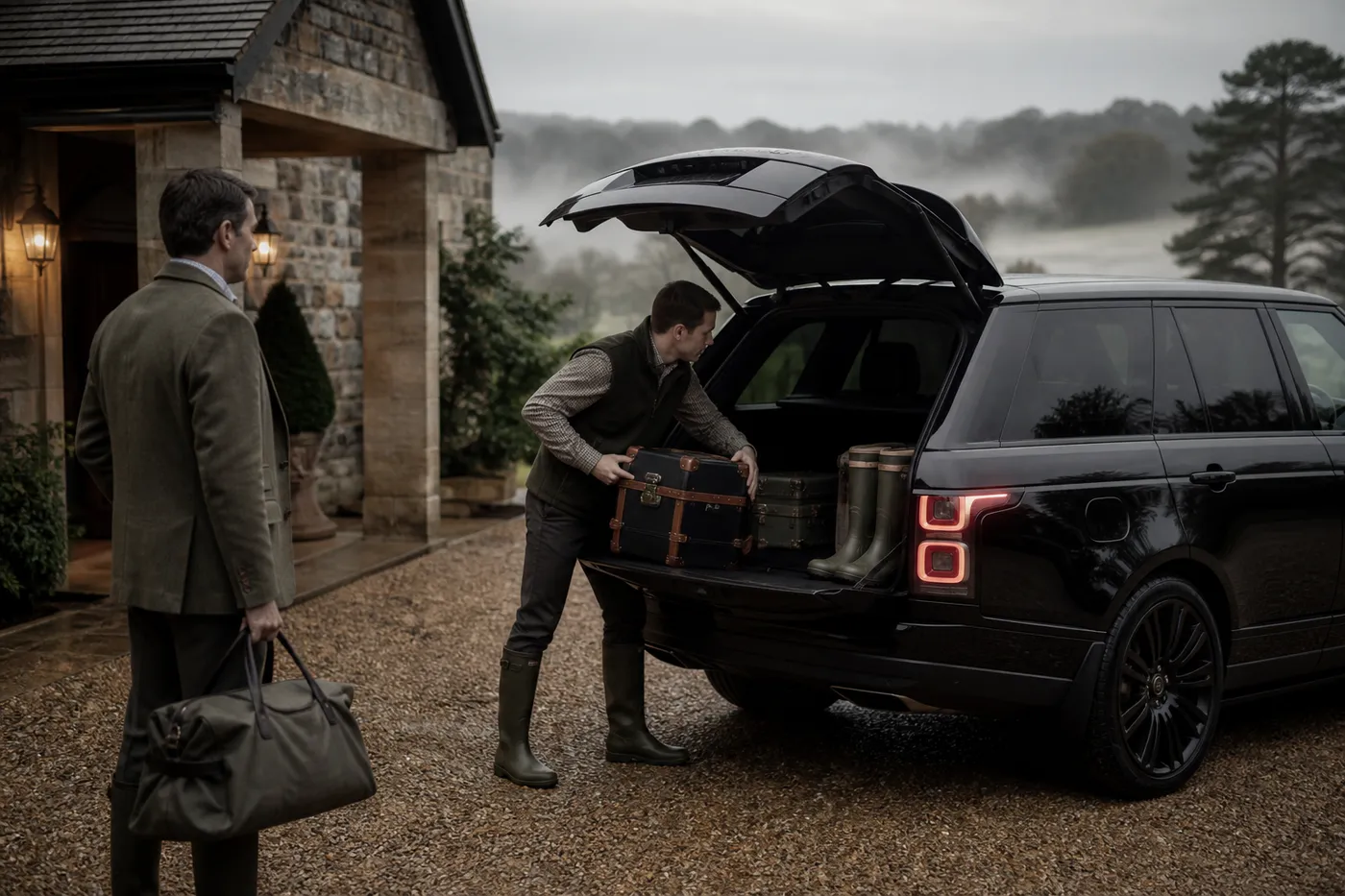
Two hands on a case, always, including the light one. It is about the car and the case as much as about the back doing the lifting. Two hands on a case, always, including the light one. One hand looks casual and it is how paintwork gets marked, cases get dropped and backs get injured, in roughly that order of frequency. Loading a boot properly takes about ninety seconds and it is one of the more consequential ninety seconds of a journey, because everything that goes wrong at the other end was decided here.
Filed under
The craft
Published
19 February 2026
Sections
8
Reading time
4 minutes
01/Opening
Where this starts
Two hands on a case, always, including the light one. One hand looks casual and it is how paintwork gets marked, cases get dropped and backs get injured, in roughly that order of frequency.
Loading a boot properly takes about ninety seconds and it is one of the more consequential ninety seconds of a journey, because everything that goes wrong at the other end was decided here.
02/At a glance
What this piece is
Filed under
The craft
Published
19 February 2026
Sections
8
Reading time
4 minutes
03/The piece
Luggage is a two-handed job
JN-01/The order is the reverse of the drops
The order is the reverse of the drops
Loading a boot is a small planning exercise disguised as a physical task. Whatever comes out first has to go in last, which means the itinerary needs to be understood before the first case is lifted rather than reconstructed at the first stop with three bags on a pavement.
Last out goes in first. On a single-destination job that is trivial. On a day with three stops it is the difference between opening a boot and lifting one case out, and unpacking most of it on a pavement.
It requires knowing the itinerary before loading, which is another argument for the chauffeur having read the job rather than following an address.
JN-02/Cases have a right way up
Cases have a right way up
Modern luggage is rigid, wheeled and heavier empty than the soft bags it replaced, and it stacks in ways that are not always obvious. Getting it wrong produces two outcomes, neither of them visible until the passenger unpacks: something crushed, or something that has moved about under braking.
Wheels down, handles accessible, soft bags on top of hard ones and never the reverse. A hard case on a soft holdall crushes whatever is in it, and the passenger discovers that when they unpack.
Anything fragile is asked about rather than assumed. It is a short question and it prevents the one outcome nobody wants.
JN-03/What does not go in the boot
What does not go in the boot
There is a category of item that should never leave a passenger’s reach and it is easy to identify by asking rather than by guessing. A laptop bag, a handbag, a coat and anything containing a document needed before the destination all belong in the cabin.
A laptop bag, a handbag, a coat and anything the passenger has said they want with them. Those go into the cabin, and asking rather than deciding is the correct approach.
The classic failure is putting a briefcase in the boot at a hotel and having to retrieve it at a traffic light because there is a document in it.
Ask what stays in the cabin before loading anything.
Wheels down, soft on top of hard.
Nothing stacked so high it moves under braking.
JN-04/Golf, skis and pushchairs
Golf, skis and pushchairs
Three particular items account for the overwhelming majority of vehicle problems in this trade, and all three are perfectly ordinary things for people to travel with. What they have in common is that they are long, rigid and completely incompatible with a saloon boot.
All three defeat a saloon boot and all three appear regularly. A set of clubs will go in some saloons and not others, skis effectively never do, and a pushchair takes more room than anybody expects.
Which is why the booking asks about them. It is not a formality; it decides the vehicle, and finding out at the kerb is too late to fix.
04/Referenced here
Pages this piece touches
The services, terminals and vehicles named above, each with a page of its own.
At the other end of a flight the same operation runs in reverse and against a slightly different set of constraints, most of them involving a trolley and a car park rather than a kerb and a clock.
At an airport the bags come off a trolley into the boot in one movement, in the order they will come out. The trolley then goes back, before the passenger is seated rather than after.
Doing that in the wrong order leaves a client sitting in a car watching a chauffeur walk away with a trolley, which is a small and entirely avoidable oddity.
JN-06/The unfashionable point about weight
The unfashionable point about weight
The last part of this is about the chauffeur rather than the client, and it is worth including because the trade generally does not talk about it at all.
Cases are heavier than they used to be, and lifting six of them into a high boot several times a day is a physical job. Doing it badly for twenty years has consequences, which is why the technique matters as much for the chauffeur as for the client.
Two hands, close to the body, and using the boot lip rather than the arms. Nothing about that is glamorous and it is the difference between a long career and a short one.
JN-07/Musical instruments and other awkward things
Musical instruments and other awkward things
Beyond the usual difficult items there is a long tail of things people travel with that no vehicle specification anticipates. A cello, a set of display boards, a folded wheelchair, a large framed picture. All of them fit somewhere and none of them fit anywhere by accident.
The pattern is the same in every case: the question has to be asked at the booking stage, because the answer determines the vehicle and there is no adjusting it at the kerb.
JN-08/Wet luggage and what it does to a boot
Wet luggage and what it does to a boot
British weather means a proportion of luggage arrives wet, and a wet case in a carpeted boot leaves a mark that outlasts the journey by several days. A boot liner solves it completely and it is one of the more useful pieces of equipment a working car carries.
The same applies to golf shoes, walking boots and anything that has been on a beach, all of which are ordinary items on this kind of work.
06/Related reading
Written alongside this one
Pieces that pick up the same thread from a different angle.
Asked often enough that the answers belong on the page rather than in a reply.
Will my luggage fit in the car I have booked?
+
That is why the booking asks how many cases and what kind. Golf clubs, skis and pushchairs all change the answer, and it is far better settled in advance than at the kerb.
Can I keep my laptop bag with me in the cabin?
+
Yes, and you will be asked what you want to keep with you before anything is loaded. Only what you have not asked for goes into the boot.
How is luggage handled on a multi-stop journey?
+
The boot is loaded in the reverse order of the drops, so each stop involves lifting out one case rather than unpacking most of it on a pavement.
Every piece here ends at the same place: a car, a time and a name.
Send the date, the pick-up point and where you are going. A written quotation comes back with the vehicle, the chauffeur's arrival time and what the figure covers.