
Skip to content
FCFirst ClassCHAUFFEURS

JNCities and routes

The Lake District in a saloon

The road out of Ambleside towards Kirkstone is signposted The Struggle, which tells you most of what you need to know.

From the journal
Luxury suv countryside

Written quotation, usually within the hour

The Lake District in a saloon: summary

The road out of Ambleside towards Kirkstone is signposted The Struggle, which tells you most of what you need to know. The road out of Ambleside towards Kirkstone is signposted The Struggle, which tells you most of what you need to know about driving in the Lake District. Steep, narrow, and named by people who were being descriptive rather than poetic. It is one of the most rewarding parts of Britain to be driven through and one of the least forgiving to plan a schedule in. Distances are small, times are long, and the difference between the two is where every Lakeland itinerary goes wrong.

Filed under

Cities and routes

Published

10 December 2024

Sections

8

Reading time

5 minutes

01Opening

Where this starts

The road out of Ambleside towards Kirkstone is signposted The Struggle, which tells you most of what you need to know about driving in the Lake District. Steep, narrow, and named by people who were being descriptive rather than poetic.

It is one of the most rewarding parts of Britain to be driven through and one of the least forgiving to plan a schedule in. Distances are small, times are long, and the difference between the two is where every Lakeland itinerary goes wrong.

02At a glance

What this piece is

Filed under
Cities and routes
Published
10 December 2024
Sections
8
Reading time
5 minutes

03The piece

The Lake District in a saloon

The A591 is the spine and it is not enough

JN-01The A591 is the spine and it is not enough

The A591 is the spine and it is not enough

The Lake District has one road that goes through the middle of it and a great many that go round the edges of individual valleys. That single fact explains most of what is difficult about driving there. The geography is radial, arranged around lakes and fells that do not permit a grid, and the result is a network with very little redundancy in it.

The main road through the central lakes carries almost everything: Kendal, Windermere, Ambleside, Grasmere, Keswick. It is a good road and it is a single road, which means a closure or an incident on it does not have a convenient alternative.

Everything off it is minor road, and minor road in Cumbria means walls, gates, gradients and passing places. The map does not distinguish between those and an ordinary country lane, and it should.
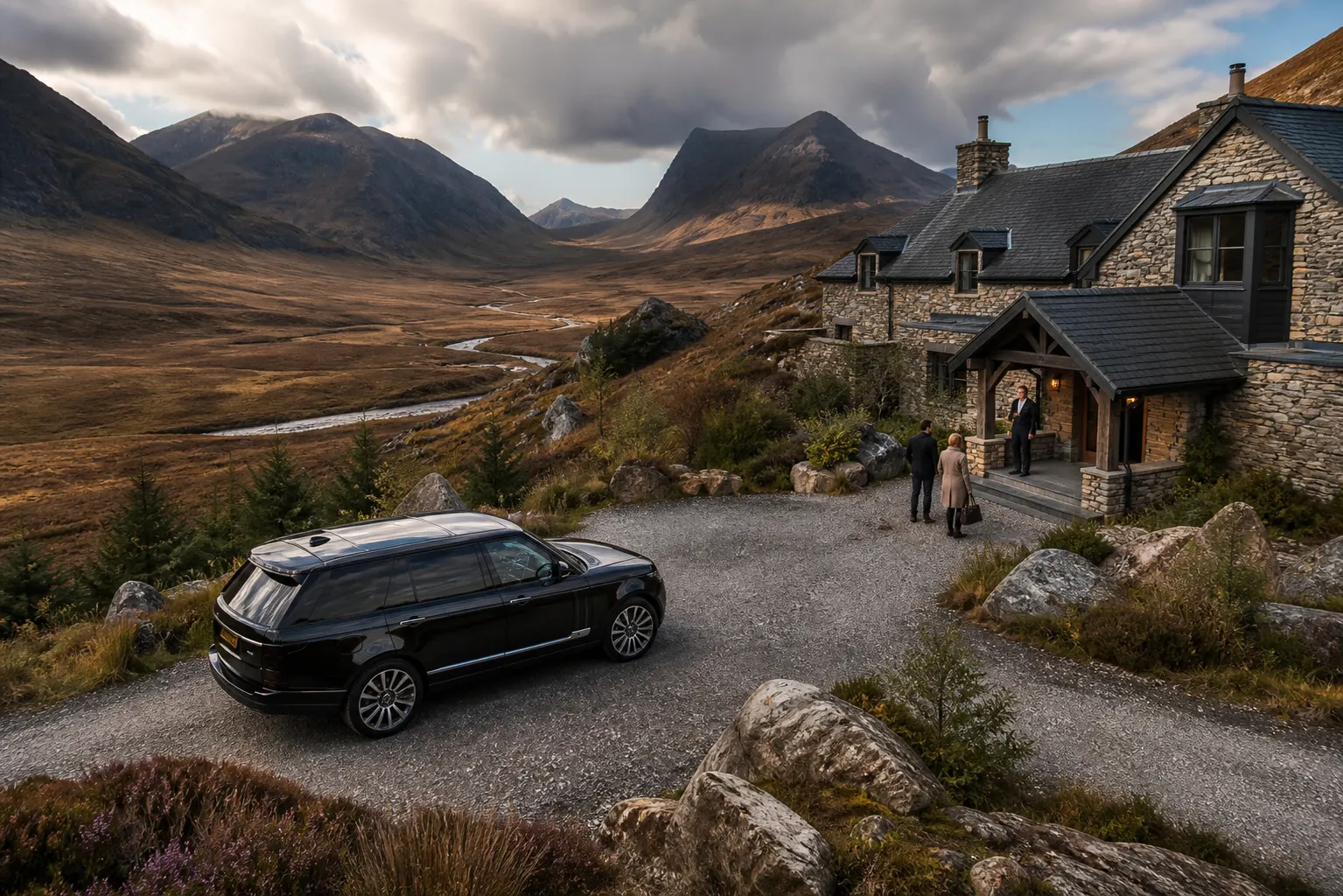
JN-02Which passes to avoid with the wrong car

Which passes to avoid with the wrong car

The passes are the reason people who like driving come to Cumbria and the reason people who are working there treat the region with respect. They range from perfectly ordinary hill roads to some of the steepest public tarmac in England, and the map gives very little indication of which is which unless you already know.

Hardknott and Wrynose are the famous ones and they are genuinely severe: gradients that a low saloon will struggle with and hairpins with no room to correct. They are not roads to take a client over unless the client has specifically asked and the vehicle is right.

Kirkstone and Whinlatter are manageable in most vehicles in good conditions. In winter that changes, and the sensible answer in poor weather is the long way round rather than the interesting way.

JN-03The season changes everything

The season changes everything

There are effectively two Lake Districts and they occupy the same ground at different times of year. One of them is a busy visitor destination with queues in the villages and full car parks by ten in the morning. The other is nearly empty, considerably more beautiful, and comes with four hours less daylight and the possibility of a closed pass.

From late spring to early autumn the central lakes carry a very large amount of visitor traffic, and the pinch points are the villages. Bowness and Ambleside on a warm Saturday are not places you drive through quickly.

Out of season it is a different region entirely: empty roads, short days and weather that can close a pass. Both versions are worth doing and they need different planning.

The hotels are up tracks

JN-04The hotels are up tracks

The hotels are up tracks

The best places to stay in Cumbria are, almost without exception, at the end of a private drive somewhere on the side of a valley. That is what makes them worth staying in and it is also a practical consideration that gets discovered at the wrong moment, usually in the dark, with a car that is lower than it ought to be.

A great many of the good places to stay in Cumbria are at the end of a drive that was not built for a long-wheelbase car. Ground clearance and turning circle matter here in a way they do not in Mayfair.

It is worth asking the hotel about the approach when the booking is made. They know, they are used to the question, and the answer occasionally changes the vehicle.

05The piece, continued

Further down the page

JN-05Getting there is the easy half

Getting there is the easy half

One of the genuinely convenient things about the region is how straightforward it is to reach. A motorway runs along its eastern edge with two junctions that lead directly into the central lakes, which means the difficult driving is confined to the last half hour of a journey that is otherwise entirely ordinary.

The M6 runs up the eastern edge of the region and the junctions at Kendal and Penrith put you into the lakes quickly. From Manchester Airport it is a straightforward run of around two hours; from London it is a long day.

That makes the region unusually accessible for somewhere that feels remote, and it explains why so much Lakeland work starts at an airport rather than at a house.

JN-06Why it is worth doing properly

Why it is worth doing properly

It is worth being clear about what a chauffeur is actually providing in a landscape like this, because it is not the same thing as a transfer between two addresses. The value is in what the passenger is able to do with the journey rather than in the journey itself.

Because a driver looking at the road is not looking at Windermere, and the whole point of being in Cumbria is looking at it. A day with somebody else driving turns a demanding piece of navigation into a view.

Book it by the hour rather than by the journey. Nothing in the Lake District keeps to a timetable, including the weather.

JN-07The ferry and the other crossings

The ferry and the other crossings

Windermere has a vehicle ferry across it that saves a substantial detour for anybody going between the eastern and western sides of the central lakes. It runs frequently, it takes a handful of cars at a time, and on a busy summer afternoon the queue for it can be longer than the drive round.

Whether to use it is a judgement made on the day rather than a plan made in advance, and it is exactly the sort of thing that a driver who works the region knows and a visitor does not.

Light and the length of the day

JN-08Light and the length of the day

Light and the length of the day

In December it is dark by four, and unlit single-track roads with stone walls are a considerably more demanding proposition after that. Any winter itinerary in Cumbria has to be built around the daylight rather than the mileage, which is a constraint that simply does not apply in a city.

In June the reverse is true and the region is at its best late in the evening, when the day visitors have gone and the light on the fells is worth the drive on its own.

08Answers

Questions this piece raises

Asked often enough that the answers belong on the page rather than in a reply.

Can a saloon car handle Lake District roads?

On the main routes, comfortably. The severe passes such as Hardknott and Wrynose are a different matter, and in winter the sensible answer is the longer route rather than the interesting one.

How long does it take to get to the Lakes from Manchester Airport?

Around two hours on motorway for most of the way, which makes the region far more accessible than it feels once you are in it.

Is hourly hire better than a fixed itinerary in the Lakes?

Almost always. Distances are short, times are long and the weather changes the plan, so a car held for the day works far better than a schedule of fixed points.

Will the car reach a hotel at the end of a track?

Usually, and it is worth asking the hotel about the approach when the booking is made. The answer occasionally changes which vehicle is sent.

FCReservations

Every piece here ends at the same place: a car, a time and a name.

Send the date, the pick-up point and where you are going. A written quotation comes back with the vehicle, the chauffeur's arrival time and what the figure covers.

Hours
Reservations answered around the clock, every day of the year.
CallGet a quote