Skip to content
FCFirst ClassCHAUFFEURS

JNCities and routes

Glasgow to Edinburgh, and the M8 in between

Forty-odd miles separate Scotland’s two big cities, which is less than a lot of English commutes and feels like more.

From the journal
Edinburgh chauffeur

Written quotation, usually within the hour

Glasgow to Edinburgh, and the M8 in between: summary

Forty-odd miles separate Scotland’s two big cities, which is less than a lot of English commutes and feels like more. Forty-odd miles separate Scotland’s two big cities, which is less than a lot of English commutes and feels like a great deal more. The M8 runs between them across the central belt, through Livingston and past the shale bings, and it is a road with a reputation that it has mostly earned. The two cities are close enough that a working day in both is entirely normal. What makes that day go well or badly is almost never the middle section. It is what happens at either end, in two city centres that are as different to drive in as any pair in Britain.

Filed under

Cities and routes

Published

13 May 2026

Sections

6

Reading time

4 minutes

01Opening

Where this starts

Forty-odd miles separate Scotland’s two big cities, which is less than a lot of English commutes and feels like a great deal more. The M8 runs between them across the central belt, through Livingston and past the shale bings, and it is a road with a reputation that it has mostly earned.

The two cities are close enough that a working day in both is entirely normal. What makes that day go well or badly is almost never the middle section. It is what happens at either end, in two city centres that are as different to drive in as any pair in Britain.

02At a glance

What this piece is

Filed under
Cities and routes
Published
13 May 2026
Sections
6
Reading time
4 minutes

03The piece

Glasgow to Edinburgh, and the M8 in between

The motorway is the simple part

JN-01The motorway is the simple part

The motorway is the simple part

The road between the two cities is one of the busiest in Scotland and one of the least demanding to drive. It runs across the central belt through a landscape of former industry and new distribution sheds, it is motorway for effectively the whole distance, and it has no significant gradients, no exposed high ground and no complicated junctions along the way. There is nothing to learn about it beyond when to use it.

Straightforward, well signed, and busy at the usual hours. The section at the Glasgow end carries a great deal of local traffic and the section near Edinburgh does the same, with the open middle stretch behaving predictably.

A run between the two cities outside peak is quick. Inside peak it is not, and the peaks at each end do not coincide neatly, which means a journey in one direction can be much easier than the same journey reversed.
JN-02Glasgow is easier to drive than Edinburgh

Glasgow is easier to drive than Edinburgh

Anyone who works both cities develops a clear preference, and it is not the preference visitors expect. Edinburgh is the handsomer place and the harder one to move a car around; Glasgow is the larger, more sprawling city and considerably more accommodating to anybody driving in it. That difference comes down to when each of them was laid out and what has been done to them since.

The grid layout of the city centre, the motorway running straight through it and the relative absence of medieval street patterns make Glasgow a comparatively simple city for a car. Loading and stopping are more practical there than in most British cities of that size.

Edinburgh is the opposite. The New Town is elegant and the Old Town is a series of closes and steep wynds, and the tram has reorganised the streets around Princes Street more than once.

JN-03The train is genuinely good here

The train is genuinely good here

It is worth saying this plainly rather than burying it. The rail link between Scotland’s two largest cities is frequent, quick and lands you in the middle of each, and for a great many journeys it is simply the better answer. A company that never says so is a company selling you something rather than advising you.

Frequent, quick and going city centre to city centre, which is exactly the case where rail wins. Anybody moving between the two central business districts with a briefcase should probably take it, and we will say so.

The car earns its place on a day involving several stops, an address outside a centre, or an onward journey to somewhere the railway does not go, which in Scotland is most places.

05The piece, continued

Further down the page

The airports complicate the map

JN-04The airports complicate the map

The airports complicate the map

Both cities have an airport and both of those airports sit on the western side of their city, which is a geographical accident with useful consequences. It means the two are on the same side of the belt as each other, connected by the same motorway, and a movement between them does not require crossing either city centre.

Glasgow Airport sits west of the city near Paisley and Edinburgh Airport sits west of Edinburgh, which means both are on the outside of their respective cities relative to the M8. That is convenient, and it makes an airport to airport transfer between them a clean motorway run.

It also means a diversion from one airport to the other is a manageable ground job rather than a crisis, which matters more in Scotland than almost anywhere else in Britain.

JN-05North of the belt is the real Scotland job

North of the belt is the real Scotland job

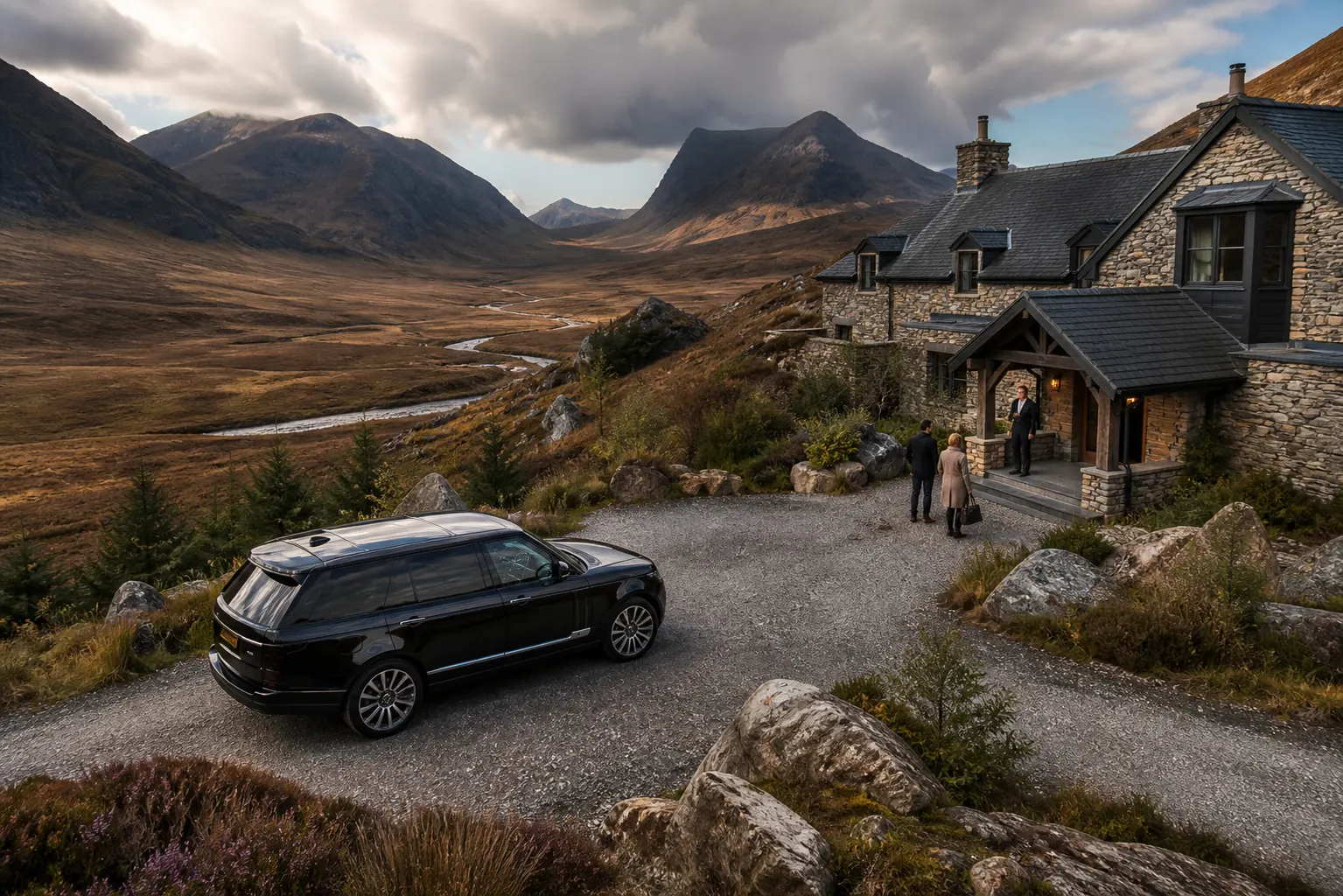
The central belt is where most of Scotland lives and it is not where most people go. Once a journey heads out of it the whole character of the work changes: longer distances, thinner public transport, roads that are genuinely rural, and destinations that a train simply does not reach. That is the country in which a chauffeured car stops being a convenience and becomes the only practical arrangement.

Most chauffeur work in Scotland that is worth the name goes north or west from one of these two cities: Perth, St Andrews, the Trossachs, Speyside, the west coast. The M8 is the connector rather than the destination.

For those journeys the car is not competing with the train at all. It is the only sensible way to do it, and the day becomes a touring job rather than a transfer.

JN-06A word about the weather

A word about the weather

Scotland has a reputation for weather that is partly deserved and largely misapplied. The central belt is not the Highlands and it does not get Highland conditions, and what it does get is a great deal of variability across very short distances, driven by the Atlantic on one side and the North Sea on the other.

The central belt gets weather from the west and it arrives without ceremony. A clear morning in Edinburgh and a wet one in Glasgow is an ordinary Tuesday, and journey times shift accordingly.

Nothing about that is dramatic. It simply means an estimate for a Scottish day should be a little wider than the same distance in the south of England.

08Answers

Questions this piece raises

Asked often enough that the answers belong on the page rather than in a reply.

How long does the drive between Glasgow and Edinburgh take?

It is a short motorway run outside peak hours. The variables sit at either end rather than in the middle, and the two cities’ peaks do not coincide, so one direction is often much easier than the other.

Would the train be better between the two cities?

For a straightforward centre to centre trip, usually yes. A car makes more sense for multiple stops, addresses outside the centres, or an onward journey north or west.

Can you transfer between Glasgow and Edinburgh airports?

It is a clean motorway run, since both airports sit on the outer side of their cities. That makes a weather diversion between them a manageable ground job rather than a crisis.

FCReservations

Every piece here ends at the same place: a car, a time and a name.

Send the date, the pick-up point and where you are going. A written quotation comes back with the vehicle, the chauffeur's arrival time and what the figure covers.

Hours
Reservations answered around the clock, every day of the year.
CallGet a quote