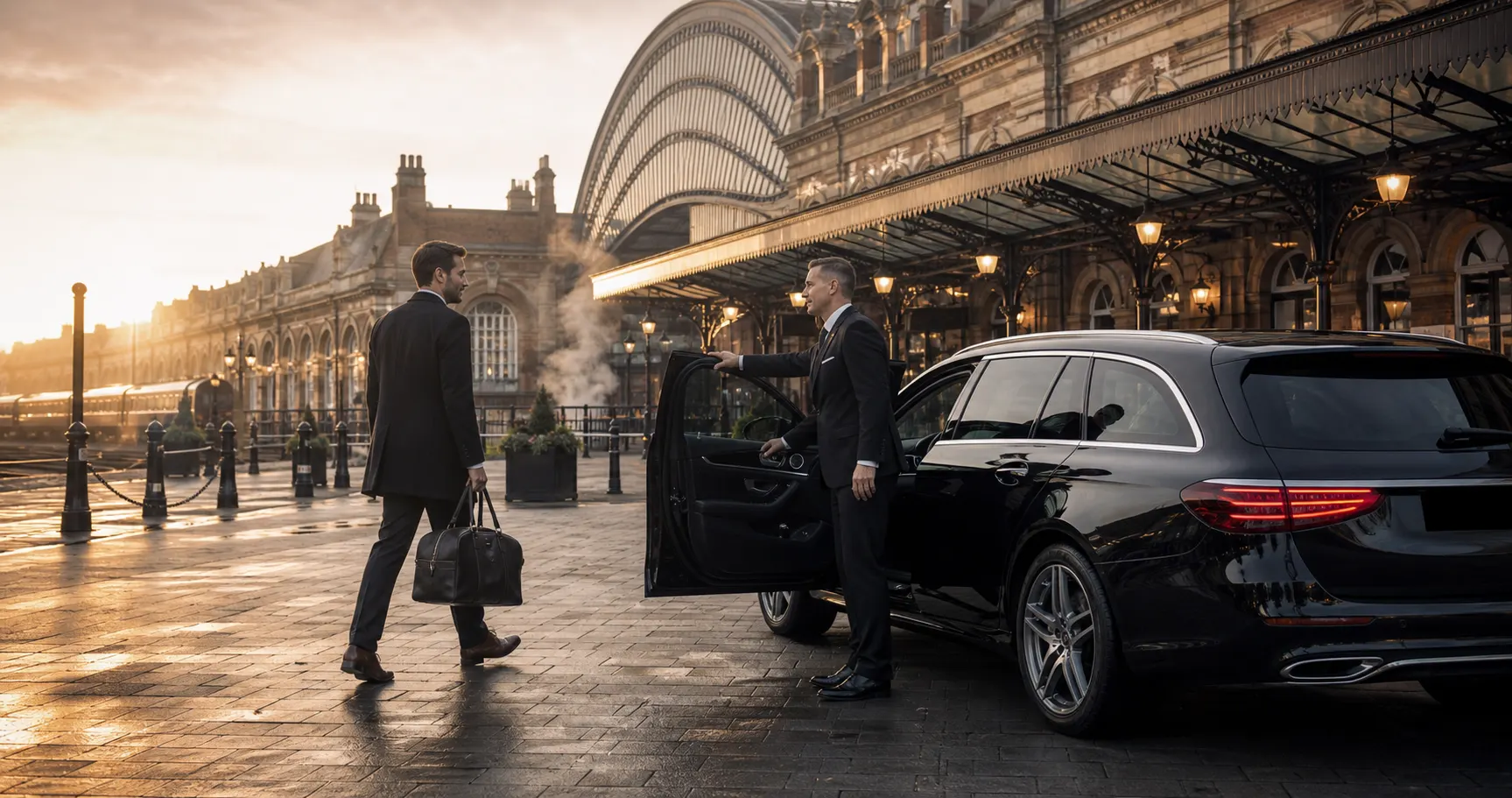
The car arrives a few minutes early and waits with the engine off. There is no doorbell unless you asked for one, no conversation unless you begin it, and the drive itself is the fastest it will be all day because the roads are genuinely empty at that hour.
Category
Airports
Contact
+44 7775 554848 or info@firstclass-chauffeurs.co.uk
01/The short answer
The car arrives a few minutes early and waits with the engine off. There is no doorbell unless you asked for one, no conversation unless you begin it, and the drive itself is the fastest it will be all day because the roads are genuinely empty at that hour.
Early runs are among the most common bookings there are, and they are the ones where the small details matter most. Nobody at half past four wants a discussion, a card machine or a driver who has just woken up in a lay-by two streets away.
QA-01/What happens before you come down
What happens before you come down
The chauffeur is in position ahead of the booked time, parked legally, lights off, waiting. A message goes to your phone rather than a knock at the door, unless you have said a knock is what you want. Some people need waking; most do not.
The car has been cleaned the night before rather than that morning, and the climate is already set. In January that is the difference between getting into a car and getting into a cold box with a windscreen someone is still scraping.
Car in position a few minutes early, engine off
A message rather than a doorbell, unless you ask otherwise
Cabin already warm or cool as the season needs
Water in the car, and a route already planned
Empty roads: the fastest airport run of the day
QA-02/Why the timings are different before six
Why the timings are different before six
The drive is quicker, sometimes dramatically. Central London to Heathrow at half past four can be under forty minutes, against ninety in the morning peak. That does not mean you can leave later, because the check-in cutoff has not moved.
What it does mean is that an early departure is the most predictable transfer of the day. The variance that makes a nine o'clock run risky is simply absent, which is why the first wave of flights is the one to book if you have a choice.
QA-03/The night before
The night before
Confirmation, chauffeur name and vehicle details are sent the previous afternoon rather than overnight, so the number you might need at four is on your phone before you go to bed. Nobody should be searching an inbox in the dark.
If the collection is from a building with a gate, a code or an awkward entrance, that goes on the booking rather than being worked out on the morning. An early start is not the time to discover that the front gate is locked until six.
QA-04/What it costs
What it costs
The same as any other hour. There is no night tariff and no early-morning surcharge: a Heathrow transfer costs the same whether the collection is at four in the morning or four in the afternoon.
Reservations are answered around the clock, so a change at three is registered at three. That matters more on early bookings than on any others, because there is nobody else to ring at that hour.
Wait outside and send a message, unless you have asked otherwise. For a house with others asleep that is usually what people want. If you would rather be knocked up, say so on the booking and that is what happens.
How early can a chauffeur collect?
+
Any hour. Two, three and four in the morning are routine bookings, particularly for the first departures out of Gatwick and Stansted. What they need is booking in advance rather than at midnight, since fewer cars are out at that hour.
Is an early flight actually easier to plan than a mid-morning one?
+
Considerably. The drive time is predictable in a way it is not at eight or nine, and the terminal is quieter for the first wave. The cost is the hour you get up, which no arrangement can improve.
Tell us the journey. We will send the price in writing.
Message us the date, the pick-up and where you are going. You will get a fixed written quotation with the vehicle, the chauffeur’s arrival time and what the figure includes — no form to fill in, and no estimate that moves later.