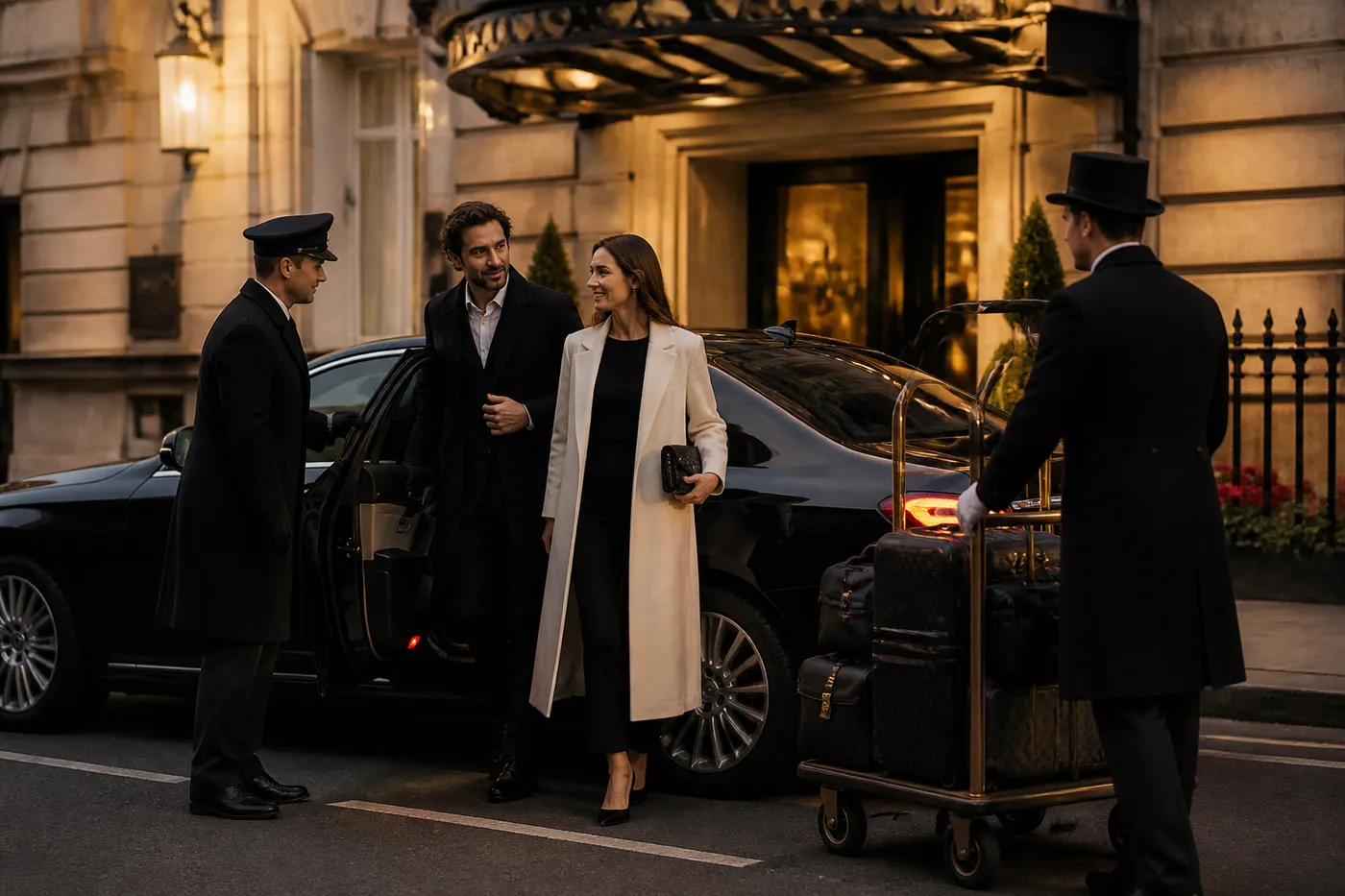
Breakfast in Birmingham, lunch in Manchester, an early evening in Leeds. It is a real shape of day and it needs designing. Breakfast in Birmingham, lunch in Manchester, an early evening in Leeds. It sounds like an exaggeration and it is an entirely ordinary shape of day for anyone covering a national territory, and it is the sort of itinerary that either works beautifully or falls apart before noon. What makes the difference is not the driving. It is whether the day was designed as a whole or assembled from three separate appointments.
Filed under
Travel and business
Published
16 November 2025
Sections
8
Reading time
4 minutes
01/Opening
Where this starts
Breakfast in Birmingham, lunch in Manchester, an early evening in Leeds. It sounds like an exaggeration and it is an entirely ordinary shape of day for anyone covering a national territory, and it is the sort of itinerary that either works beautifully or falls apart before noon.
What makes the difference is not the driving. It is whether the day was designed as a whole or assembled from three separate appointments.
02/At a glance
What this piece is
Filed under
Travel and business
Published
16 November 2025
Sections
8
Reading time
4 minutes
03/The piece
Three cities before dinner
JN-01/The order of the cities matters
The order of the cities matters
The sequence in which appointments are visited is usually determined by when people agreed to meet rather than by where they are, and it is the largest single source of wasted time in a multi-city day. A route that runs with the geography rather than against it can save two hours without changing anything about the meetings themselves.
A route that runs with the geography costs a fraction of one that zigzags. Birmingham to Manchester to Leeds is a sensible line; Manchester to Birmingham to Leeds is two hours longer for the same three meetings.
That is obvious when it is written down and it is routinely got wrong, because appointments are usually made in the order people agreed to them.
JN-02/The peaks are the constraint
The peaks are the constraint
The second design principle is about hours rather than distance. Every city in Britain is difficult to enter at half past eight and difficult to leave at half past five, and a day built without reference to that will spend its time in exactly the wrong places.
Arriving into a city centre at half past eight or leaving one at half past five costs a great deal more time than the same journey at eleven. A three-city day should aim to be between cities during the peaks and in cities during the quiet hours.
Getting that right is worth more than any amount of clever routing on the motorway.
JN-03/Where the train wins and where it does not
Where the train wins and where it does not
It would be dishonest to write about intercity business travel without addressing the railway, which for several of these city pairs is genuinely quicker than any car. The question is not speed between stations; it is what happens either side of them.
Between city centres the train is frequently quicker and the case for it is strong. What it cannot do is the last mile, the luggage, or the meeting that turns out to be at a business park eight miles out.
The hybrid version, which is a train between cities with a chauffeur at each end, works well and requires the chauffeurs to be booked in each place rather than one following the train.
JN-04/One chauffeur or two
One chauffeur or two
There is a practical limit on how long a single chauffeur should be at the wheel, and a three-city day can exceed it without anybody noticing until the last leg. Handling that properly means designing the day around the limit rather than discovering it at seven in the evening.
A day that starts at six and ends at nine is a long duty for one person, and adding three hundred miles of driving to it makes it a longer one. Where the total goes beyond what a single chauffeur should reasonably do, the answer is a handover rather than an optimistic schedule.
That is arranged in advance and it is invisible to the client except as a different person at the wheel after lunch.
04/Referenced here
Pages this piece touches
The services, terminals and vehicles named above, each with a page of its own.
There is an advantage to the road version of this day that has nothing to do with speed and that only becomes obvious after doing it the other way with a bag over one shoulder.
The advantage of doing it by road is that everything stays in one place all day. Coats, bags, samples, papers. Nobody carries anything between cities and nothing gets left on a train.
For a day with any quantity of material, that is the decisive argument and it is more practical than glamorous.
JN-06/What to fix and what to leave loose
What to fix and what to leave loose
A day like this needs a structure rather than a timetable, and the difference between the two is where the margin sits.
Fix the first meeting and the last. Leave the middle with a margin, because it will need one. A day with three fixed times and no slack is a day that will be apologising by lunchtime.
A written quotation for that kind of day should describe the shape rather than a list of point to point legs, because that is what is actually being bought.
JN-07/Where the day should start
Where the day should start
A multi-city day frequently begins the night before, in a hotel in the first city rather than at home. That single decision removes the longest and least predictable leg from the front of the schedule and turns a very early start into an ordinary one.
It costs a night’s accommodation and it buys back both time and the risk of the whole day sliding from the first appointment onward.
JN-08/Eating on a day like this
Eating on a day like this
Nobody schedules lunch on a three-city day and everybody needs it. The realistic version is a stop of twenty minutes somewhere on a motorway or a sandwich in the car between the second and third cities, and it is better planned than left to chance.
It also applies to the chauffeur, whose day is longer than the client’s at both ends and who cannot eat while driving.
06/Related reading
Written alongside this one
Pieces that pick up the same thread from a different angle.
Asked often enough that the answers belong on the page rather than in a reply.
Can one chauffeur cover a three-city day?
+
Sometimes, and where the total duty is too long we arrange a handover rather than pushing it. That is planned in advance and is invisible to you beyond a different person at the wheel.
Is it better to take the train between cities?
+
Between city centres the train is often quicker. A car wins where the meetings are outside the centres, where there is material to carry, or where the day has several stops.
How should a multi-city day be booked?
+
As a day rather than as separate legs, so the shape can be designed around the peaks and the geography. That is also what the written quotation describes.
Every piece here ends at the same place: a car, a time and a name.
Send the date, the pick-up point and where you are going. A written quotation comes back with the vehicle, the chauffeur's arrival time and what the figure covers.