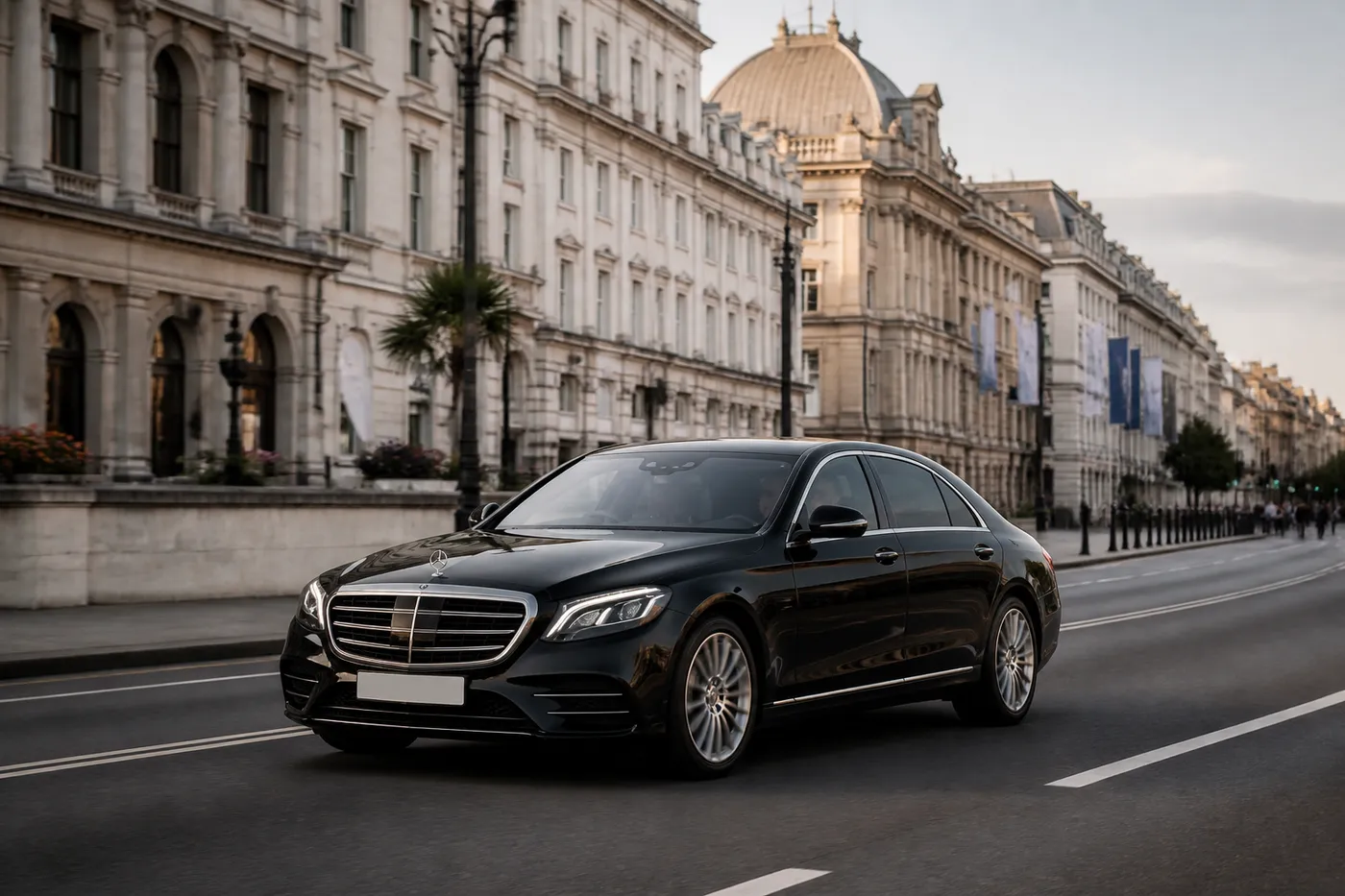
The driving is rarely the biggest part of the figure. Here is the anatomy of one ordinary job, taken apart line by line. A chauffeur quotation looks like a single number and it never is. Underneath it there is a small amount of arithmetic that almost no operator explains, partly out of habit and partly because the honest version makes the figure look less magical. It is worth understanding, because once you can see what a price is made of you can also see which parts of your own booking are making it larger, and several of those are things you control. The example used here is deliberately ordinary: a Tuesday morning collection from a Kensington address to Heathrow Terminal 5, one passenger, two cases, in an E-Class. What follows is what the fare for that job has to cover, in the order the day actually happens rather than in the order a price list would present it.
Category
Booking
Published
25 March 2025
Updated
28 April 2026
Sections
8 sections
Category
Booking
Reading time
8 minutes
Published
25 March 2025
Last updated
28 April 2026
01/The short version
What is actually inside a chauffeur quotation
A chauffeur quotation looks like a single number and it never is. Underneath it there is a small amount of arithmetic that almost no operator explains, partly out of habit and partly because the honest version makes the figure look less magical. It is worth understanding, because once you can see what a price is made of you can also see which parts of your own booking are making it larger, and several of those are things you control.
The example used here is deliberately ordinary: a Tuesday morning collection from a Kensington address to Heathrow Terminal 5, one passenger, two cases, in an E-Class. What follows is what the fare for that job has to cover, in the order the day actually happens rather than in the order a price list would present it.
GD-01/The journey is the smallest part
The journey is the smallest part
From Kensington to Terminal 5 is about seventeen miles and, at the hour this job runs, roughly fifty minutes. If a chauffeur job were only the driving between two addresses, this would be a very cheap piece of work. It is not, and the reason is that the car has to get to Kensington and it has to get away from Heathrow, and neither of those legs has a passenger in it.
Those are the positioning legs, and on a short transfer they frequently exceed the paid distance. A car coming from a base in west London to a 05:30 pick-up is forty minutes out; the run to the airport is fifty; and afterwards the chauffeur either drives back empty or waits for something else. The paid seventeen miles sit in the middle of something closer to two and a half hours of car time.
GD-02/Where the hour of day changes everything
Where the hour of day changes everything
The same route at 04:30 and at 08:30 are different jobs with different costs. The early one takes thirty-five minutes and the chauffeur is free by six; the later one takes an hour and ten and puts him into the middle of the morning with a car in the wrong place. That is why time of day appears in a quotation at all, and why the version people assume is arbitrary is usually the opposite.
Night work carries its own arithmetic. A 02:00 collection is not more expensive because the roads are difficult, they are lovely at two in the morning. It is more expensive because a chauffeur who works from midnight to four cannot also work the following morning, and one job has to carry the cost of that.
GD-03/Parking, tolls and the fixed costs of an airport
Parking, tolls and the fixed costs of an airport
On an airport job the short-stay parking is a real cost and it goes inside the figure rather than beside it. So does the drop-off charge on a departure. Neither is large on its own; both are entirely predictable, which is precisely why they should be inside a quoted price rather than presented afterwards as a surprise.
The same principle covers tolls and crossings on a long-distance run. If the sensible route uses the Dartford Crossing or the Mersey tunnels, that goes in the quotation, and the alternative of a cheaper route that takes forty minutes longer is a false economy that the passenger pays for in time.
Short-stay parking on an arrival, drop-off charge on a departure
Tolls and crossings on the route we would actually take
The positioning legs at both ends of the paid journey
The hour of day, which changes both the drive and the chauffeur day
GD-04/The vehicle class, and what it is really pricing
The vehicle class, and what it is really pricing
An E-Class and a Maybach are several times apart, and not because of the badge. They are apart because of what the car costs to buy, insure and depreciate, and because the more expensive vehicles do fewer jobs per week. A Maybach does not do four school runs and a Heathrow transfer in a day; it does one or two pieces of work, and the price reflects that as much as the leather does.
This matters when you are choosing. Stepping from an E-Class to an S-Class on a fifty-minute airport run is a modest step, and it buys a quieter cabin and more rear legroom, which some people care about and some do not. Stepping to a Maybach on the same run is a very large one, and it buys considerably more of the same thing. Whether that is worth it depends on the passenger rather than the road.
GD-05/The waiting allowance, priced as risk
The waiting allowance, priced as risk
On an arrival, part of the figure is buying an amount of uncertainty. Nobody knows whether the border will take four minutes or thirty-five, and the allowance is the operator carrying that risk instead of the passenger. An operator who quotes low and charges by the minute afterwards has simply moved the risk onto you, which is why the cheap headline is not always the cheap job.
Departures do not carry that risk, which is one reason a departure from the same address is often quoted lower than the arrival. The car turns up at an agreed time, the passenger comes out, and the whole thing is over in three minutes at the kerb.
GD-06/What makes a quotation cheaper
What makes a quotation cheaper
Several things, and most of them are within your control. Being flexible about the hour is the biggest: the same journey at 10:30 rather than 08:00 is a different piece of work. Booking a return leg with the outbound is the second, because a car that has something to come back for is not returning empty. Choosing the vehicle for the load rather than for the impression is the third, and it is the one that saves the most money most often.
What does not make it cheaper is haggling on the number itself. There is no margin hidden in an ordinary airport transfer waiting to be discovered by a firm tone. If a figure needs to come down, the honest way is to change the job rather than to squeeze the price, and any operator worth using will tell you which change would do it.
Move the hour if you can, particularly out of the 07:00 to 09:30 window
Book the return at the same time as the outbound
Size the car to the luggage rather than to the occasion
Give a full address at both ends so nothing has to be estimated
GD-07/When our quotation will be the wrong answer
When our quotation will be the wrong answer
A four-mile hop across a town centre is not our job and the figure will make that obvious. A minimum-charge transfer for a journey that takes eleven minutes is poor value against a local taxi, and there is nothing clever we can do to change that arithmetic. The same is true of a single passenger with hand luggage going somewhere on a direct train line at a sensible hour.
Hourly hire has its own version of this. The four-hour minimum means that a two-hour need costs the same as a four-hour one, so if the day is genuinely two hours of driving in two separate pieces, two transfers will beat a half-day hire. We would rather quote you the cheaper shape than the one that suits us.
And where the vehicle you want is not the vehicle the job needs, we will say so. Booking a Phantom for a two-hundred-mile motorway day is possible, on the longer minimum block it carries, and it is not the car we would put you in for that journey.
GD-08/What a good quotation should tell you
What a good quotation should tell you
A figure on its own is not a quotation, it is a number. What you should get in writing is the vehicle named rather than a class described, the pick-up time and address, the waiting allowance where there is one, what happens if the journey runs long, and whether parking and tolls are inside the figure. Five lines, and they remove almost every argument that airport and event work generates.
It should also say what it does not include. If a booking is priced for four hours and the day is likely to run to six, saying so in advance is more useful than a low number that grows. Your written quotation confirms the final price, what it includes and any applicable tax, and it is the document rather than the phone call that matters.
02/If you read nothing else
The points that matter most
01
The journey is the smallest part
From Kensington to Terminal 5 is about seventeen miles and, at the hour this job runs, roughly fifty minutes.
02
Where the hour of day changes everything
The same route at 04:30 and at 08:30 are different jobs with different costs.
03
Parking, tolls and the fixed costs of an airport
On an airport job the short-stay parking is a real cost and it goes inside the figure rather than beside it.
04
The vehicle class, and what it is really pricing
An E-Class and a Maybach are several times apart, and not because of the badge.
05
The waiting allowance, priced as risk
On an arrival, part of the figure is buying an amount of uncertainty.
06
What makes a quotation cheaper
Several things, and most of them are within your control.
03/Where this leads
Pages worth opening next
Each of these covers a part of this guide in more depth, on the page that owns it.
The same answers we would give on the phone, written down.
Why does a seventeen-mile airport transfer cost more than a forty-mile motorway run?
+
Because the paid mileage is the smallest part of an airport job. The car has to position to the pick-up, park in a short stay at the airport, carry a waiting allowance for an unpredictable border, and then usually return empty. A forty-mile run between two towns has none of that overhead, which is why the mileage and the price do not track each other.
Is a fixed price genuinely fixed, or does it move if the traffic does?
+
Fixed means fixed. A quoted transfer is that figure whether the M4 behaves or not, because the risk of a bad run belongs to the operator rather than the passenger. What can change the figure is a change you make: an extra stop, a different destination, or an hour of waiting that was not part of the job.
Can I get a better price by booking directly rather than through a broker?
+
Usually, though not always dramatically. A broker takes a margin and passes the driving to somebody else, which also means the person quoting you is not the person who will be standing in the arrivals hall. The larger difference is in accountability rather than in money.
What is the cheapest way to book a car for a day with three journeys in it?
+
Work out how much of the day the car is genuinely needed. Three separate journeys spread over twelve hours is three transfers. Three journeys inside five hours is a half-day hire, which will usually beat three separate figures. Tell us the shape of the day and we will quote whichever is cheaper.
Does the price change if I want a specific chauffeur?
+
No, though it can change availability. Requesting somebody who has driven you before is a normal request and costs nothing, but it narrows the pool, and at short notice on a busy day it may mean a different time rather than a different price. Ask early and it is usually straightforward.
Tell us the journey. We will send the price in writing.
Message us the date, the pick-up and where you are going. You will get a fixed written quotation with the vehicle, the chauffeur’s arrival time and what the figure includes — no form to fill in, and no estimate that moves later.